Reaction equation

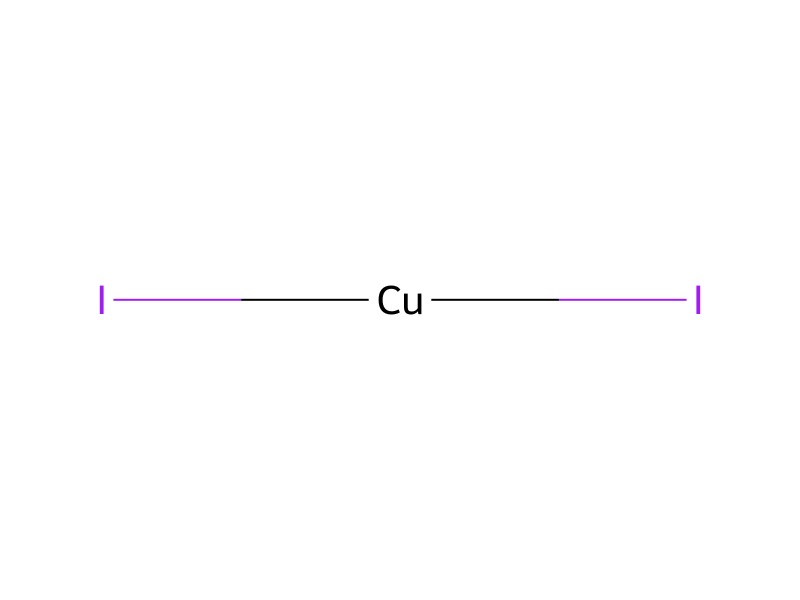
[Br:1][C:2]1[CH:14]=[CH:13][C:12]2[C:11]3[C:6](=[CH:7][CH:8]=[CH:9][CH:10]=3)[NH:5][C:4]=2[CH:3]=1.I[C:16]1[CH:21]=[CH:20][CH:19]=[CH:18][N:17]=1.P([O-])([O-])([O-])=O.[K+].[K+].[K+].C1C(N)CCC(N)C1>[Cu](I)I.O.O1CCOCC1>[Br:1][C:2]1[CH:14]=[CH:13][C:12]2[C:11]3[C:6](=[CH:7][CH:8]=[CH:9][CH:10]=3)[N:5]([C:16]3[CH:21]=[CH:20][CH:19]=[CH:18][N:17]=3)[C:4]=2[CH:3]=1Participants
8
Reactant 4




Product 1

Reagents, catalysts & solvents 3


Conditions
- Temperature
- 65 °C
Procedure
A 100 mL 3-neck flask was charged with copper iodide (0.057 g, 0.301 mmol), 2-bromo-9H-carbazole (7.4 g, 30.1 mmol), 2-iodopyridine (12.3 g, 60.1 mmol), potassium phosphate (12.8 g, 60.1 mmol), (1R,4R)-cyclohexane-1,4-diamine (0.343 g, 3.0 mmol), and dioxane (25 mL) and the reaction mixture was heated at 65° C. for 16 hours. The reaction mixture was then poured into deionized water and extracted with dichloromethane The organic layers were combined and subjected to a column chromatography (neutral Al2O3, 99/1 hexane/EtOAc) to yield 4.2 g (43%) of 2-bromo-9-(pyridin-2-yl)-9H-carbazole as a white solid. The product was confirmed by GC/MS and NMR.
Workup
- extractionextracted with dichloromethane The organic layers
Sources & evidence
- ORD record
- ord-025f65fadd3e46f68e5821f6da41c4a5
- Source dataset
- uspto-grants-2016_09
- Patent number
- US09450195B2
Linked notes
Loading…