Reaction equation

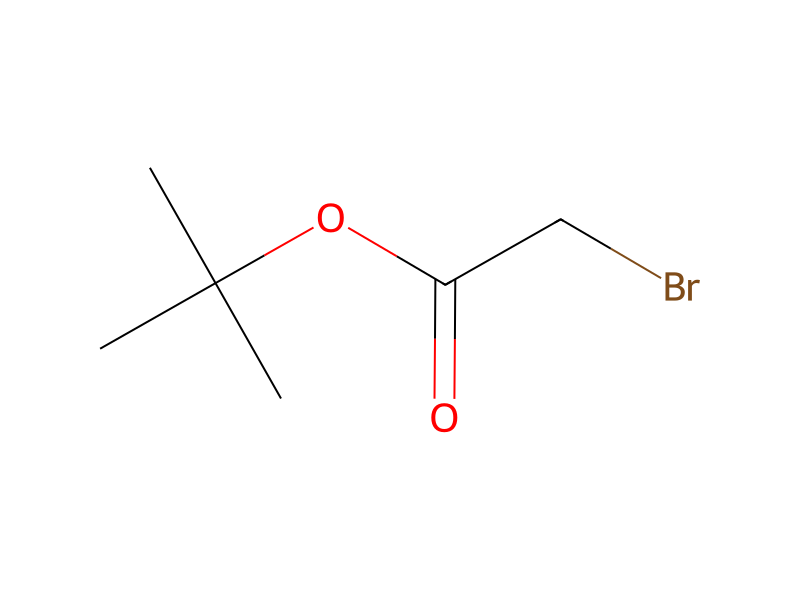
[Br:1][C:2]1[CH:3]=[C:4]([CH:7]=[CH:8][C:9]=1[OH:10])[CH:5]=[O:6].C(=O)([O-])[O-].[Cs+].[Cs+].Br[CH2:18][C:19]([O:21][C:22]([CH3:25])([CH3:24])[CH3:23])=[O:20]>CN(C=O)C>[Br:1][C:2]1[CH:3]=[C:4]([CH:5]=[O:6])[CH:7]=[CH:8][C:9]=1[O:10][CH2:18][C:19]([O:21][C:22]([CH3:25])([CH3:24])[CH3:23])=[O:20]Participants
5
Reactant 3


Product 1

Reagents, catalysts & solvents 1

Procedure
To a solution of 3-bromo-4-hydroxybenzaldehyde (5 g, 25 mmol, 1 eq, Aldrich, Milwaukee, Wis., USA) in DMF (200 mL) was added solid cesium carbonate (16.25 g, 50 mmol, 2 eq) followed by dropwise addition of t-butyl 2-bromoacetate (4.4 mL, 30 mmol, 1.2 eq, Aldrich, Milwaukee, Wis., USA). After stirring at room temperature for 18 h, the DMF was removed in vacuo and the resultant residue was extracted between EtOAc (50 mL) and brine (50 mL). The separated organic layer was dried (Na2SO4), and concentrated in vacuo to give 7.74 g (98.4%) of t-butyl 2-(2-bromo-4-formylphenoxy)acetate (1). 1HNMR (CDCl3, 300 MHz): δ 9.83 (s, 1H), 8.08 (d, 1H), 7.76 (dd, 1H), 6.83 (d, 1H), 4.67 (s, 1H).1.44 (s, 9H).
Workup
- customthe DMF was removed in vacuo
- extractionthe resultant residue was extracted between EtOAc (50 mL) and brine (50 mL)
- dry with materialThe separated organic layer was dried (Na2SO4)
- concentrationconcentrated in vacuo
Sources & evidence
- ORD record
- ord-03cdefa305c4419ab250d0cc1ffdea8f
- Source dataset
- uspto-grants-2014_09
- Patent number
- US08822467B2
Linked notes
Loading…