Reaction equation
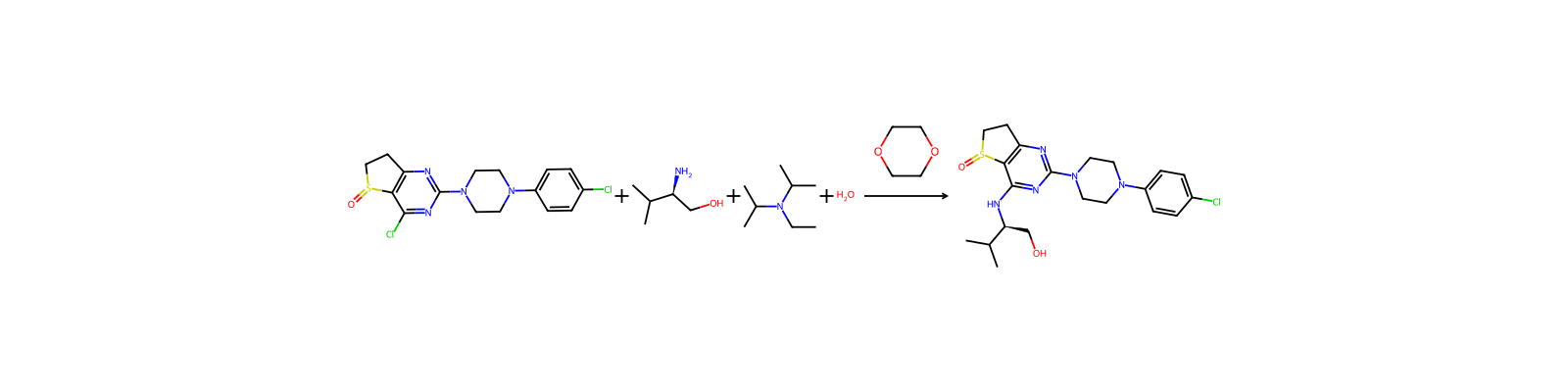
Cl[C:2]1[C:3]2[S:23](=[O:24])[CH2:22][CH2:21][C:4]=2[N:5]=[C:6]([N:8]2[CH2:13][CH2:12][N:11]([C:14]3[CH:19]=[CH:18][C:17]([Cl:20])=[CH:16][CH:15]=3)[CH2:10][CH2:9]2)[N:7]=1.[NH2:25][C@H:26]([CH:29]([CH3:31])[CH3:30])[CH2:27][OH:28].C(N(C(C)C)CC)(C)C.O>O1CCOCC1>[Cl:20][C:17]1[CH:18]=[CH:19][C:14]([N:11]2[CH2:12][CH2:13][N:8]([C:6]3[N:7]=[C:2]([NH:25][C@H:26]([CH:29]([CH3:31])[CH3:30])[CH2:27][OH:28])[C:3]4[S:23](=[O:24])[CH2:22][CH2:21][C:4]=4[N:5]=3)[CH2:9][CH2:10]2)=[CH:15][CH:16]=1Participants
6
Reactant 4



Product 1

Reagents, catalysts & solvents 1

Conditions
- Temperature
- 120 °C
Procedure
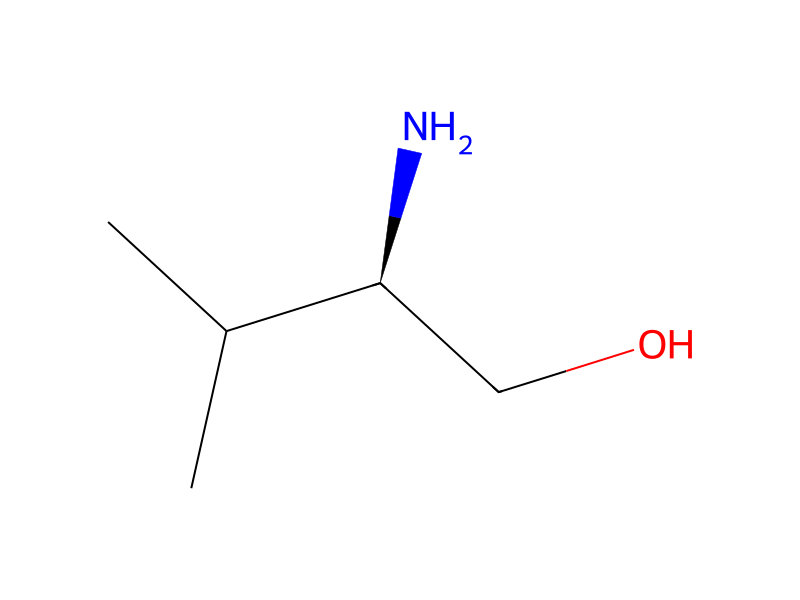
220 mg 4-chloro-2-[4-(4-chloro-phenyl)-piperazin-1-yl]-6,7-dihydro-thieno[3,2-d]pyrimidine 5-oxide (cf Example 124), 118.43 mg (R)-(−)-2-amino-3-methyl-butan-1-ol and 197.52 μl diisopropylethylamine are placed in 4 ml dioxane, and the mixture is heated to 120° C. in the microwave for 0.3 hours. Then the reaction mixture is mixed with water, the precipitate formed is suction filtered, washed and dried. The diastereomers are separated by preparative HPLC (method B). 25.5 mg of Diastereomer 1 (Example 54) and 40.5 mg of Diastereomer 2 (Example 57) are obtained as a powder. Analytical HPLC (method A): Diastereomer I: RT=3.61 min; Diastereomer 2, RT=3.71 min.
Workup
- customthe precipitate formed
- filtrationfiltered
- washwashed
- customdried
- customThe diastereomers are separated by preparative HPLC (method B)
- custom25.5 mg of Diastereomer 1 (Example 54) and 40.5 mg of Diastereomer 2 (Example 57) are obtained as a powder
Sources & evidence
- ORD record
- ord-1e7cedad7cd441eabe301eec4eeae6c0
- Source dataset
- uspto-grants-2014_09
- Patent number
- US08822474B2
Linked notes
Loading…