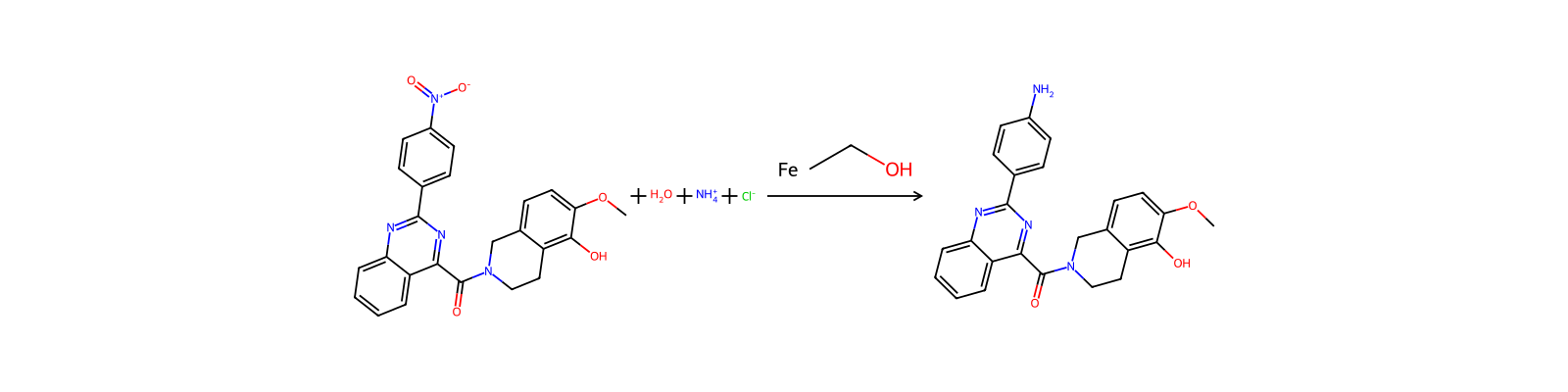
[N+:1]([C:4]1[CH:9]=[CH:8][C:7]([C:10]2[N:19]=[C:18]([C:20]([N:22]3[CH2:31][CH2:30][C:29]4[C:24](=[CH:25][CH:26]=[C:27]([O:33][CH3:34])[C:28]=4[OH:32])[CH2:23]3)=[O:21])[C:17]3[C:12](=[CH:13][CH:14]=[CH:15][CH:16]=3)[N:11]=2)=[CH:6][CH:5]=1)([O-])=O.O.[NH4+].[Cl-]>[Fe].C(O)C>[NH2:1][C:4]1[CH:5]=[CH:6][C:7]([C:10]2[N:19]=[C:18]([C:20]([N:22]3[CH2:31][CH2:30][C:29]4[C:24](=[CH:25][CH:26]=[C:27]([O:33][CH3:34])[C:28]=4[OH:32])[CH2:23]3)=[O:21])[C:17]3[C:12](=[CH:13][CH:14]=[CH:15][CH:16]=3)[N:11]=2)=[CH:8][CH:9]=1Into a 1-L round-bottom flask purged and maintained with an inert atmosphere of nitrogen, was placed 2-[[2-(4-nitrophenyl)quinazolin-4-yl]carbonyl]-5-hydroxy-6-methoxy-1,2,3,4-tetrahydroisoquinoline (9 g, 19.72 mmol, 1.00 equiv), water (300 mL), ethanol (300 mL), Fe (2.5 g, 2.30 equiv) and NH4Cl (2.4 g, 44.87 mmol, 2.30 equiv). The resulting solution was stirred overnight at 90° C. The solids were collected by filtration. The residue was dissolved in 200 mL of DMSO. The solids were filtered out. The resulting solution was diluted with 3 L of H2O. The solids were collected by filtration. The filter cake was washed with 1×1 L of water. This resulted in 2.5 g (30%) of 2-[[2-(4-aminophenyl)quinazolin-4-yl]carbonyl]-6-methoxy-1,2,3,4-tetrahydroisoquinolin-5-ol as a yellow solid. 1H NMR (300 MHz, DMSO-d6) δ 2.62 and 2.88 (2t, 2H), 3.45 and 4.01 (2t, 2H), 3.74-3.80 (2s, 3H), 4.36 and 4.89 (2s, 2H), 5.80 (s, 2H), 6.31-6.92 (m, 4H), 7.53-7.63 (m, 1H), 7.73-7.84 (2d, 1H), 7.94-7.99 (m, 2H), 8.18-8.25 (m, 2H), 8.68-8.74 (2s, 1H); MS (ESI) m/z 427 ([M+H]+).
Loading…