HomeMCPWorkbenchSkills
HomeWorkbenchNotificationsMe
llms.txt · MCP GuidePrivacy Policy · Terms of Service · Supportv1.8.0
  1. Home
  2. /Reaction

2-Bromotoluene → Benzenamine, 2-methyl-N-(2-methylphenyl)-

HRID 72814
Notes
Print preview

Reaction equation

HRID 72814 reaction equation
C(P(C(C)(C)C)C1C=CC=C[C:7]=1[C:12]1[CH:17]=[CH:16][CH:15]=[CH:14][CH:13]=1)(C)(C)C.Br[C:23]1[CH:28]=[CH:27][CH:26]=[CH:25][C:24]=1[CH3:29].ClC1C=CC=CC=1C.[NH2-:38].[Li+].CC(C)([O-])C.[Na+]>C(OCC)C.C1C=CC(/C=C/C(/C=C/C2C=CC=CC=2)=O)=CC=1.C1C=CC(/C=C/C(/C=C/C2C=CC=CC=2)=O)=CC=1.C1C=CC(/C=C/C(/C=C/C2C=CC=CC=2)=O)=CC=1.[Pd].[Pd].C1C=CC(/C=C/C(/C=C/C2C=CC=CC=2)=O)=CC=1.C1C=CC(/C=C/C(/C=C/C2C=CC=CC=2)=O)=CC=1.[Pd].C1(C)C=CC=CC=1>[C:12]1([CH3:7])[CH:13]=[CH:14][CH:15]=[CH:16][C:17]=1[NH:38][C:23]1[CH:28]=[CH:27][CH:26]=[CH:25][C:24]=1[CH3:29]
ParticipantsProcedureWorkupSources & evidenceReaction notes

Participants

10

Reactant 5

HCID 72362-BromotolueneHCID 72382-ChlorotolueneHCID 24532Lithium amideHCID 27342152-(Di-tert-butylphosphino)biphenylHCID 23676156Sodium t-butoxide

Product 1

HCID 136423Benzenamine, 2-methyl-N-(2-methylphenyl)-Yield 72%

Reagents, catalysts & solvents 4

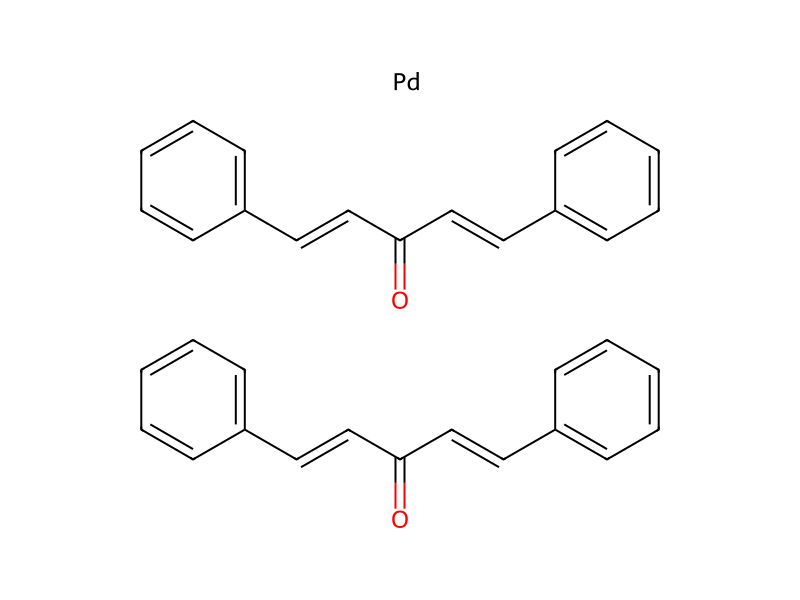
HCID 6505921(1E,4E)-1,5-diphenylpenta-1,4-dien-3-one; palladiumCatalystHCID 9811564Bis(dibenzylideneacetone)palladiumCatalystHCID 1140TolueneSolventHCID 3283Diethyl EtherSolvent

Procedure

The round-bottom flask was heated then allow to cool to room temperature under argon. Added Pd2(dba)3 (1.39 g, 1.52 mmol, 1.0 mol %) or Pd(dba)2 (1.38 g, 2.4 mmol, 1.4 mol %), 2-(di-tert-butylphosphino)biphenyl (1.09 g, 3.65 mmol, 2.4 mol %), 2-bromotoluene (40 mL, 332.1 mmol) or 2-chlorotoluene (39 mL, 332.1 mmol), lithium amide (3.47 g, 151.1 mmol, 45 mol %), sodium t-butoxide (29.5 g, 297.7 mmol, 90 mol %), followed by toluene (150 mL). The reaction mixture was heated at 80° C. under argon overnight, then allowed to cool to room temperature. Diluted with diethyl ether then filtered through a pad of Celite. Concentrated the resulting filtrate in vacuo. Used the crude material in the next reaction without purification. (Crude material can be purified by flash chromatography with hexane which gave the product as white crystals with a yellow tint (23.4 g, 118.6 mmol, 72% yield)).

Workup

  1. temperatureThe round-bottom flask was heated
  2. temperatureThe reaction mixture was heated at 80° C. under argon overnight
  3. temperatureto cool to room temperature
  4. filtrationthen filtered through a pad of Celite
  5. concentrationConcentrated the resulting filtrate in vacuo
  6. customin the next reaction
  7. customwithout purification
  8. custom(Crude material can be purified by flash chromatography with hexane which

Sources & evidence

ORD record
ord-6dc0c40063fa4ce2bed62a222591a84e
Source dataset
uspto-grants-2014_09
DOI
10.6084/m9.figshare.5104873.v1
Patent number
US08828986B2

Reaction notes

Loading…

On this pageParticipantsProcedureWorkupSources & evidenceReaction notes