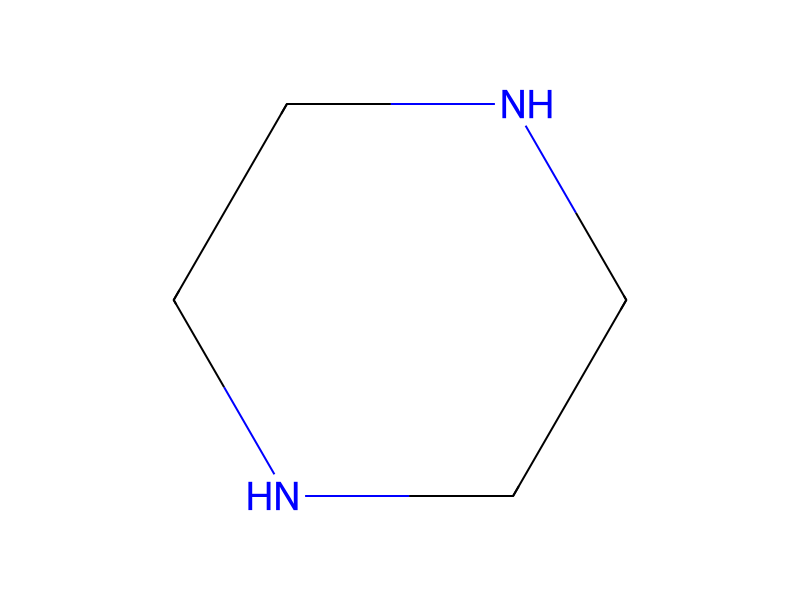
Piperazine → 4-Nitro-1-piperazin-1-yl-isoquinoline
HRID 729613
Reaction equation

Cl[C:2]1[C:11]2[C:6](=[CH:7][CH:8]=[CH:9][CH:10]=2)[C:5]([N+:12]([O-:14])=[O:13])=[CH:4][N:3]=1.[NH:15]1[CH2:20][CH2:19][NH:18][CH2:17][CH2:16]1>C(#N)C>[N+:12]([C:5]1[C:6]2[C:11](=[CH:10][CH:9]=[CH:8][CH:7]=2)[C:2]([N:15]2[CH2:20][CH2:19][NH:18][CH2:17][CH2:16]2)=[N:3][CH:4]=1)([O-:14])=[O:13]Participants
4
Reactant 2

Product 1

Reagents, catalysts & solvents 1

Conditions
- Temperature
- 60 °C
Procedure
Treat a slurry of 1-chloro-4-nitro-isoquinoline (2.5 g, 12 mmol) in acetonitrile (100 mL) with solid piperazine (5.2 g, 60 mmol). Heat the resulting yellow mixture overnight at 60° C. After cooling to ambient temperature, partition the reaction mixture between ethyl acetate and a saturated aqueous sodium bicarbonate solution. Add MeOH, dichloromethane and ethyl acetate, and filter the entire mixture to give a bright yellow solid. (2.15 g, 69%; LCMS ES+ (m/z) 259 [M+H]).