Reaction equation

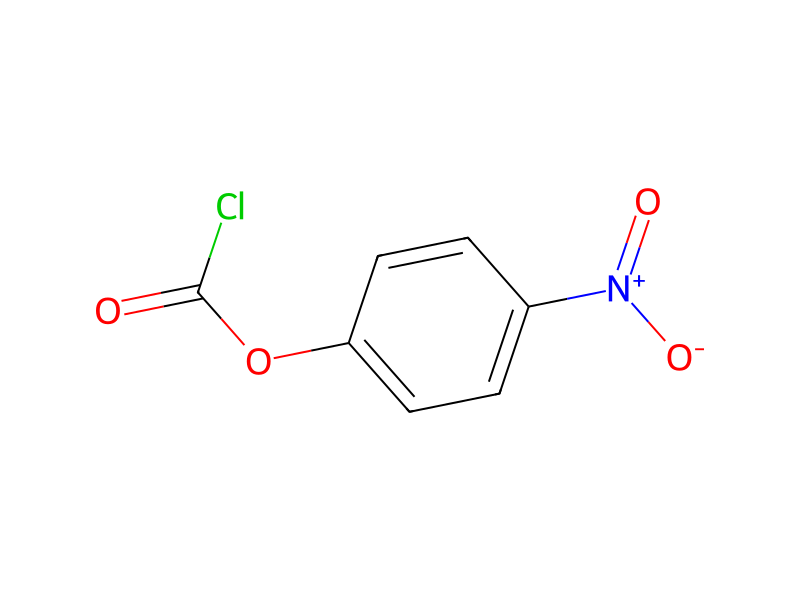
[C:1](Cl)(=[O:12])[O:2][C:3]1[CH:8]=[CH:7][C:6]([N+:9]([O-:11])=[O:10])=[CH:5][CH:4]=1.ClCCl.[NH2:17][C:18]1[CH:27]=[CH:26][C:21]([C:22]([O:24][CH3:25])=[O:23])=[CH:20][C:19]=1[Cl:28].N1C=CC=CC=1>C(Cl)(Cl)Cl>[Cl:28][C:19]1[CH:20]=[C:21]([CH:26]=[CH:27][C:18]=1[NH:17][C:1]([O:2][C:3]1[CH:8]=[CH:7][C:6]([N+:9]([O-:11])=[O:10])=[CH:5][CH:4]=1)=[O:12])[C:22]([O:24][CH3:25])=[O:23]Participants
6





Procedure
A 3.5 g portion of 4-nitrophenyl chlorocarbonate was added at 0° C. to a 30 ml dichloromethane suspension of 3 g of methyl 4-amino-3-chlorobenzoate and 4 ml of pyridine and stirred at room temperature for 2Hours. The reaction solution was diluted with chloroform and washed with 1 M hydrochloric acid, water, saturated sodium bicarbonate aqueous solution, water and saturated brine in that order, and the organic layer was dried with anhydrous sodium sulfate. This was concentrated under a reduced pressure, and the thus obtained residue was recrystallized from hexane-ethyl acetate to obtain 4.23 g of methyl 3-chloro-4-{[(4-nitrophenoxy)carbonyl]amino}benzoate as a pale brown powder.
Workup
- washwashed with 1 M hydrochloric acid, water, saturated sodium bicarbonate aqueous solution, water and saturated brine in that order
- dry with materialthe organic layer was dried with anhydrous sodium sulfate
- concentrationThis was concentrated under a reduced pressure
- customthe thus obtained residue was recrystallized from hexane-ethyl acetate
Sources & evidence
- ORD record
- ord-5af8aeb32cf54573a24ddac1c50705c3
- Source dataset
- uspto-grants-2009_09
- Patent number
- US07585886B2
Linked notes
Loading…