HomeMCPWorkbenchSkills
HomeWorkbenchNotificationsMe
llms.txt · MCP GuidePrivacy Policy · Terms of Service · Supportv1.8.3
  1. Home
  2. /Reaction

Hydrochloric Acid → (S)-1-Isopropyl-4-[1-(2-trifluoromethyl-pyrimidin-5-yl)-piperidine-4-carbonyl]-2-methyl piperazine hydrochloride

HRID 734354
Print

Reaction equation

HRID 734354 reaction equation
C1(P(C2CCCCC2)C2C=CC=CC=2C2C=CC=CC=2N(C)C)CCCCC1.[CH:29]([N:32]1[CH2:37][CH2:36][N:35]([C:38]([CH:40]2[CH2:45][CH2:44][NH:43][CH2:42][CH2:41]2)=[O:39])[CH2:34][C@@H:33]1[CH3:46])([CH3:31])[CH3:30].Br[C:48]1[CH:49]=[N:50][C:51]([C:54]([F:57])([F:56])[F:55])=[N:52][CH:53]=1.CC(C)([O-])C.[Na+].[ClH:64]>O1CCOCC1.CO.C(Cl)Cl.C1C=CC(/C=C/C(/C=C/C2C=CC=CC=2)=O)=CC=1.C1C=CC(/C=C/C(/C=C/C2C=CC=CC=2)=O)=CC=1.C1C=CC(/C=C/C(/C=C/C2C=CC=CC=2)=O)=CC=1.[Pd].[Pd]>[ClH:64].[CH:29]([N:32]1[CH2:37][CH2:36][N:35]([C:38]([CH:40]2[CH2:41][CH2:42][N:43]([C:48]3[CH:49]=[N:50][C:51]([C:54]([F:57])([F:56])[F:55])=[N:52][CH:53]=3)[CH2:44][CH2:45]2)=[O:39])[CH2:34][C@@H:33]1[CH3:46])([CH3:31])[CH3:30]

ParticipantsProcedureWorkupSources & evidenceReaction notes

Participants

10

Reactant 5

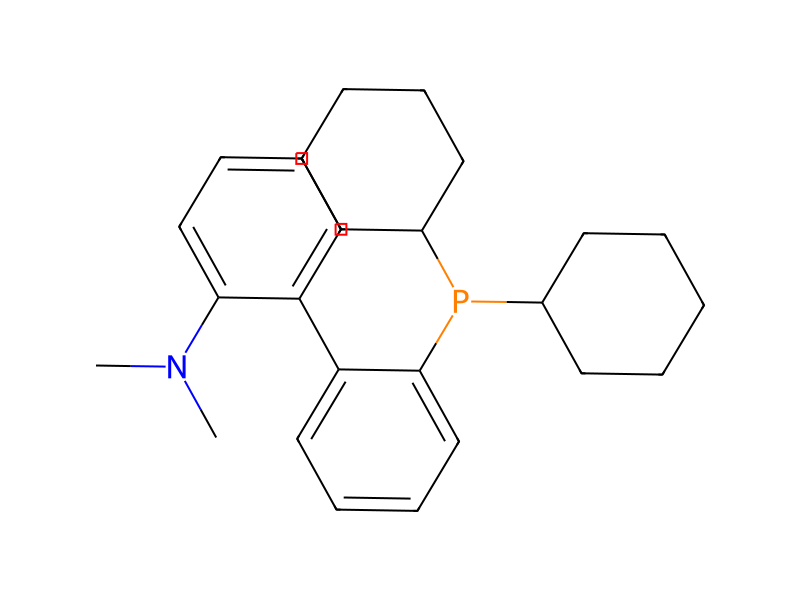
HCID 313Hydrochloric AcidHCID 27342172-(Dicyclohexylphosphino)-2'-(dimethylamino)biphenylHCID 23676156Sodium t-butoxideHCID 336979635-Bromo-2-(trifluoromethyl)pyrimidineHCID 68815891(S)-1-isopropyl-4-(piperidine4-carbonyl)-2-methyl piperazine

Product 1

HCID 68817779
(S)-1-Isopropyl-4-[1-(2-trifluoromethyl-pyrimidin-5-yl)-piperidine-4-carbonyl]-2-methyl piperazine hydrochloride

Reagents, catalysts & solvents 4

HCID 9811564Bis(dibenzylideneacetone)palladiumCatalystHCID 887MethanolSolventHCID 6344DichloromethaneSolventHCID 312751,4-DioxaneSolvent

Procedure

Tris(dibenzylideneacetone)dipalladium(0)(30 mg) and 2-dicyclohexylphosphino-2′-(N,N-dimethylamino)biphenyl (60 mg) were added to a solution of (S)-1-isopropyl4-(piperidine-4-carbonyl]-2-methyl piperazine (free base compound from D29)(0.134 g) and 5-bromo-2-trifluromethylpyrimidine (D30)(0.12 g) in degassed dioxane (3 ml). This was followed by the addition of sodium-t-butoxide (0.1 g). The reaction was carried out in a Personal Chemistry microwave reactor at 120° C. for 5 min. After cooling the reaction mixture was diluted with methanol (10 ml), the solids were filtered off and the filtrate was applied to an SCX resin column. Initial elution with methanol was followed by elubon with methanolic ammonia (2M). The ammoniacal eluates were concentrated to a gum and further purified by silica gel chromatography, eluting with 0-10% methanolic ammonia (2M) in DCM. Evaporation of the appropriate fractions gave the free base which was dissolved in DCM (3 ml) and treated with ethereal 1M HCl (2 ml) to give the title compound (E89) as a light yellow solid (56 mg). MS electrospray (+ve) 400 (MH+). 1H NMR δ [MeOH-d4]: 1.28-1.29 (3H, m), 1.4-1.5 (8H, m), 1.8-1.9 (4H, m), 2.98-3.2 (3H, m), 3.45-3.57 (3H, m), 4.0-4.08 (3H, m), 4.35-4.45 (1H, m), 4.6-4.78 (1H, s), 8.5 (2H, s).

Workup

  1. temperatureAfter cooling the reaction mixture
  2. filtrationthe solids were filtered off
  3. washInitial elution with methanol
  4. concentrationThe ammoniacal eluates were concentrated to a gum
  5. customfurther purified by silica gel chromatography
  6. washeluting with 0-10% methanolic ammonia (2M) in DCM
  7. customEvaporation of the appropriate fractions
  8. customgave the free base which

Sources & evidence

ORD record
ord-268f471130dc45d181780c3283eb431e
Source dataset
uspto-grants-2009_09
DOI
10.6084/m9.figshare.5104873.v1
Patent number
US07592347B2

Reaction notes

On this pageParticipantsProcedureWorkupSources & evidenceReaction notes




