Reaction equation

[O:1]1[C:5]2[CH:6]=[CH:7][CH:8]=[CH:9][C:4]=2[N:3]=[C:2]1[C:10]1[CH:11]=[CH:12][C:13](C2CCOCC2)=[C:14]([N+:16]([O-])=O)[CH:15]=1.[CH3:25][OH:26]>C1COCC1.[Pd]>[O:1]1[C:5]2[CH:6]=[CH:7][CH:8]=[CH:9][C:4]=2[N:3]=[C:2]1[C:10]1[CH:11]=[CH:12][C:13]([NH:3][CH:4]2[CH2:5][CH2:6][O:26][CH2:25][CH2:9]2)=[C:14]([CH:15]=1)[NH2:16]Participants
5


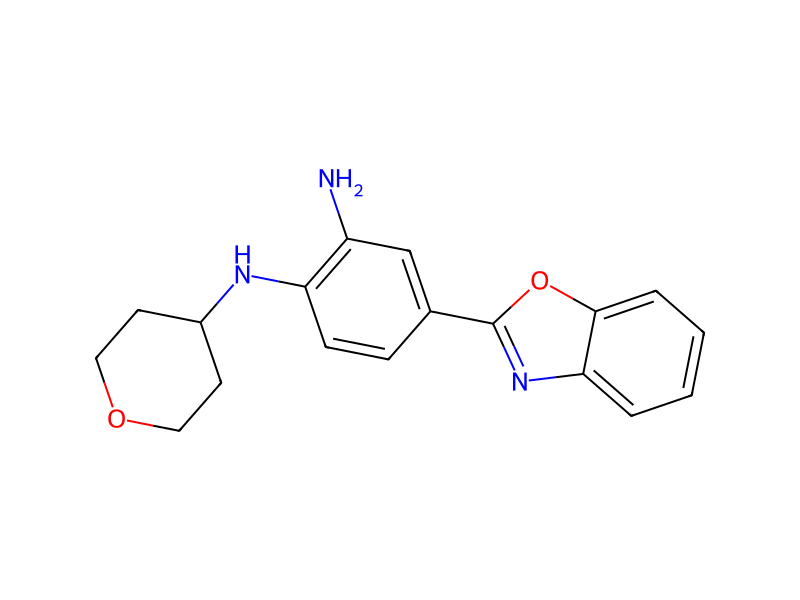


Procedure
5-(Benzoxazol-2-yl)-2-(tetrahydropyran-4-yl)nitrobenzene (see Working Example 20-1) (1.00 g, 0.76 mol) was dissolved in a solvent mixture of THF (50 mL) and methanol (50 mL), and Pd/C (5%, wet, 0.5 g) was added to carry out a hydrogenation reaction. After being stirred overnight at room temperature, the catalyst was removed by filtration and the filtrate was concentrated under reduced pressure to yield the title compound (812 mg, 89.1%) as a gray solid.
Workup
- additionwas added
- customa hydrogenation reaction
- customthe catalyst was removed by filtration
- concentrationthe filtrate was concentrated under reduced pressure
Sources & evidence
- ORD record
- ord-db448fdc435e4d0a9b8ec2680e8c8fa4
- Source dataset
- uspto-grants-2014_09
- Patent number
- US08829035B2
Linked notes
Loading…