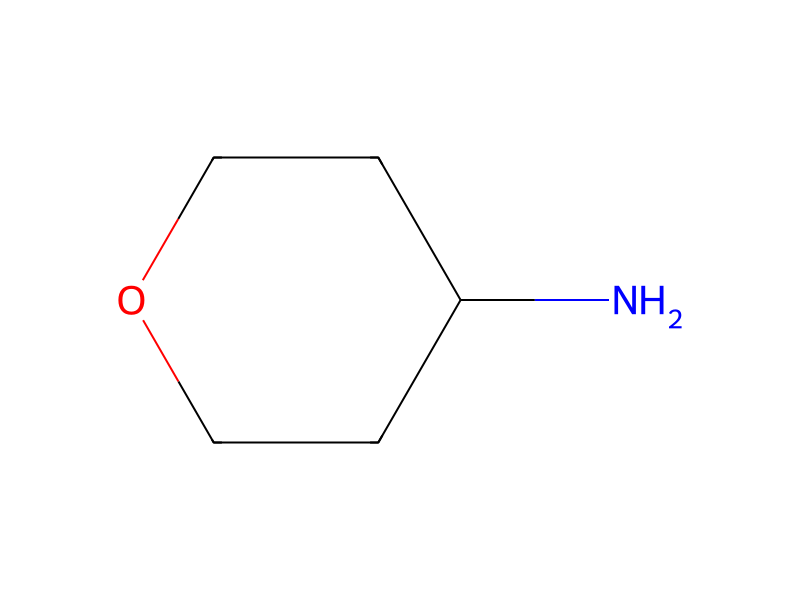
[Cl:1][C:2]1[CH:3]=[CH:4][C:5]2[O:9][C:8]([C:10]3[CH:11]=[CH:12][C:13](F)=[C:14]([N+:16]([O-])=O)[CH:15]=3)=[N:7][C:6]=2[CH:20]=1.[NH2:21][CH:22]1[CH2:27][CH2:26][O:25][CH2:24][CH2:23]1.O.[H][H]>C(#N)C.[C].[Pd]>[Cl:1][C:2]1[CH:3]=[CH:4][C:5]2[O:9][C:8]([C:10]3[CH:11]=[CH:12][C:13]([NH:21][CH:22]4[CH2:27][CH2:26][O:25][CH2:24][CH2:23]4)=[C:14]([CH:15]=3)[NH2:16])=[N:7][C:6]=2[CH:20]=1To a suspension of 5-chloro-2-(2-fluoronitrobenzen-5-yl)benzoxazole (see Working Example 100-1) (5.00 g, 17.1 mmol) in acetonitrile (20 mL) was added 4-aminotetrahydropyran (3.81 g, 38.0 mmol), and this was heated to reflux for 3 hours. After the reaction was complete, this was cooled to room temperature, water was added, and the precipitated crystals were filtered, washed with water and then dried. To a solution of the crystals obtained in a solvent mixture of methanol/tetrahydrofuran (1:1, 100 mL) was added 10% palladium-carbon (500 mg). A hydrogen atmosphere was substituted in the flask, and this was stirred at room temperature overnight. After the reaction was complete, this was filtered through Celite, the filtrate was concentrated, and the residue obtained was purified by silica gel column chromatography to yield the title compound (2.86 g, 49% yield) as yellowish-brown crystals.