Reaction equation
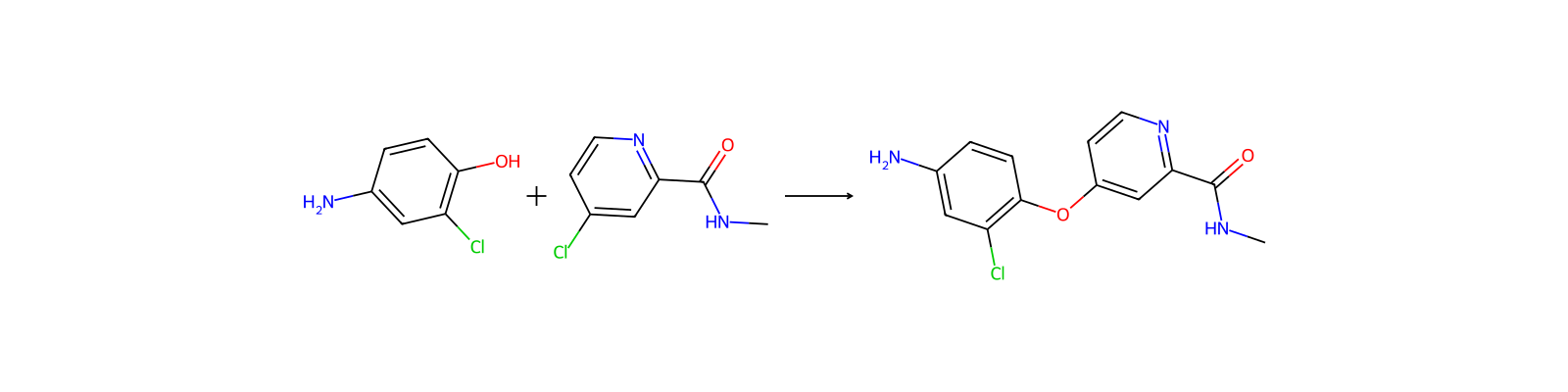
[NH2:1][C:2]1[CH:7]=[CH:6][C:5]([OH:8])=[C:4]([Cl:9])[CH:3]=1.Cl[C:11]1[CH:16]=[CH:15][N:14]=[C:13]([C:17]([NH:19][CH3:20])=[O:18])[CH:12]=1>>[CH3:20][NH:19][C:17]([C:13]1[CH:12]=[C:11]([O:8][C:5]2[CH:6]=[CH:7][C:2]([NH2:1])=[CH:3][C:4]=2[Cl:9])[CH:16]=[CH:15][N:14]=1)=[O:18]Participants
3


Procedure
Entry 52: According to Method A2, Step 4, 4-amino-2-chlorophenol was reacted with 4-chloro-N-methyl-2-pyridinecarboxamide, which had been synthesized according to Method A2, Step 3b, to give 4-(2-(N-methylcarbamoyl)-4-pyridyloxy)-3-chloroaniline. According to Method C1a, 4-chloro-3-(trifluoromethyl)phenyl isocyanate was reacted with 4-(2-(N-methylcarbamoyl)-4-pyridyloxy)-3-chloroaniline to afford the urea.
Workup
- customhad been synthesized
Sources & evidence
- ORD record
- ord-aee74da1bb3f4b4599e297c262059df5
- Source dataset
- uspto-grants-2014_09
- Patent number
- US08841330B2
Linked notes
Loading…