Reaction equation
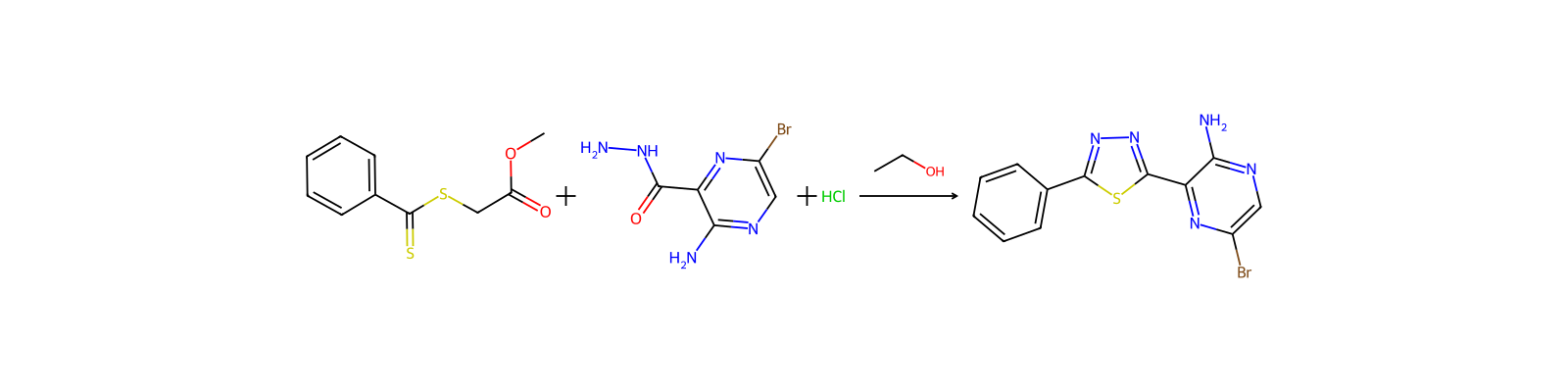
[C:1]1([C:7](SCC(OC)=O)=[S:8])[CH:6]=[CH:5][CH:4]=[CH:3][CH:2]=1.[NH2:15][C:16]1[C:17]([C:23]([NH:25][NH2:26])=O)=[N:18][C:19]([Br:22])=[CH:20][N:21]=1.Cl>C(O)C>[Br:22][C:19]1[N:18]=[C:17]([C:23]2[S:8][C:7]([C:1]3[CH:6]=[CH:5][CH:4]=[CH:3][CH:2]=3)=[N:26][N:25]=2)[C:16]([NH2:15])=[N:21][CH:20]=1Participants
5




Procedure
Methyl 2-((phenylcarbonothioyl)thio)acetate (3.6 g, 15.9 mmol) and 3-amino-6-bromopyrazine-2-carbohydrazide (2.9 g, 12.5 mmol) were suspended in 200 mL of ethanol and refluxed for 2 days. To the mixture, 50 mL of sat. ethanolic HCl was added and the mixture was refluxed overnight. A precipitate formed. The formed solid was filtered and dried to afford 5-Bromo-3-(5-phenyl-1,3,4-thiadiazol-2-yl)pyrazin-2-amine 5 (1.5 g, 36%).
Workup
- temperaturerefluxed for 2 days
- temperaturethe mixture was refluxed overnight
- customA precipitate formed
- filtrationThe formed solid was filtered
- customdried
Sources & evidence
- ORD record
- ord-2cbc8a8a228140bbba6a6dbcefb60f77
- Source dataset
- uspto-grants-2014_09
- Patent number
- US08841449B2
Linked notes
Loading…