Reaction equation
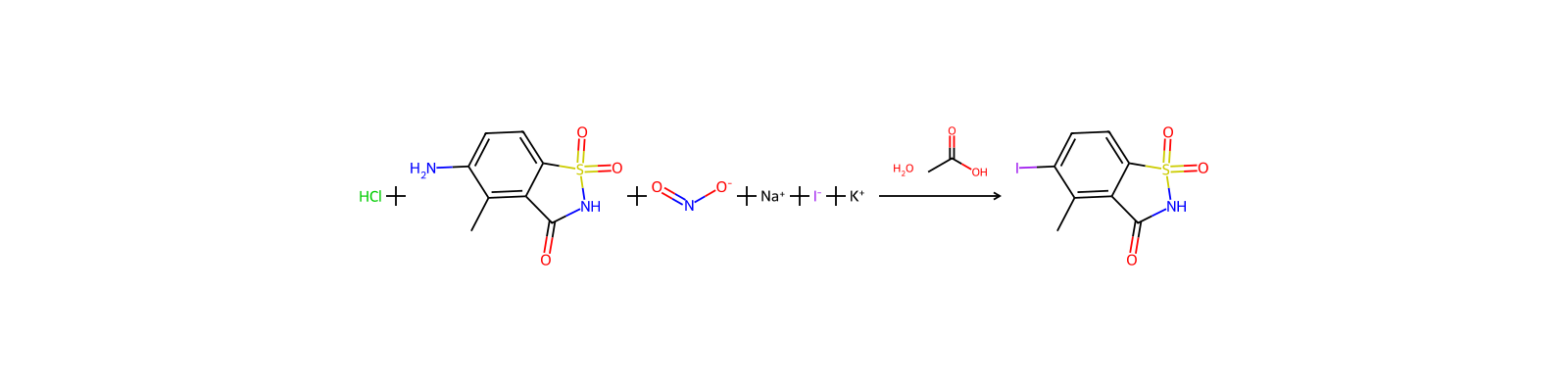
Cl.[CH3:2][C:3]1[C:13](N)=[CH:12][CH:11]=[C:10]2[C:4]=1[C:5](=[O:15])[NH:6][S:7]2(=[O:9])=[O:8].N([O-])=O.[Na+].[I-:20].[K+]>O.C(O)(=O)C>[CH3:2][C:3]1[C:13]([I:20])=[CH:12][CH:11]=[C:10]2[C:4]=1[C:5](=[O:15])[NH:6][S:7]2(=[O:9])=[O:8]Participants
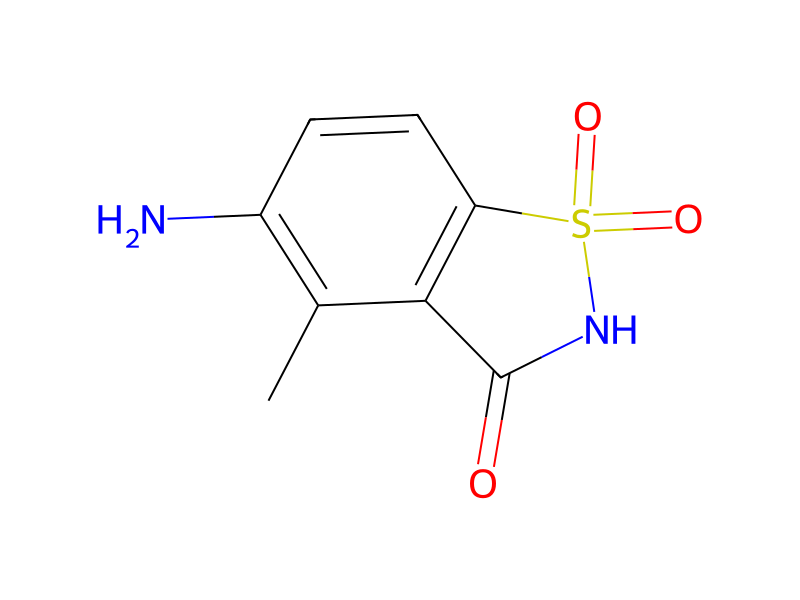
Reactant 4



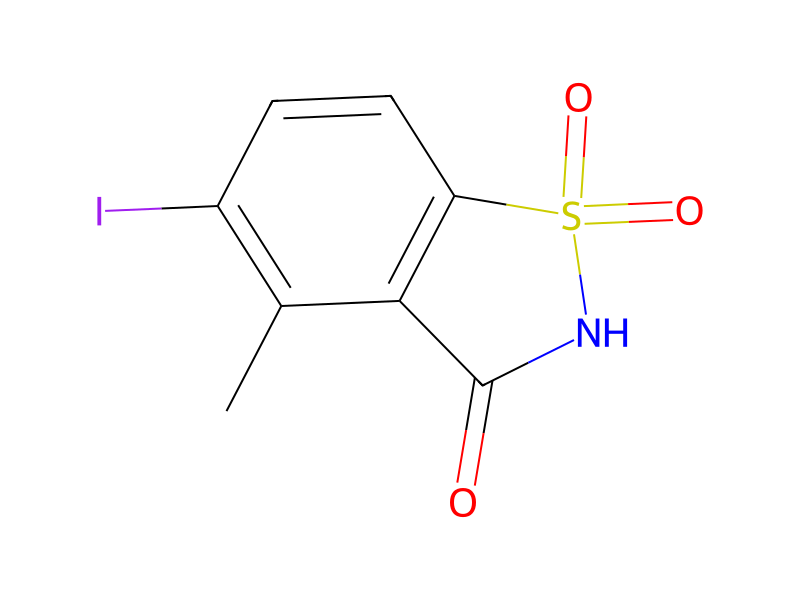
Product 1
Reagents, catalysts & solvents 2


Conditions
- Temperature
- 50 °C
Procedure
A mixture of 205 ml of glacial acetic acid, 160 ml of water and 40 ml of conc. HCl is initially taken and 23.4 g (0.11 mol) of 4-methyl-5-aminosaccharin are introduced with stirring at 15°-20° C. 7.9 g (0.115 mol) of sodium nitrite are added dropwise to the resulting suspension at 5°-10° C. and it is stirred at 5° C. for 30 min. The diazonium salt, which is present as a suspension, is then added dropwise in portions to a solution of 19.1 g (0.115 mol) of potassium iodide in 170 ml of water which is warmed to 50° C., nitrogen being formed. After cooling to room temperature, the deposited product is isolated by filtering off with suction, washed with water and dried under reduced pressure at 50° C. 32.5 g (0.1 mol=91% of theory) of a solid of m.p.: 257°-258° C. are obtained. A combustion analysis gave an iodine content of 38.5% (theory 39.3%).
Workup
- stirringit is stirred at 5° C. for 30 min
- customnitrogen being formed
- temperatureAfter cooling to room temperature
- customthe deposited product is isolated
- filtrationby filtering off with suction
- washwashed with water
- customdried under reduced pressure at 50° C
- custom32.5 g (0.1 mol=91% of theory) of a solid of m.p.: 257°-258° C. are obtained
Sources & evidence
- ORD record
- ord-64895c5b03224120a7cbd0bc650559fc
- Source dataset
- uspto-grants-1998_03
- Patent number
- US05723415
Linked notes
Loading…