HomeMCPWorkbenchSkills
HomeWorkbenchNotificationsMe
llms.txt · MCP GuidePrivacy Policy · Terms of Service · Supportv1.8.0
  1. Home
  2. /Reaction

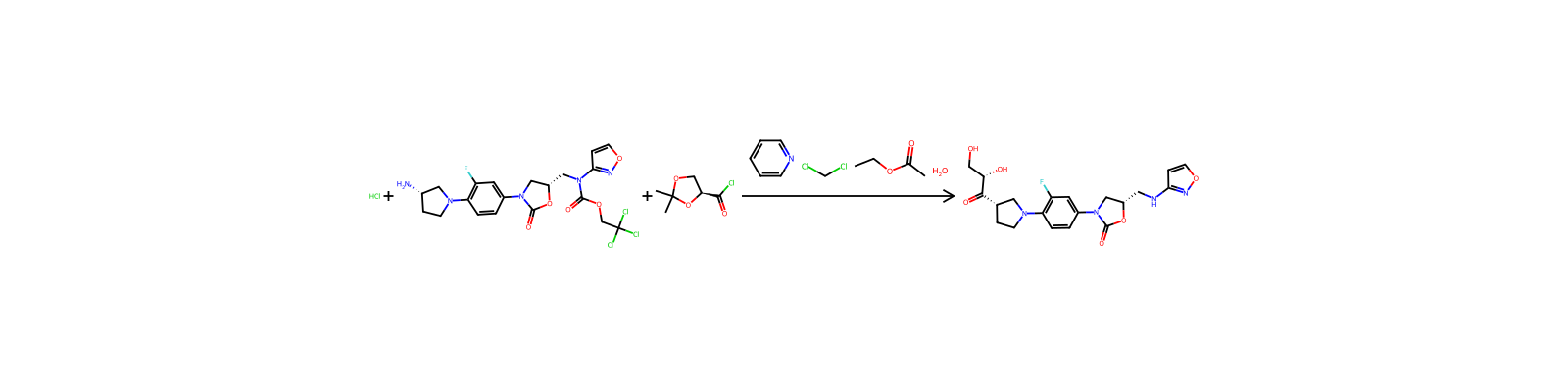
HCID 10374773, compound → 3-(4-(3(S)-(2(S),3-Dihydroxypropanoyl)pyrrolidin-1-yl)-3-fluorophenyl)-5(S)-(isoxazol-3-ylaminomethyl)oxazolidin-2-one

HRID 8167
Notes
Print preview

Reaction equation

HRID 8167 reaction equation
Cl.N[C@H:3]1[CH2:7][CH2:6][N:5]([C:8]2[CH:13]=[CH:12][C:11]([N:14]3[CH2:18][C@H:17]([CH2:19][N:20]([C:29]4[CH:33]=[CH:32][O:31][N:30]=4)C(OCC(Cl)(Cl)Cl)=O)[O:16][C:15]3=[O:34])=[CH:10][C:9]=2[F:35])[CH2:4]1.CC1(C)[O:41][C@H:40]([C:42](Cl)=[O:43])[CH2:39][O:38]1>N1C=CC=CC=1.ClCCl.C(OCC)(=O)C.O>[OH:41][C@@H:40]([CH2:42][OH:43])[C:39]([C@H:3]1[CH2:7][CH2:6][N:5]([C:8]2[CH:13]=[CH:12][C:11]([N:14]3[CH2:18][C@H:17]([CH2:19][NH:20][C:29]4[CH:33]=[CH:32][O:31][N:30]=4)[O:16][C:15]3=[O:34])=[CH:10][C:9]=2[F:35])[CH2:4]1)=[O:38]
ParticipantsProcedureWorkupSources & evidenceReaction notes

Participants

7

Reactant 2

HCID 10374773HCID 10374773, compoundHCID 695849253-(4(3(S) aminopyrrolidin-1-yl)-3-fluorophenyl)-5(R)-(N-(2,2,2-trichloroethyloxycarbonyl)isoxazol-3-ylaminomethyl)oxazolidin-2-one hydrochloride salt

Product 1

HCID 537427063-(4-(3(S)-(2(S),3-Dihydroxypropanoyl)pyrrolidin-1-yl)-3-fluorophenyl)-5(S)-(isoxazol-3-ylaminomethyl)oxazolidin-2-oneYield 143.5%

Reagents, catalysts & solvents 4

HCID 962
Water
Solvent
HCID 1049PyridineSolvent
HCID 6344DichloromethaneSolvent
HCID 8857Ethyl AcetateSolvent

Procedure

3-(4-(3(S)-Aminopyrrolidin-1-yl)-3-fluorophenyl)-5(R)-(N-(2,2,2-trichloroethyl-oxycarbonyl)isoxazol-3-ylaminomethyl)oxazolidin-2-one hydrochloride salt (400 mg, 0.698 mM) in pyridine (5 ml) was treated dropwise with a solution of 2,2-dimethyl-1,3-dioxolan-4(S)-ylcarbonyl chloride (200 mg, 1.2 mM) in dichloromethane (2 ml), and the mixture stirred 3 hours at ambient temperature. The mixture was diluted with ethyl acetate (15 ml) and water (15 ml), the organic layer separated, washed with aqueous sodium bicarbonate (10 ml) and brine (10 ml), and evaporated, then azeotroped with toluene (20 ml). The residue was purified by chromatography on a 10 g silica Mega Bond Elut® column, eluting with a gradient increasing in polarity from 0 to 100% ethyl acetate in dichloromethane. Relevant fractions were combined and evaporated to give the desired product (435 mg).

Workup

  1. customthe organic layer separated
  2. washwashed with aqueous sodium bicarbonate (10 ml) and brine (10 ml)
  3. customevaporated
  4. customazeotroped with toluene (20 ml)
  5. customThe residue was purified by chromatography on a 10 g silica Mega Bond Elut® column
  6. washeluting with
  7. temperaturea gradient increasing in polarity from 0 to 100% ethyl acetate in dichloromethane
  8. customevaporated

Sources & evidence

ORD record
ord-8438e2094b024065b29bce8406738a13
Source dataset
uspto-grants-2006_08
DOI
10.6084/m9.figshare.5104873.v1
Patent number
US07087629B2

Reaction notes

Loading…

On this pageParticipantsProcedureWorkupSources & evidenceReaction notes