Reaction equation
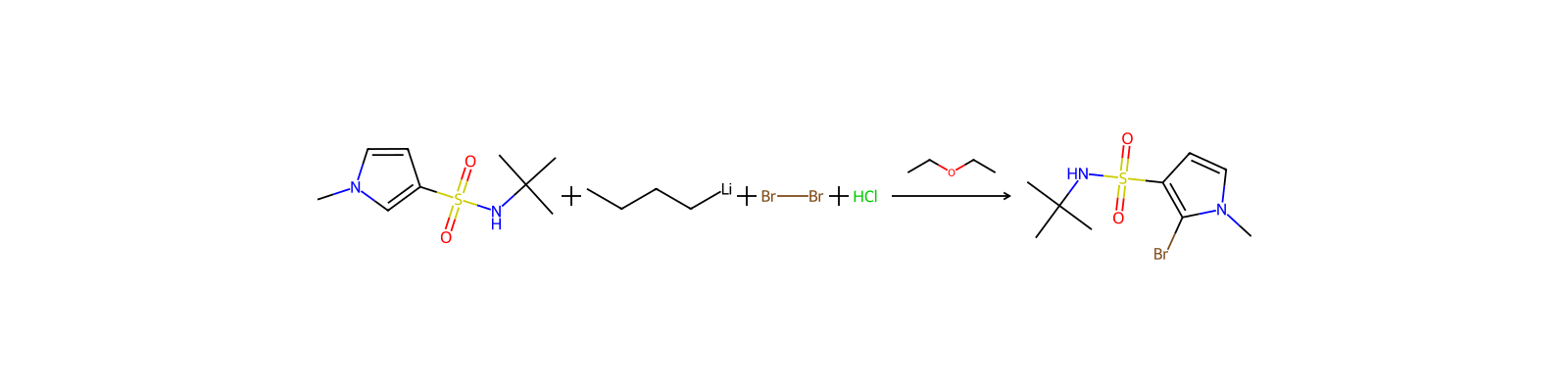
[CH3:1][C:2]([NH:5][S:6]([C:9]1[CH:13]=[CH:12][N:11]([CH3:14])[CH:10]=1)(=[O:8])=[O:7])([CH3:4])[CH3:3].C([Li])CCC.[Br:20]Br.Cl>C(OCC)C>[Br:20][C:10]1[N:11]([CH3:14])[CH:12]=[CH:13][C:9]=1[S:6]([NH:5][C:2]([CH3:1])([CH3:3])[CH3:4])(=[O:8])=[O:7]Participants
Reactant 4


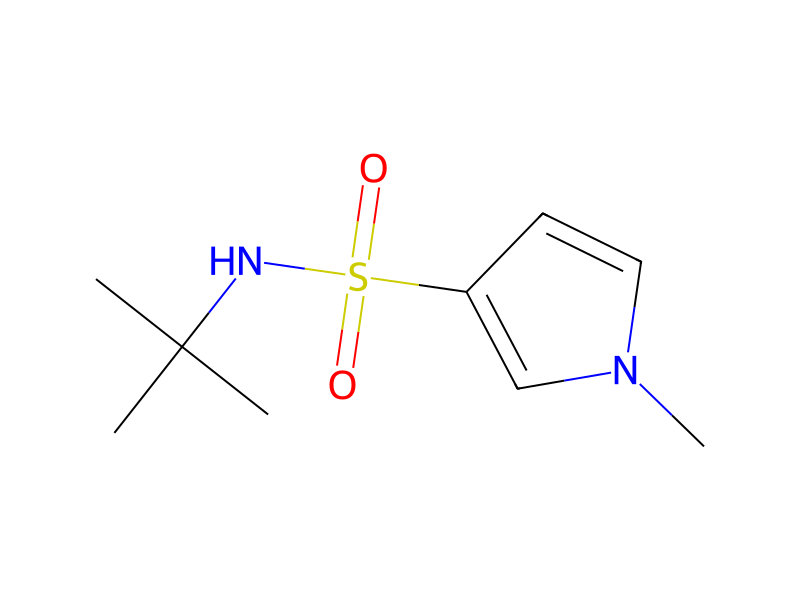

Product 1
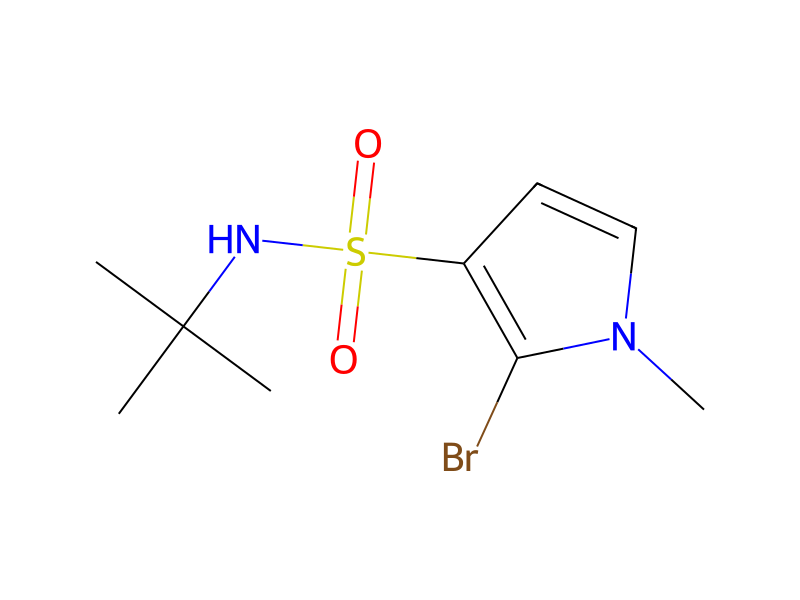
Reagents, catalysts & solvents 1

Conditions
- Temperature
- -78 °C
Procedure
To a solution of 8.85 g (41 mmol) of N-(1,1-dimethylethyl)-1-methyl-1H-pyrrole-3-sulfonamide in 200 mL diethyl ether under a nitrogen atmosphere cooled to -78° C. was added dropwise, at such a rate as to keep the temperature below -65° C., 36.0 mL (85 mmol) 2.41M n-butyllithium in hexanes. The reaction was stirred at -78° C. for ca. 15 minutes. To the reaction mixture was added 2.2 mL (41 mmol) of bromine dropwise. The light orange reaction mixture was allowed to warm to room temperature and stir for ca. 2 hours. The reaction mixture darkened as it stirred at room temperature. The reaction mixture was cooled to 0° C. and acidified with 1N HCl. The ether phase was separated, washed with brine, dried (MgSO4) and concentrated in vacuo. The crude residue was chromatographed on silica (25% ethyl acetate/80% hexanes) affording 7.11 g of the title compound as an orange oil.
Workup
- additionwas added dropwise
- temperatureto warm to room temperature
- stirringstir for ca. 2 hours
- stirringstirred at room temperature
- temperatureThe reaction mixture was cooled to 0° C.
- customThe ether phase was separated
- washwashed with brine
- dry with materialdried (MgSO4)
- concentrationconcentrated in vacuo
- customThe crude residue was chromatographed on silica (25% ethyl acetate/80% hexanes)
Sources & evidence
- ORD record
- ord-0d425205828e434aa8465064fdc60f2d
- Source dataset
- uspto-grants-1998_03
- Patent number
- US05723410
Linked notes
Loading…