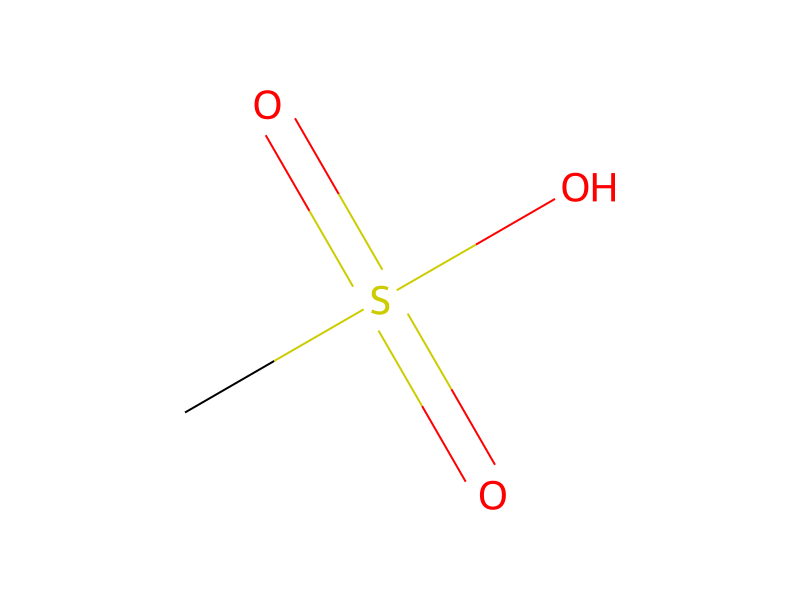
Methanesulfonic Acid → Tert-butyl 4'-methylbiphenyl-2-carboxylate
Reaction equation

[CH3:1][C:2]1[CH:7]=[CH:6][C:5]([C:8]2[C:9]([C:14]([OH:16])=[O:15])=[CH:10][CH:11]=[CH:12][CH:13]=2)=[CH:4][CH:3]=1.CS(O)(=O)=O.[CH2:22]=[C:23]([CH3:25])[CH3:24]>C1(C)C=CC=CC=1>[CH3:1][C:2]1[CH:7]=[CH:6][C:5]([C:8]2[C:9]([C:14]([O:16][C:23]([CH3:25])([CH3:24])[CH3:22])=[O:15])=[CH:10][CH:11]=[CH:12][CH:13]=2)=[CH:4][CH:3]=1Participants
5
Reactant 3


Product 1

Reagents, catalysts & solvents 1

Procedure
A 100-ml flask was charged with 5 ml of toluene and 2.12 g (10 mmol) of 4′-methyl-2-biphenylcarboxylic acid, and they were vigorously stirred. To this mixture was added 0.32 ml (5 mmol) of methanesulfonic acid, and isobutene gas (98 mmol) was introduced thereto at a flow rate of 1.2 liter/min for 2 minutes. The resulting mixture was stirred at room temperature for 20 minutes. After having confirmed that almost all of the peaks ascribed to 4′-methyl-2-biphenylcarboxylic acid disappeared by HPLC, the reaction solution was washed with a 1.5 M aqueous sodium hydroxide, and dried over anhydrous magnesium sulfate. Thereafter, the solution was concentrated by distilling off toluene by using a rotary evaporator, to give 2.52 g of tert-butyl 4′-methyl-2-biphenylcarboxylate as crystals (yield: 94% based on 4′-methyl-2-biphenylcarboxylic acid, purity by HPLC: 99.9%). Incidentally, the obtained compound had the same physical properties as those of the compound obtained in Example II-1.