HomeMCPSkillsWorkbenchOpenChem
HomeWorkbenchNotificationsMe
llms.txt · skill.md · MCP GuidePrivacy Policy · Terms of Service · Supportv1.8.4
  1. Home
  2. /Reaction

Acetone Cyanohydrin → HCID 178428877, compound

HRID 848978
Print

Reaction equation

C1(N=C=NC2CCCCC2)CCCCC1.[I:16][C:17]1[C:18]([CH3:30])=[C:19]([CH:23]=[CH:24][C:25]=1[S:26]([CH3:29])(=[O:28])=[O:27])[C:20]([OH:22])=O.[CH3:31][C:32]([N:35]1[C:39]([OH:40])=[CH:38][CH:37]=[N:36]1)([CH3:34])[CH3:33].C(N(CC)CC)C.CC(C)(O)C#N>C(#N)C.ClCCl>[CH3:31][C:32]([N:35]1[C:39]([OH:40])=[C:38]([C:20](=[O:22])[C:19]2[CH:23]=[CH:24][C:25]([S:26]([CH3:29])(=[O:28])=[O:27])=[C:17]([I:16])[C:18]=2[CH3:30])[CH:37]=[N:36]1)([CH3:34])[CH3:33]
ParticipantsProcedureWorkupSources & evidenceReaction notes

Participants

8

Reactant 5

HCID 6406Acetone CyanohydrinHCID 8471TriethylamineHCID 10868DicyclohexylcarbodiimideHCID 211831523-Iodo-2-methyl-4-methylsulfonylbenzoic AcidHCID 178448738HCID 178448738, compound

Product 1

HCID 178428877HCID 178428877, compound

Reagents, catalysts & solvents 2

HCID 6342AcetonitrileSolvent2×HCID 6344DichloromethaneSolvent2×

Procedure

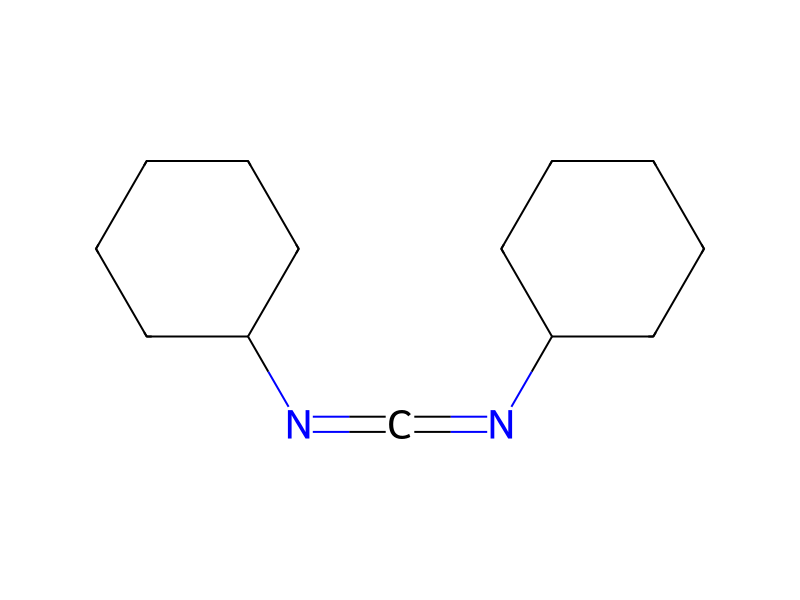
A solution of 8.4 9 (40 mmol) of 1,3-dicyclohexylcarbodiimide in 40 mL of acetonitrile was added to a mixture of 13.6 g (40 mmol) of 3-iodo-2-methyl-4-methylsulfonylbenzoic acid and 5.6 g (40 mmol) of 1-(1,1-dimethylethyl)-5-hydroxypyrazole in 80 mL of acetonitrile with stirring. The mixture was allowed to stir for 1 hour and was then filtered, washing the filter cake with a little acetonitrile. Triethylamine (16.8 mL, 120 mmol) and acetone cyanohydrin (1 mL, 10 mmol) were added with stirring to the filtrate. After about 1.5 hour, dichloromethane was added and the resulting mixture was washed with a mixture of 2N aqueous hydrochloric acid and saturated aqueous sodium chloride. It was then concentrated by evaporation under reduced pressure. The residue obtained was dissolved in dichloromethane and the resulting solution was extracted with dilute aqueous sodium hydroxide. The aqueous extract was acidified with concentrated aqueous hydrochloric acid and the resulting mixture was extracted with dichloromethane. Fifty mL of triethylamine was added to the dichloromethane extract and the resulting solution was washed with saturated aqueous sodium chloride solution and then several times with 2N aqueous hydrochloric acid. It was then concentrated by evaporation under reduced pressure. The residue was triturated with hexane to obtain 16.8 g (72.7 percent of theory of the title compound as a light yellow powder melting at 171-172° C.

Workup

  1. stirringto stir for 1 hour
  2. filtrationwas then filtered
  3. washwashing the filter cake with a little acetonitrile
  4. stirringwith stirring to the filtrate
  5. washthe resulting mixture was washed with a mixture of 2N aqueous hydrochloric acid and saturated aqueous sodium chloride
  6. concentrationIt was then concentrated by evaporation under reduced pressure
  7. customThe residue obtained
  8. extractionthe resulting solution was extracted with dilute aqueous sodium hydroxide
  9. extractionThe aqueous extract
  10. extractionthe resulting mixture was extracted with dichloromethane
  11. additionFifty mL of triethylamine was added to the dichloromethane
  12. extractionextract
  13. washthe resulting solution was washed with saturated aqueous sodium chloride solution
  14. concentrationIt was then concentrated by evaporation under reduced pressure
  15. customThe residue was triturated with hexane

Sources & evidence

ORD record
ord-e015a27353a847809062c3a62ae07a99
Source dataset
uspto-grants-2000_01
DOI
10.6084/m9.figshare.5104873.v1
Patent number
US06010981

Reaction notes

On this pageParticipantsProcedureWorkupSources & evidenceReaction notes