Reaction equation

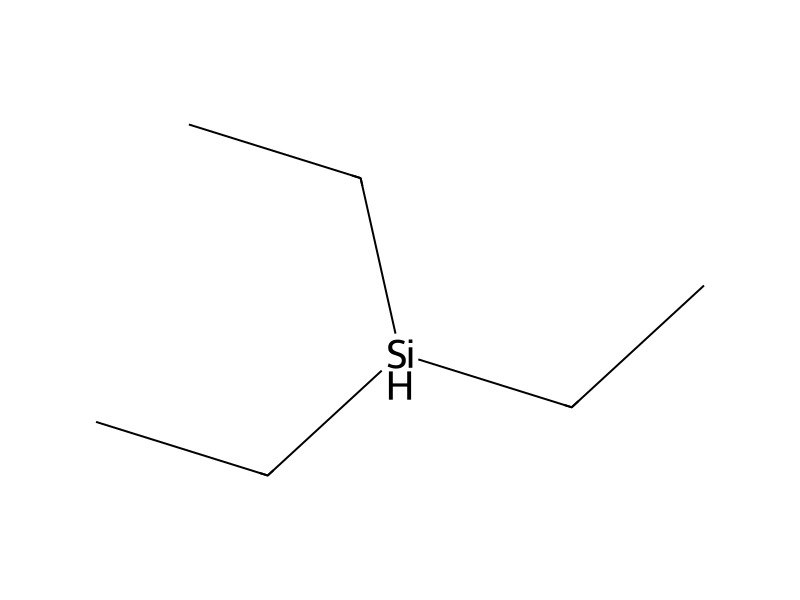
[CH3:1][O:2][C:3]1[CH:4]=[C:5]([CH:8]=[CH:9][C:10]=1[O:11][CH3:12])[CH:6]=[CH2:7].C([SiH](CC)CC)C.C(OCC)C>C1C=CC=CC=1>[CH3:1][O:2][C:3]1[CH:4]=[C:5]([CH2:6][CH3:7])[CH:8]=[CH:9][C:10]=1[O:11][CH3:12]Participants
5
Reactant 3


Product 1

Reagents, catalysts & solvents 1

Conditions
- Temperature
- 60 °C
Procedure
In a 5 mL flask opened to the air, to a clear solution of 3,4-dimethoxystyrene (100 μL, 0.755 mmol) in benzene (0.8 mL) was added triethylsilane (240 μL, 0.816 mmol). The flask was placed in a 60° C. bath and iodo[bis(triphenylphosphine)]dioxorhenium(V) (32 mg, 0.037 mmol) was added. The resulting brown solution was heated at 60° C. for 12 hours. The crude reaction mixture was directly applied to a SiO2 column and chromatographed eluting with 4:1 hexanes:diethyl ether to afford 3,4-dimethoxyethylbenzene (52 mg, 57% yield) as a colorless liquid. The reaction was repeated using pent-2-enal and t-butyl acrylate as the electrophilic reactants, as indicated in the first two schemes above (wherein “TES” represents triethylsilyl).
Workup
- customwas placed in a 60° C.
- customThe crude reaction mixture
- customchromatographed
- washeluting with 4:1 hexanes
Sources & evidence
- ORD record
- ord-8aadcf4acfbb4971aadb87d91ca5d5c6
- Source dataset
- uspto-grants-2007_08
- Patent number
- US07262315B2
Linked notes
Loading…