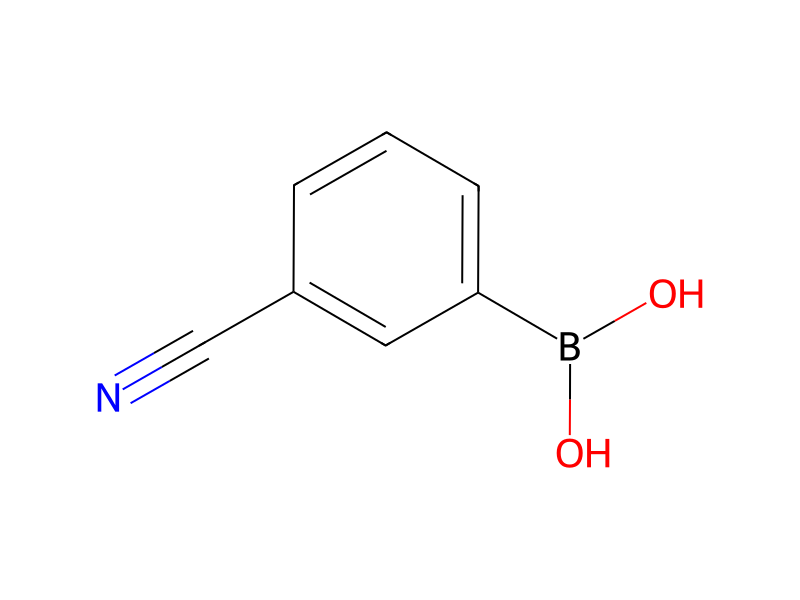
[C:1]([C:3]1[CH:4]=[C:5](B(O)O)[CH:6]=[CH:7][CH:8]=1)#[N:2].[Br:12][C:13]1[CH:18]=[CH:17][C:16](I)=[CH:15][CH:14]=1.C(=O)([O-])[O-].[Na+].[Na+]>CN(C=O)C.C1C=CC([P]([Pd]([P](C2C=CC=CC=2)(C2C=CC=CC=2)C2C=CC=CC=2)([P](C2C=CC=CC=2)(C2C=CC=CC=2)C2C=CC=CC=2)[P](C2C=CC=CC=2)(C2C=CC=CC=2)C2C=CC=CC=2)(C2C=CC=CC=2)C2C=CC=CC=2)=CC=1>[Br:12][C:13]1[CH:18]=[CH:17][C:16]([C:5]2[CH:6]=[CH:7][CH:8]=[C:3]([C:1]#[N:2])[CH:4]=2)=[CH:15][CH:14]=1To a magnetically stirring solution of 3-cyanophenyl boronic acid (0.62 g, 4.24 mmol) and 1-bromo-4-iodobenzene (1.0 g, 3.53 mmol) in anhydrous DMF (7.0 mL), under argon at room temperature, was added 2M sodium carbonate solution (7.0 mL) followed by Pd(PPh3)4 (0.21 g, 0.18 mmol). The resulting mixture was heated to 75° C. overnight. The resulting dark reaction mixture was cooled to room temperature filtered to remove the solids and the resultant filtrate was poured into water (50 mL) and extracted with EtOAc (2×25 mL). The organics were washed with water (50 mL) and brine (50 mL) then dried over Na2SO4, filtered and concentrated. The crude residue was purified by flash chromatography (5% EtOAc in Hexanes) to yield the intermediate bromide as a white solid (0.36 g, 33%).
Loading…