Reaction equation
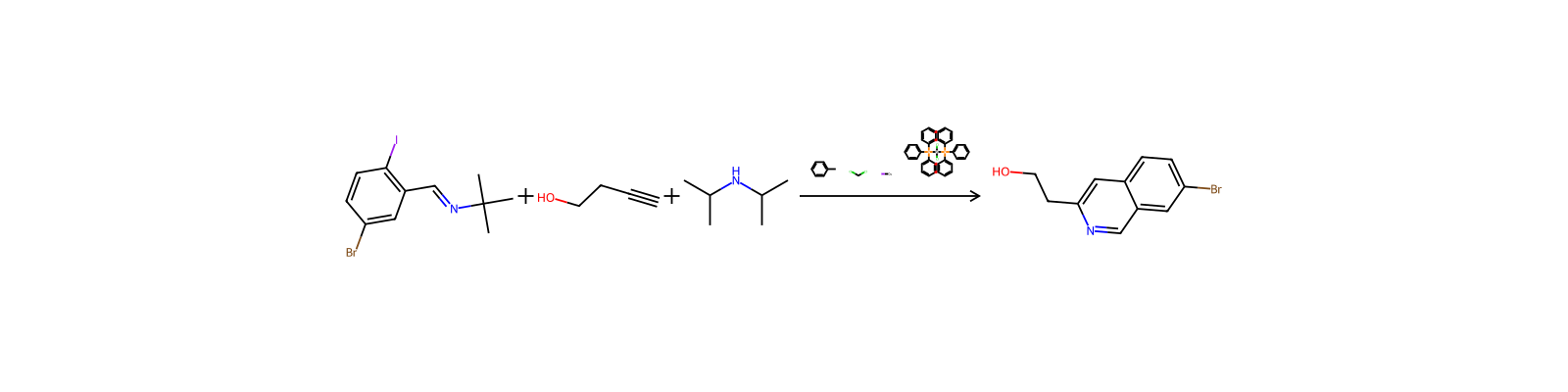
[Br:1][C:2]1[CH:3]=[CH:4][C:5](I)=[C:6](/[CH:8]=[N:9]/[C:10]([CH3:13])([CH3:12])C)[CH:7]=1.[CH2:15]([OH:19])CC#C.C(NC(C)C)(C)C>C1(C)C=CC=CC=1.C(Cl)Cl.[Cu]I.Cl[Pd](Cl)([P](C1C=CC=CC=1)(C1C=CC=CC=1)C1C=CC=CC=1)[P](C1C=CC=CC=1)(C1C=CC=CC=1)C1C=CC=CC=1>[Br:1][C:2]1[CH:7]=[C:6]2[C:5]([CH:13]=[C:10]([CH2:12][CH2:15][OH:19])[N:9]=[CH:8]2)=[CH:4][CH:3]=1Participants
Reactant 3



Product 1

Reagents, catalysts & solvents 4




Procedure
The product from Example 62D (1.3 g, 3.6 mmol), 3-butyn-1-ol (0.3 g, 4.3 mmol), CuI (0.04 g, 0.2 mmol), and PdCl2(PPh3)2 (0.08 g, 0.1 mmol) were combined in toluene (15 mL). The mixture was treated with diisopropylamine (0.54 g, 5.3 mmol) and stirred at room temperature for 4 hours. The mixture was then treated with additional CuI (0.07 g, 0.4 mmol) and heated at 100° C. for 4 hours. The mixture was allowed to cool to room temperature, diluted with 30 mL CH2Cl2, and filtered. The filtrate was washed with 2×10 mL 15% NaCl and concentrated under reduced pressure. The residue was purified by column chromatography (silica gel, 10:90 MeOH:CHCl3) to provide the title compound. 1H NMR (CDCl3, 400 MHz) δ 9.08 (s, 1H), 8.09 (d, J=4 Hz, 1H), 7.73 (dd, J=8, 4 Hz, 1H), 7.63 (d, J=8 Hz, 1H), 7.48 (s, 1H), 4.08 (t, J=4 Hz, 2H), 3.92 (s, 1H), 3.15 (t, J=4 Hz, 2H). 13C NMR (CDCl3, 100 MHz) δ 153.8, 150.3, 134.5, 133.8, 129.4, 127.6, 120.0, 118.6, 62.3, 39.4. MS (DCI/NH3) 252, 254 [M+H]+.
Workup
- temperatureheated at 100° C. for 4 hours
- temperatureto cool to room temperature
- filtrationfiltered
- washThe filtrate was washed with 2×10 mL 15% NaCl
- concentrationconcentrated under reduced pressure
- customThe residue was purified by column chromatography (silica gel, 10:90 MeOH:CHCl3)
Sources & evidence
- ORD record
- ord-f4021131a631495ea3441a0c7e2243d8
- Source dataset
- uspto-grants-2006_12
- Patent number
- US07153889B2
Linked notes
Loading…