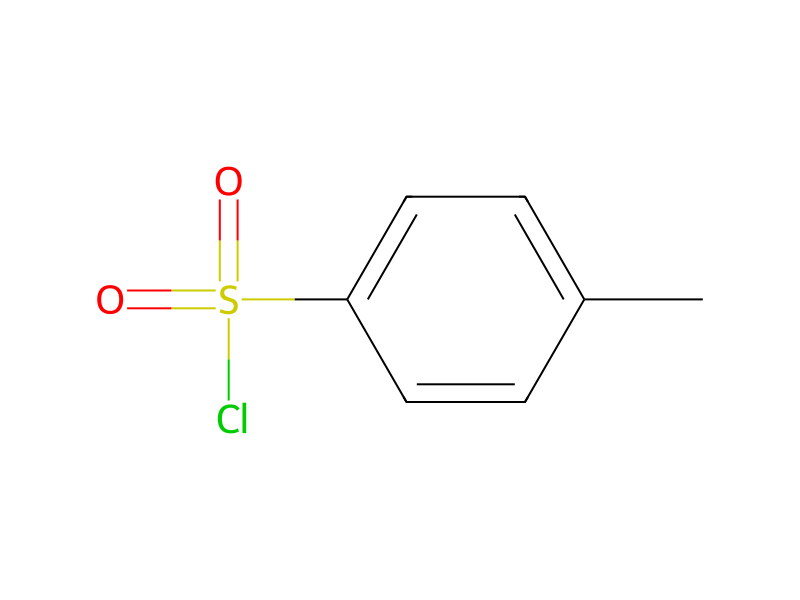
4-Toluenesulfonyl chloride → HCID 20814155, compound
HRID 896014
Reaction equation

[CH3:1][C:2]1[N:12]2[C:13]3[C:8]([O:9][CH2:10][CH:11]2[CH2:14][OH:15])=[CH:7][CH:6]=[CH:5][C:4]=3[N:3]=1.[C:16]1([CH3:26])[CH:21]=[CH:20][C:19]([S:22](Cl)(=[O:24])=[O:23])=[CH:18][CH:17]=1>N1C=CC=CC=1>[CH3:1][C:2]1[N:12]2[C:13]3[C:8]([O:9][CH2:10][CH:11]2[CH2:14][O:15][S:22]([C:19]2[CH:20]=[CH:21][C:16]([CH3:26])=[CH:17][CH:18]=2)(=[O:24])=[O:23])=[CH:7][CH:6]=[CH:5][C:4]=3[N:3]=1Participants
4
Reactant 2

Product 1

Reagents, catalysts & solvents 1

Procedure
(2-Methyl-3,4-dihydro-5-oxa-1,2a-diaza-acenaphthylen-3-yl)-methanol (2.0 g, 9.8 mmole) was dissolved in pyridine (35 mL), p-toluenesulfonyl chloride (4.0 g, 20.9 mmole) was added and the resulting mixture was stirred at room temperature overnight. The solvent was removed and the residue partitioned between 400 mL each of methylene chloride and saturated aqueous sodium bicarbonate. The organic phase was washed with brine, dried over sodium sulfate, filtered and concentrated in vacuum. The crude residue was column chromatographed on silica gel using methylene chloride to elute 2.6 g of the title compound. 1H NMR (DMSO-d6): δ 7.60 (d, 1H); 7.20 (m, 3H); 7.05 (t, 1H); 6.65 (d, 1H); 4.75 (d, 1H); 4.57 (dd, 1H); 4.10 (m, 3H); 2.58 (s, 3H); 2.47 (s, 3H).