Reaction equation
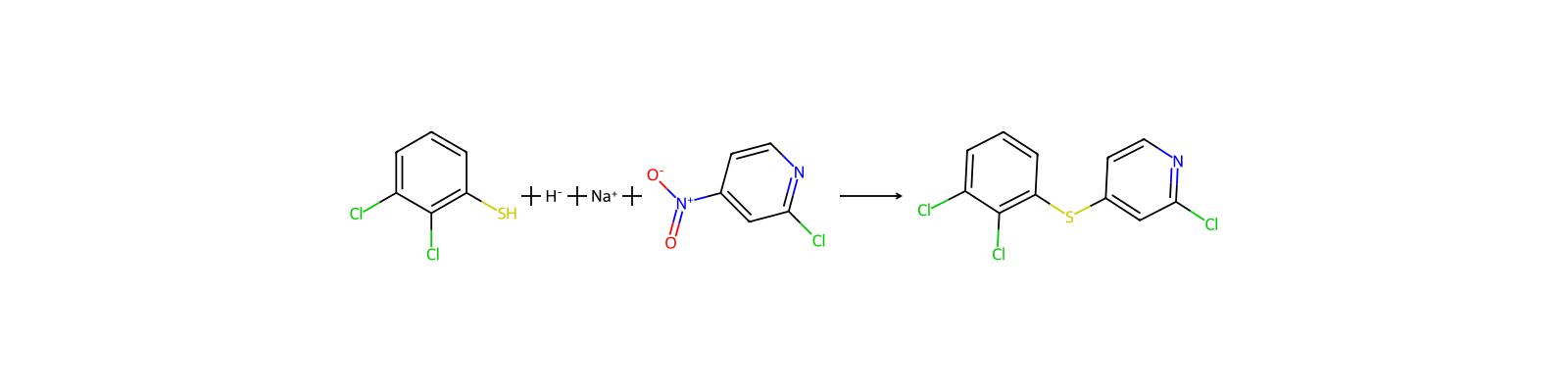
[Cl:1][C:2]1[C:7]([Cl:8])=[CH:6][CH:5]=[CH:4][C:3]=1[SH:9].[H-].[Na+].[Cl:12][C:13]1[CH:18]=[C:17]([N+]([O-])=O)[CH:16]=[CH:15][N:14]=1>>[Cl:12][C:13]1[CH:18]=[C:17]([S:9][C:3]2[CH:4]=[CH:5][CH:6]=[C:7]([Cl:8])[C:2]=2[Cl:1])[CH:16]=[CH:15][N:14]=1Participants
4



Procedure
Using the method of Example 3, Step A, 2,3-dichlorobenzenethiol (1.69 g, 9.46 mmol), 60% sodium hydride in mineral oil (378 mg, 9.46 mmol), and 2-chloro-4-nitropyridine (1.50 g, 9.46 mmol) were reacted to provide 2-chloro-4-(2,3-dichlorophenylthio)pyridine (1.55 g, 56% yield) as a white powder. 1H NMR (CDCl3) δ 8.19 (d, 1H), 7.61 (d, 1H), 7.54 (d, 1H), 7.29 (t, 1H), 6.95 (s, 1H), 6.87 (d, 1H).
Workup
- customwere reacted
Sources & evidence
- ORD record
- ord-190cb40e592f469aaa554d8c082c5e06
- Source dataset
- uspto-grants-2011_09
- Patent number
- US08022222B2
Linked notes
Loading…