Reaction equation

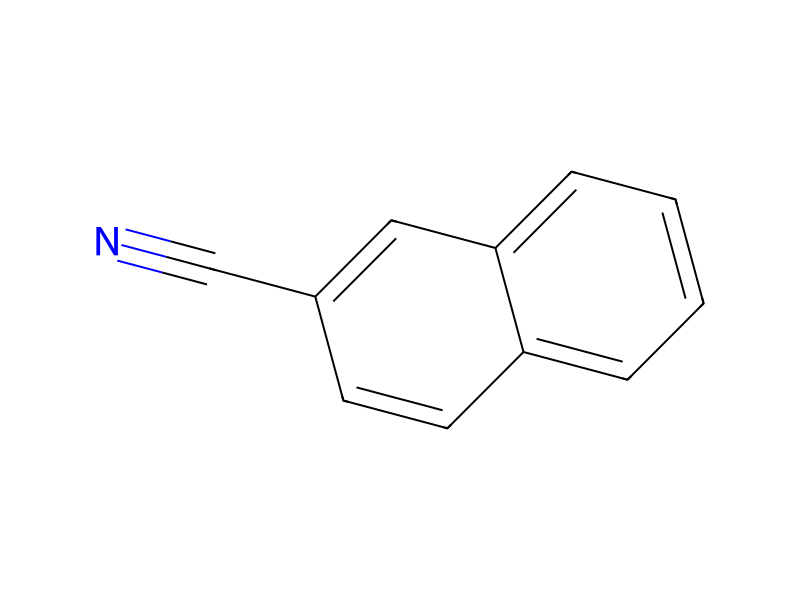
[Na].N.[C:3](#[N:5])[CH3:4].[C:6]([C:8]1[CH:17]=[CH:16][C:15]2[C:10](=[CH:11][CH:12]=[CH:13][CH:14]=2)[CH:9]=1)#[N:7]>C(OCC)C>[NH2:7][C:6]([C:8]1[CH:17]=[CH:16][C:15]2[C:10](=[CH:11][CH:12]=[CH:13][CH:14]=2)[CH:9]=1)=[CH:4][C:3]#[N:5]Participants
Reactant 4



Product 1

Reagents, catalysts & solvents 1

Procedure
To a solution of 2.0 grams (0.087 mole) of sodium in 125 milliliters of liquid ammonia was added a solution of 3.67 grams (0.089 mole) of acetonitrile in 10 milliliters of diethyl ether over a period of about five minutes. The reaction mixture was then cooled in a dry ice-acetone bath and a solution of 10.0 grams (0.065 mole) of 2-cyanonaphthalene in a minimum of dry diethyl ether was rapidly added within about five minutes after completion of the acetonitrile addition. The reaction mixture was stirred for about one and one-half hours and the ammonia was then allowed to evaporate. Water was cautiously added to the reaction mixture under nitrogen and the resulting mixture was extracted with diethyl ether. The ether was separated and the residue recrystallized from a mixture of chloroform and hexane. There was obtained 2.8 grams (22% of theoretical) of β-amino-β-(2naphthyl)acrylonitrile, melting point 85°-90°C. By the process described in Dornow et al., Chemische Berichte 82, 254-6 (1949), the β-amino-β-(2-naphthyl)acrylonitrile was hydrolyzed to β-amino-β-(2-naphthyl)acrylamide.
Workup
- temperatureThe reaction mixture was then cooled in a dry ice-acetone bath
- customto evaporate
- additionWater was cautiously added to the reaction mixture under nitrogen
- extractionthe resulting mixture was extracted with diethyl ether
- customThe ether was separated
- customthe residue recrystallized from a mixture of chloroform and hexane
Sources & evidence
- ORD record
- ord-7994beaba9a141138201bbf42dec4bc3
- Source dataset
- uspto-grants-1976_07
- Patent number
- US03970644
Linked notes
Loading…