Reaction equation
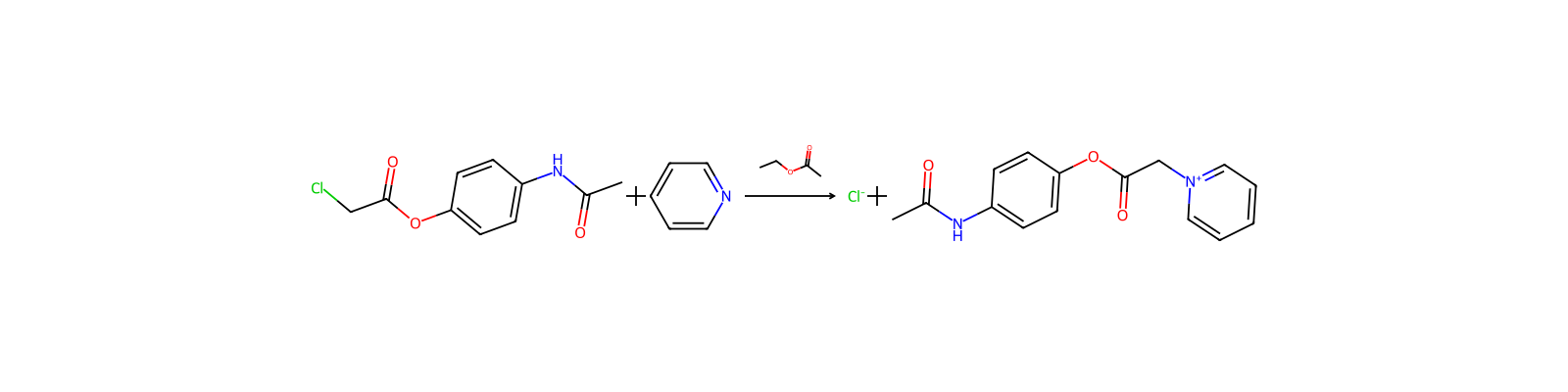
[Cl:1][CH2:2][C:3]([O:5][C:6]1[CH:11]=[CH:10][C:9]([NH:12][C:13](=[O:15])[CH3:14])=[CH:8][CH:7]=1)=[O:4].[N:16]1[CH:21]=[CH:20][CH:19]=[CH:18][CH:17]=1>C(OCC)(=O)C>[Cl-:1].[C:13]([NH:12][C:9]1[CH:10]=[CH:11][C:6]([O:5][C:3](=[O:4])[CH2:2][N+:16]2[CH:21]=[CH:20][CH:19]=[CH:18][CH:17]=2)=[CH:7][CH:8]=1)(=[O:15])[CH3:14]Participants
4
Reactant 2


Product 1

Reagents, catalysts & solvents 1

Procedure
4-Acetamidophenyl 2-chloroacetate [2] (1.138 g, 5 mmol) and pyridine (0.475 g, 6 mmol) were suspended in 50 ml of anhydrous ethyl acetate and refluxed for 48 hrs. After cooling to room temperature the white precipitate was filtered, washed with ethylacetate and diethylether and dried under reduced pressure to give [5] in 97% yield. The product was pure according to 1H NMR and was directly subjected to the next step without further purification. The desired compound is isolated as a colourless powder. 1H-NMR (300 MHz, d6-DMSO) δ(ppm)=10.31 (s, 1H), 9.27 (d, J=6.5 Hz, 2H), 8.76 (t, 7.9 Hz, 1H), 8.29 (t, 7.2 Hz, 2H), 7.71 (d, J=9.7 Hz, 2H), 7.11 (d, J=9.7 Hz, 2H), 4.69 (s, 2H), 2.08 (s, 3H). mp 199° C. (dec), T5%onset 198° C.
Workup
- temperaturerefluxed for 48 hrs
- filtrationwas filtered
- washwashed with ethylacetate and diethylether
- customdried under reduced pressure
Sources & evidence
- ORD record
- ord-80e450c50c8f441480a2e0140187d156
- Source dataset
- uspto-grants-2016_03
- Patent number
- US09278134B2
Linked notes
Loading…