HomeMCPWorkbenchSkills
HomeWorkbenchNotificationsMe
llms.txt · MCP GuidePrivacy Policy · Terms of Service · Supportv1.8.3
  1. Home
  2. /Reaction

Cesium fluoride → methyl 2-(4-(1-(4-(trifluoromethoxy)phenyl)-1H-1,2,4-triazol-3-yl)phenyl)acetate

HRID 924162
Print

Reaction equation

HRID 924162 reaction equation
Br[C:2]1[N:6]=[CH:5][N:4]([C:7]2[CH:12]=[CH:11][C:10]([O:13][C:14]([F:17])([F:16])[F:15])=[CH:9][CH:8]=2)[N:3]=1.CC1(C)C(C)(C)OB([C:26]2[CH:31]=[CH:30][C:29]([CH2:32][C:33]([O:35][CH3:36])=[O:34])=[CH:28][CH:27]=2)O1.F[B-](F)(F)F.C([PH+](C(C)(C)C)C(C)(C)C)(C)(C)C.[F-].[Cs+]>O1CCOCC1.O.[Cl-].[Na+].O.C([O-])(=O)C.[Pd+2].C([O-])(=O)C>[F:15][C:14]([F:17])([F:16])[O:13][C:10]1[CH:11]=[CH:12][C:7]([N:4]2[CH:5]=[N:6][C:2]([C:26]3[CH:31]=[CH:30][C:29]([CH2:32][C:33]([O:35][CH3:36])=[O:34])=[CH:28][CH:27]=3)=[N:3]2)=[CH:8][CH:9]=1
ParticipantsConditionsProcedureWorkupSources & evidenceReaction notes

Participants

9

Reactant 4

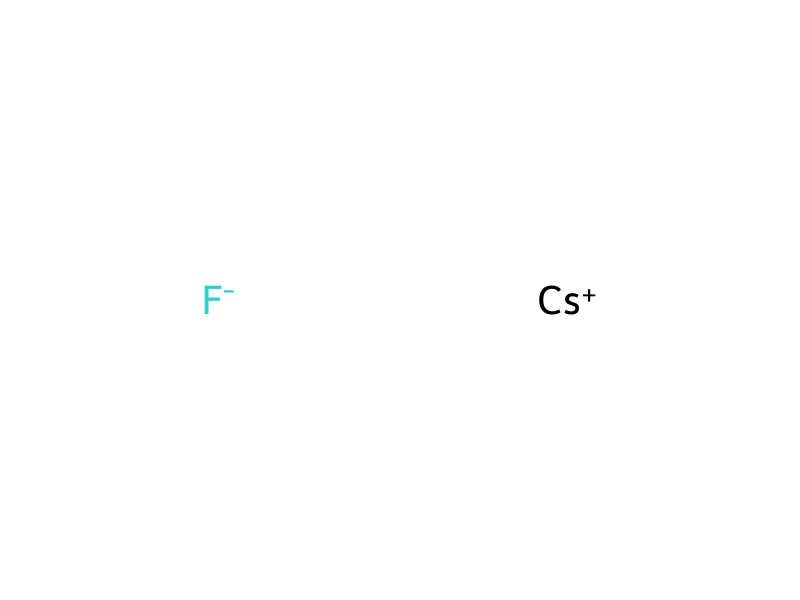
HCID 25953Cesium fluorideHCID 2734635Tri-tert-butylphosphine tetrafluoroborateHCID 11219601Methyl 2-[4-(tetramethyl-1,3,2-dioxaborolan-2-yl)phenyl]acetateHCID 712094283-bromo-1-(4-(trifluoromethoxy)phenyl)-1H-1,2,4-triazole

Product 1

HCID 90405381methyl 2-(4-(1-(4-(trifluoromethoxy)phenyl)-1H-1,2,4-triazol-3-yl)phenyl)acetate
Yield 82%

Reagents, catalysts & solvents 4

HCID 167845palladium(II) acetateCatalystHCID 962WaterSolventHCID 312751,4-DioxaneSolventHCID 57417360Sodium chloride; waterSolvent

Conditions

Temperature
60 °C

Procedure

To a 200 mL round bottomed flask equipped with a magnetic stir bar was added 3-bromo-1-(4-(trifluoromethoxy)phenyl)-1H-1,2,4-triazole (C1) (3.45 g, 11.2 mmol), and methyl 2-(4-(4,4,5,5-tetramethyl-1,3,2-dioxaborolan-2-yl)phenyl)acetate (C2) (3.71 g, 13.4 mmol). These reagents were diluted with dioxane (45.0 mL) and water (11.3 mL) and the resulting solution was sparged with nitrogen gas for 10 minutes. Tri-tert-butylphosphonium tetrafluoroborate (0.325 g, 1.12 mmol), palladium(II) acetate (0.126 g, 0.560 mmol) and cesium fluoride (3.40 g, 22.4 mmol) were added as solids. The flask was sealed and placed under nitrogen atmosphere. The reaction mixture was heated to an internal temperature of 60° C. The reaction mixture was allowed to cool to room temperature, and was poured into a brine solution and the layers were partitioned. The aqueous phase was extracted with ethyl acetate (3×100 mL). The combined organic layers were dried over anhydrous magnesium sulfate, filtered, and concentrated. The resulting residue was purified via flash column chromatography using 0-10% ethyl acetate/hexanes as eluent to afford the title compound as an off-white solid (3.45 g, 82%): 1H NMR (400 MHz, DMSO-d6) δ 9.41 (s, 1H), 8.11-8.04 (m, 4H), 7.63 (ddt, J=7.9, 2.1, 1.1 Hz, 2H), 7.48-7.36 (m, 2H), 3.77 (s, 2H), 3.64 (s, 3H); 19F NMR (376 MHz, DMSO-d6) δ −57.02; ESIMS m/z 378 ([M+H]+).

Workup

  1. customTo a 200 mL round bottomed flask equipped with a magnetic stir bar
  2. customthe resulting solution was sparged with nitrogen gas for 10 minutes
  3. customThe flask was sealed
  4. temperatureto cool to room temperature
  5. customthe layers were partitioned
  6. extractionThe aqueous phase was extracted with ethyl acetate (3×100 mL)
  7. dry with materialThe combined organic layers were dried over anhydrous magnesium sulfate
  8. filtrationfiltered
  9. concentrationconcentrated
  10. customThe resulting residue was purified via flash column chromatography

Sources & evidence

ORD record
ord-ea1ca206da074b03b42d74f1078a511a
Source dataset
uspto-grants-2016_03
DOI
10.6084/m9.figshare.5104873.v1
Patent number
US09278964B2

Reaction notes

On this pageParticipantsConditionsProcedureWorkupSources & evidenceReaction notes


