HomeMCPWorkbenchSkills
HomeWorkbenchNotificationsMe
llms.txt · MCP GuidePrivacy Policy · Terms of Service · Supportv1.8.3
  1. Home
  2. /Reaction

Water → Tyclopyrazoflor

HRID 924586
Print

Reaction equation

HRID 924586 reaction equation
[Cl:1][C:2]1[C:6]([NH:7][CH2:8][CH3:9])=[CH:5][N:4]([C:10]2[CH:11]=[N:12][CH:13]=[CH:14][CH:15]=2)[N:3]=1.N1C=CC=CC=1.[F:22][C:23]([F:33])([F:32])[CH2:24][CH2:25][S:26][CH2:27][CH2:28][C:29](Cl)=[O:30].O>C(Cl)Cl.CN(C)C1C=CN=CC=1>[Cl:1][C:2]1[C:6]([N:7]([CH2:8][CH3:9])[C:29](=[O:30])[CH2:28][CH2:27][S:26][CH2:25][CH2:24][C:23]([F:33])([F:32])[F:22])=[CH:5][N:4]([C:10]2[CH:11]=[N:12][CH:13]=[CH:14][CH:15]=2)[N:3]=1
ParticipantsProcedureWorkupSources & evidenceReaction notes

Participants

7

Reactant 4

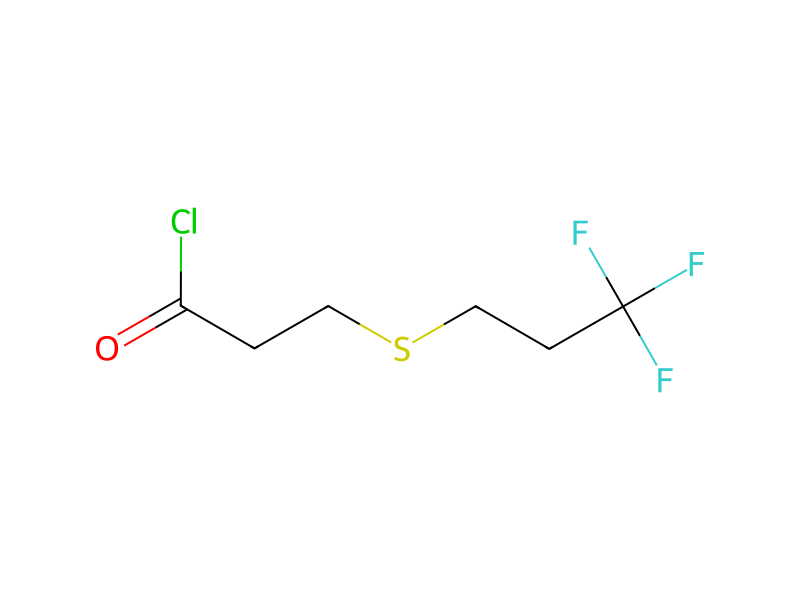
HCID 962WaterHCID 1049PyridineHCID 674989573-chloro-N-ethyl-1-(pyridin-3-yl)-1H-pyrazol-4-amineHCID 867006283-((3,3,3-Trifluoropropyl)thio)propanoyl chloride

Product 1

HCID 86700627TyclopyrazoflorYield 89%

Reagents, catalysts & solvents 2

HCID 14284
4-(Dimethylamino)pyridine
Catalyst
HCID 6344DichloromethaneSolvent

Procedure

To a solution of 3-chloro-N-ethyl-1-(pyridin-3-yl)-1H-pyrazol-4-amine (prepared as described in the U.S. Publication No. 2012/0110702 to Yap et al.) (10.0 g, 44.9 mmol) in CH2Cl2 (100 mL), at a temperature of about 0° C. and under N2, was added pyridine (5.45 mL, 67.4 mmol), 4-dimethylaminopyridine (DMAP) (2.74 g, 22.45 mmol), and 3-((3,3,3-trifluoropropyl)thio)propanoyl chloride (9.91 g, 44.9 mmol), sequentially. The reaction was warmed to room temperature and stirred for one hour. The reaction mixture was poured into water (100 mL), and the resulting mixture was stirred for five minutes. The mixture was transferred to a separatory funnel, and the layers were separated. The aqueous phase was extracted with CH2Cl2 (3×50 mL), and the combined organic extracts were dried over sodium sulfate (Na2SO4), filtered, and concentrated in vacuo. The crude product was purified via normal phase flash chromatography (0% to 100% EtOAc/CH2Cl2) to provide the desired product as a pale yellow solid (17.21 g, 89%): IR (thin film) 1659 cm−1; 1H NMR (400 MHz, CDCl3) δ 8.95 (d, J=2.6 Hz, 1H), 8.63 (dd, J=4.7, 1.3 Hz, 1H), 8.05 (ddd, J=8.3, 2.7, 1.4 Hz, 1H), 7.96 (s, 1H), 7.47 (dd, J=8.3, 4.8 Hz, 1H), 3.72 (q, J=7.1 Hz, 2H), 2.84 (t, J=7.2 Hz, 2H), 2.66 (m, 2H), 237 (t, J=7.2 Hz, 2H), 2.44 (m, 2H), 1.17 (t, J=7.2 Hz, 3H); ESIMS m/z 409 ([M+2H]+).


Workup

  1. stirringthe resulting mixture was stirred for five minutes
  2. customThe mixture was transferred to a separatory funnel
  3. customthe layers were separated
  4. extractionThe aqueous phase was extracted with CH2Cl2 (3×50 mL)
  5. dry with materialthe combined organic extracts were dried over sodium sulfate (Na2SO4)
  6. filtrationfiltered
  7. concentrationconcentrated in vacuo
  8. customThe crude product was purified via normal phase flash chromatography (0% to 100% EtOAc/CH2Cl2)

Sources & evidence

ORD record
ord-5da95622eaa34f24a6d631a6e6429aa4
Source dataset
uspto-grants-2016_03
DOI
10.6084/m9.figshare.5104873.v1
Patent number
US09282740B2

Reaction notes

On this pageParticipantsProcedureWorkupSources & evidenceReaction notes