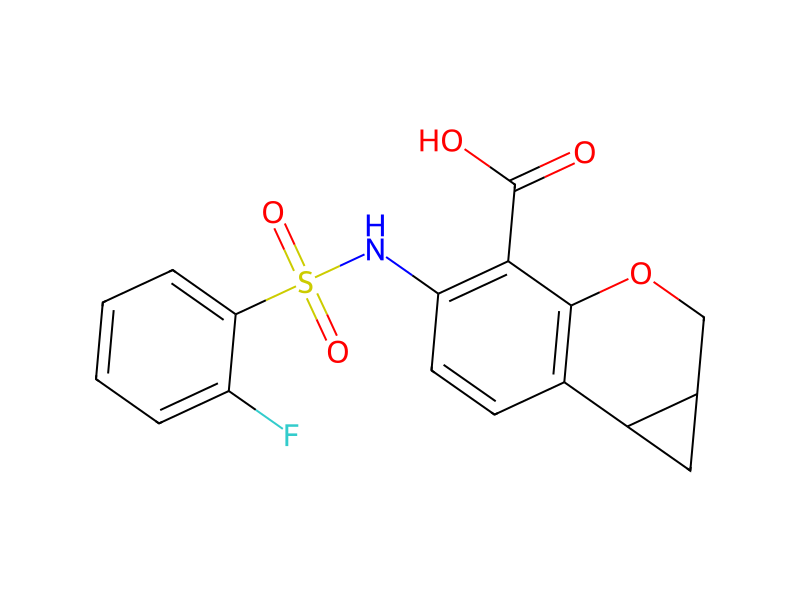
Lithium hydroxide, monohydrate → (1aRS,7bSR)-5-(2-fluorobenzenesulfonylamino)-1,1a,2,7b-tetrahydrocyclopropa[c]chromene-4-carboxylic acid
Reaction equation

[F:1][C:2]1[CH:7]=[CH:6][CH:5]=[CH:4][C:3]=1[S:8]([NH:11][C:12]1[C:21]([C:22]([O:24]C)=[O:23])=[C:20]2[C:15]([CH:16]3[CH2:26][CH:17]3[CH2:18][O:19]2)=[CH:14][CH:13]=1)(=[O:10])=[O:9].O.[OH-].[Li+]>O1CCOCC1.O>[F:1][C:2]1[CH:7]=[CH:6][CH:5]=[CH:4][C:3]=1[S:8]([NH:11][C:12]1[C:21]([C:22]([OH:24])=[O:23])=[C:20]2[C:15]([CH:16]3[CH2:26][CH:17]3[CH2:18][O:19]2)=[CH:14][CH:13]=1)(=[O:9])=[O:10]Participants
5