Reaction equation

[Br:1][C:2]1[CH:11]=[C:10]2[C:5]([C:6]([NH:13][CH2:14][CH:15]([CH3:17])[CH3:16])=[C:7]([NH2:12])[CH:8]=[N:9]2)=[CH:4][CH:3]=1.[CH2:18]([O:20][CH2:21][C:22](Cl)=O)[CH3:19]>N1C=CC=CC=1>[Br:1][C:2]1[CH:3]=[CH:4][C:5]2[C:6]3[N:13]([CH2:14][CH:15]([CH3:17])[CH3:16])[C:19]([CH2:18][O:20][CH2:21][CH3:22])=[N:12][C:7]=3[CH:8]=[N:9][C:10]=2[CH:11]=1Participants
4
Reactant 2

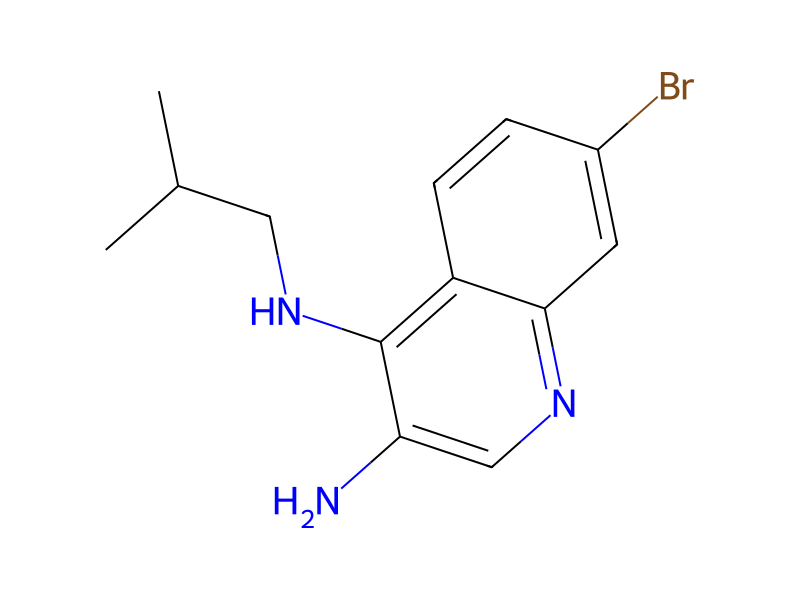
Product 1

Reagents, catalysts & solvents 1

Procedure
A solution of 7-bromo—N4-isobutylquinoline-3,4-diamine (85 g, prepared according to Part F of Example 1) in anhydrous pyridine (413 mL) was immersed in an ice bath, and ethoxyacetyl chloride (36.9 g, 300 mmol) was added. The reaction was allowed to warm to room temperature and was then heated in an oil bath held at 85° C. for 3.5 h. The reaction mixture was concentrated under vacuum, and the residue was taken up in diethyl ether and washed with 2M Na2CO3 (2×) followed by H2O (1×). The organic layer was dried (MgSO4), filtered, and concentrated. Recrystallization of the resulting solid from boiling 15% ethyl acetate in hexanes afforded 43.0 g of 7-bromo-2-ethoxymethyl-1-isobutyl-1H-imidazo[4,5-c]quinoline as brown crystals.
Workup
- temperaturewas then heated in an oil bath
- concentrationThe reaction mixture was concentrated under vacuum
- washwashed with 2M Na2CO3 (2×)
- dry with materialThe organic layer was dried (MgSO4)
- filtrationfiltered
- concentrationconcentrated
- customRecrystallization of the resulting solid
Sources & evidence
- ORD record
- ord-dbeb3e2c5d2e43e88e3b4fdfc8b56049
- Source dataset
- uspto-grants-2006_08
- Patent number
- US07091214B2
Linked notes
Loading…