Reaction equation

[Br:1][C:2]1[CH:11]=[C:10]2[C:5]([C:6]([NH:15][CH2:16][CH:17]([CH3:19])[CH3:18])=[C:7]([N+:12]([O-])=O)[CH:8]=[N:9]2)=[CH:4][CH:3]=1>C1(C)C=CC=CC=1.[Pt]>[Br:1][C:2]1[CH:11]=[C:10]2[C:5]([C:6]([NH:15][CH2:16][CH:17]([CH3:19])[CH3:18])=[C:7]([NH2:12])[CH:8]=[N:9]2)=[CH:4][CH:3]=1Participants
4
Reactant 1

Product 1
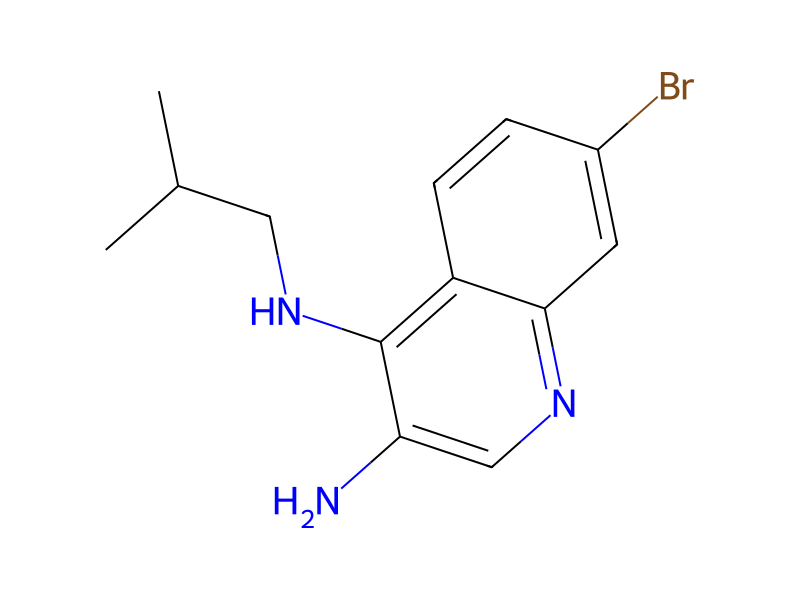
Reagents, catalysts & solvents 2


Procedure
(7-Bromo-3-nitroquinolin-4-yl)-(2-methylpropyl)amine (117 g) was dissolved in hot toluene (2 L) and poured into stainless steel Parr vessel. Additional toluene (2 L) and 5% platinum on carbon (12.5 g) were added. The vessel was evacuated, charged with hydrogen (54 psi, 3.7×10⁵ Pa), and shaken overnight at room temperature. The reaction mixture evacuated, filtered through a layer of CELITE filter aid, and concentrated under reduced pressure to provide 7-bromo-N4-(2-methylpropyl)quinoline-3,4-diamine, which was used without purification.
Workup
- customThe vessel was evacuated
- additioncharged with hydrogen (54 psi, 3.7×10⁵ Pa)
- customThe reaction mixture evacuated
- filtrationfiltered through a layer of CELITE
- filtrationfilter aid
- concentrationconcentrated under reduced pressure
Sources & evidence
- ORD record
- ord-796b06cb40f64989bb91238e51ff606a
- Source dataset
- uspto-grants-2006_08
- Patent number
- US07091214B2
Linked notes
Loading…