Reaction equation
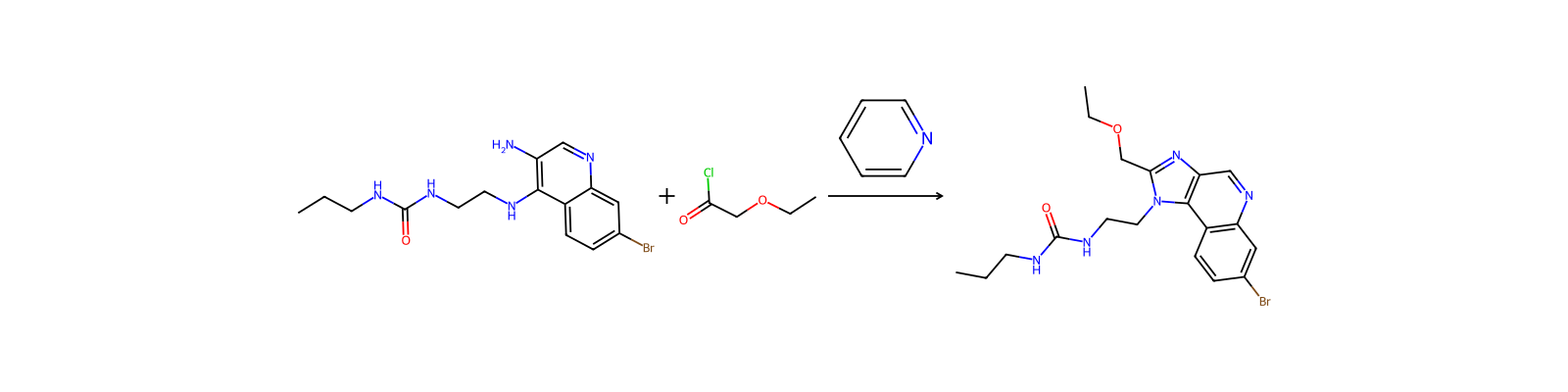
[NH2:1][C:2]1[CH:3]=[N:4][C:5]2[C:10]([C:11]=1[NH:12][CH2:13][CH2:14][NH:15][C:16]([NH:18][CH2:19][CH2:20][CH3:21])=[O:17])=[CH:9][CH:8]=[C:7]([Br:22])[CH:6]=2.[CH2:23]([O:25][CH2:26][C:27](Cl)=O)[CH3:24]>N1C=CC=CC=1>[Br:22][C:7]1[CH:8]=[CH:9][C:10]2[C:11]3[N:12]([CH2:13][CH2:14][NH:15][C:16]([NH:18][CH2:19][CH2:20][CH3:21])=[O:17])[C:24]([CH2:23][O:25][CH2:26][CH3:27])=[N:1][C:2]=3[CH:3]=[N:4][C:5]=2[CH:6]=1Participants
4



Conditions
- Temperature
- 80 °C
Procedure
To a stirred solution of 1-[2-(3-amino-7-bromoquinolin-4-ylamino)ethyl]-3-(2-methylethyl)urea (27.2 g, 0.0743 mol) in 600 mL pyridine was slowly added ethoxyacetyl chloride (1.1 equivalents). After 1.5 hours the mixture was yellow and turbid. The reaction mixture was then heated at 80° C. for 12 hours and then concentrated under reduced pressure. The residue was dissolved in water and saturated aqueous potassium carbonate and stirred vigorously for three hours. A precipitate was present, was isolated by filtration, and air-dried for 48 hours to provide 32 g of 1-[2-(7-bromo-2-ethoxymethyl-1H-imidazo[4,5-c]quinolin-1-yl)ethyl]-3-(2-methylethyl)urea.
Workup
- concentrationconcentrated under reduced pressure
- dissolutionThe residue was dissolved in water
- customwas isolated by filtration
- customair-dried for 48 hours
Sources & evidence
- ORD record
- ord-9312b9100a3448fd880c4a1e4f95c690
- Source dataset
- uspto-grants-2006_08
- Patent number
- US07091214B2
Linked notes
Loading…