Phenyl isocyanate → HCID 69458742, compound
Reaction equation
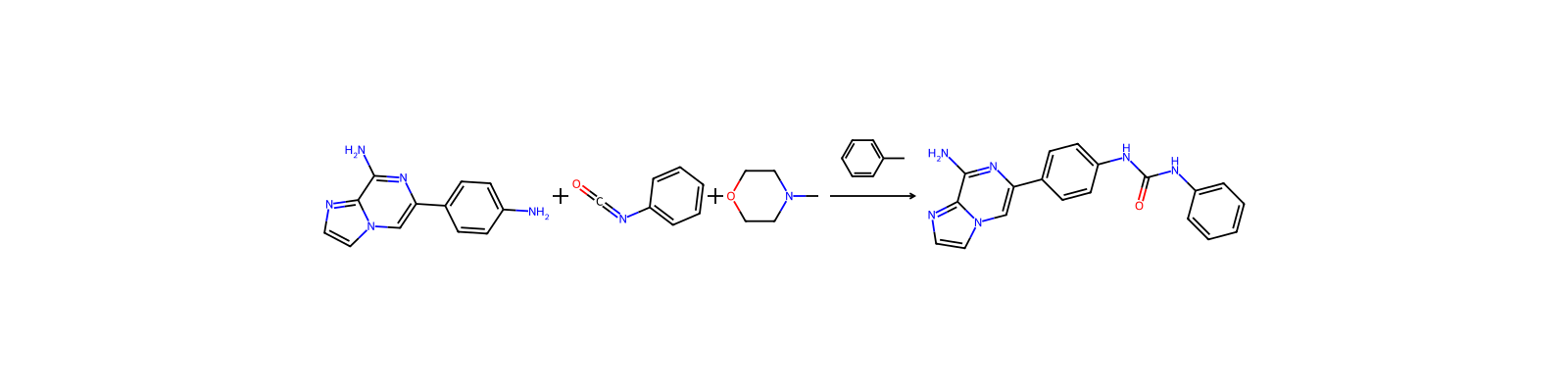
[NH2:1][C:2]1[CH:7]=[CH:6][C:5]([C:8]2[N:9]=[C:10]([NH2:17])[C:11]3[N:12]([CH:14]=[CH:15][N:16]=3)[CH:13]=2)=[CH:4][CH:3]=1.[C:18]1([N:24]=[C:25]=[O:26])[CH:23]=[CH:22][CH:21]=[CH:20][CH:19]=1.CN1CCOCC1>C1(C)C=CC=CC=1>[NH2:17][C:10]1[C:11]2[N:12]([CH:14]=[CH:15][N:16]=2)[CH:13]=[C:8]([C:5]2[CH:4]=[CH:3][C:2]([NH:1][C:25]([NH:24][C:18]3[CH:23]=[CH:22][CH:21]=[CH:20][CH:19]=3)=[O:26])=[CH:7][CH:6]=2)[N:9]=1Participants
5
Reactant 3



Product 1

Reagents, catalysts & solvents 1

Procedure
(FIG. 1) Procedure: A mixture of 1.00 eq. of 6-(4-Amino-phenyl)-imidazo[1,2-a]pyrazin-8-ylamine, 1.50 eq. of phenylisocyanate, and 2.00 eq. of N-methylmorpholine, in toluene is mixed at room temperature for 2 hr. The mixture is partitioned between 1 N NaOH and ethyl acetate and extracted three times. The organic extracts are combined and dried over MgSO4. The solvent is removed under reduced pressure and the resulting residue is purified by flash chromatography (50% ethyl acetate/hexanes) to yield 8.