Reaction equation

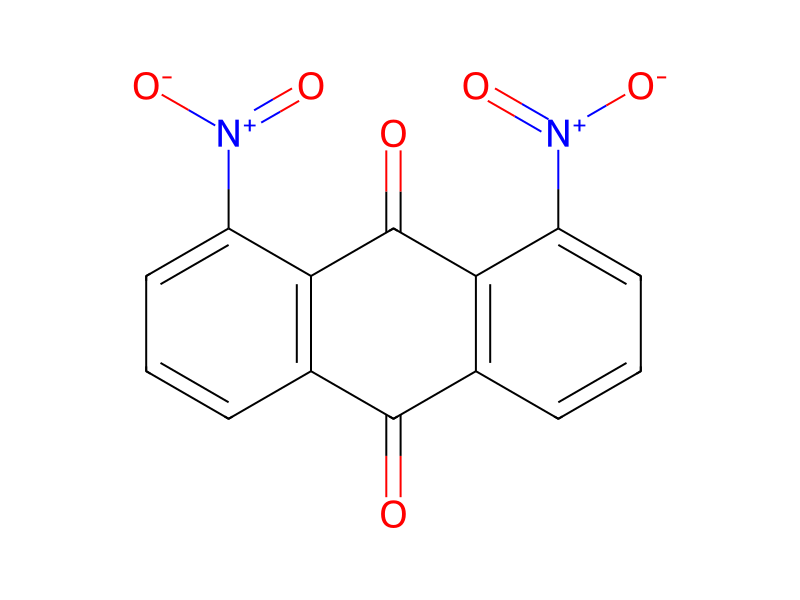
[N+:1]([C:4]1[C:17]2[C:16](=[O:18])[C:15]3[C:10](=[CH:11][CH:12]=[CH:13][CH:14]=3)[C:9](=[O:19])[C:8]=2[CH:7]=[CH:6][CH:5]=1)([O-])=O.[N+](C1C2C(=O)C3C(=C([N+]([O-])=O)C=CC=3)C(=O)C=2C=CC=1)([O-])=O.[N+](C1C2C(=O)C3C(=CC=CC=3[N+]([O-])=O)C(=O)C=2C=CC=1)([O-])=O.[OH-].[Na+].[H][H].C1(C=CC(O)=CC=1)O>[C].[Pd]>[NH2:1][C:4]1[C:17]2[C:16](=[O:18])[C:15]3[C:10](=[CH:11][CH:12]=[CH:13][CH:14]=3)[C:9](=[O:19])[C:8]=2[CH:7]=[CH:6][CH:5]=1Participants
Reactant 6





Product 1

Reagents, catalysts & solvents 1

Conditions
- Temperature
- 30 °C
Procedure
A 500 ml. electromagnetically stirred flask was charged with 5.0 g of crude 1-nitroanthraquinone having a purity of 97% and containing 2% of 1,5-dinitroanthraquinone and 1% of 1,8-dinitroanthraquinone as impurities (0.0l92 mole of 1-nitroanthraquinone, and 0.005 mole of all the dinitroanthraquinones), 100 g (0.1 mole) of a 4% aqueous solution of sodium hydroxide and 0.1 g of 5% palladium-carbon. The inside of the flask was purged with hydrogen, and at a reaction temperature of 30° C., they were stirred. In 3 hours, the reaction was stopped with the absorption of 0.08 mole of hydrogen. The amount of hydrogen absorbed was slightly in excess of the sum of the amount of hydrogen required to convert the nitro group to an amino group (0.0606 mole) and the amount of hydrogen required to convert 1-aminoanthraquinone to its hydroquinone derivative (0.0192 mole). The inside of the flask was purged with nitrogen, and the reaction mixture was filtered in an atmosphere of nitrogen to separate the catalyst. The filtrate was oxidized with air at 20° to 30° C. for 2 hours with stirring to afford 4.2 g of 1-aminoanthraquinone in a yield of 97.4% of theory. The product had a purity of 99% as determined by infrared absorption spectroscopy.
Workup
- customThe inside of the flask was purged with hydrogen
- customThe amount of hydrogen absorbed
- customThe inside of the flask was purged with nitrogen
- filtrationthe reaction mixture was filtered in an atmosphere of nitrogen
- customto separate the catalyst
- waitThe filtrate was oxidized with air at 20° to 30° C. for 2 hours
- stirringwith stirring
Sources & evidence
- ORD record
- ord-9bc872d6daec4f4a807b833faff29f5d
- Source dataset
- uspto-grants-1977_10
- Patent number
- US04054586
Linked notes
Loading…