HomeMCPSkillsWorkbenchOpenChem
HomeWorkbenchNotificationsMe
llms.txt · skill.md · MCP GuidePrivacy Policy · Terms of Service · Supportv1.8.5
  1. Home
  2. /Reaction

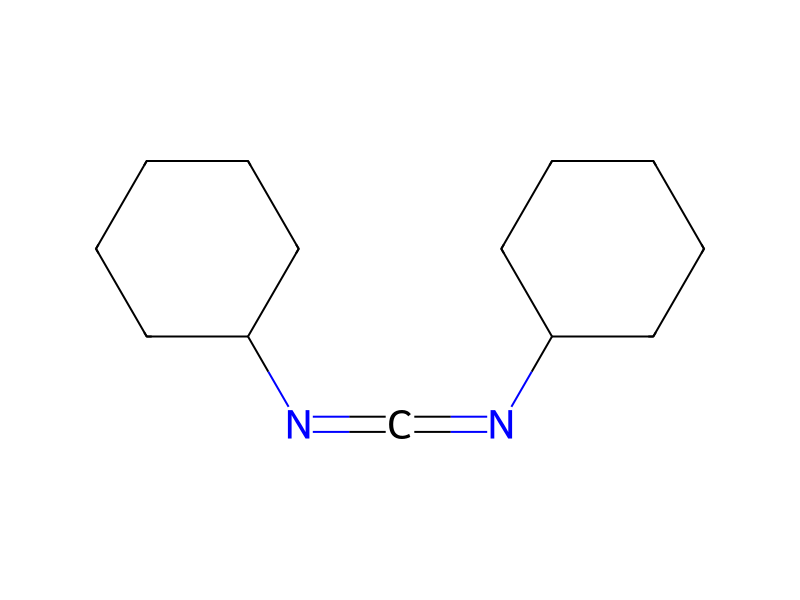
Dicyclohexylcarbodiimide → 2,4-Dimethyl-4-isopropyl-2-oxazolin-5-one

HRID 981436
Print

Reaction equation

[C:1]([NH:4][C:5]([CH3:12])([CH:9]([CH3:11])[CH3:10])[C:6]([OH:8])=[O:7])(=O)[CH3:2].C1(N=C=NC2CCCCC2)CCCCC1>C1COCC1>[CH3:2][C:1]1[O:7][C:6](=[O:8])[C:5]([CH3:12])([CH:9]([CH3:11])[CH3:10])[N:4]=1
ParticipantsConditionsProcedureWorkupSources & evidenceReaction notes

Participants

4

Reactant 2

HCID 10868DicyclohexylcarbodiimideHCID 2338052-Acetamido-2,3-dimethylbutanoic acid

Product 1

HCID 146957652,4-Dimethyl-4-isopropyl-2-oxazolin-5-one

Reagents, catalysts & solvents 1

HCID 8028TetrahydrofuranSolvent

Conditions

Temperature
25 °C

Procedure

2-Acetamido-2,3-dimethylbutyric acid (16 g) is dissolved in THF (200 mL) and dicyclohexylcarbodiimide (DCC, 21.0 g) is added. The mixture is allowed to stir for 16 hours at 25° C. At the end of this time the mixture is filtered and evaporated to dryness. The residue is dissolved in CH2Cl2 (10 mL) and filtered again. Evaporation of the filtrate gives the crude product which is purified by distillation at 0.65 mmHg, having bp 50° C.

Workup

  1. filtrationAt the end of this time the mixture is filtered
  2. customevaporated to dryness
  3. dissolutionThe residue is dissolved in CH2Cl2 (10 mL)
  4. filtrationfiltered again
  5. customEvaporation of the filtrate

Sources & evidence

ORD record
ord-9b49f7beb86d42ccb7cc40b50b316e68
Source dataset
uspto-grants-1991_02
DOI
10.6084/m9.figshare.5104873.v1
Patent number
US04992094

Reaction notes

On this pageParticipantsConditionsProcedureWorkupSources & evidenceReaction notes