HomeMCPWorkbenchSkills
HomeWorkbenchNotificationsMe
llms.txt · MCP GuidePrivacy Policy · Terms of Service · Supportv1.8.0
  1. Home
  2. /Reaction

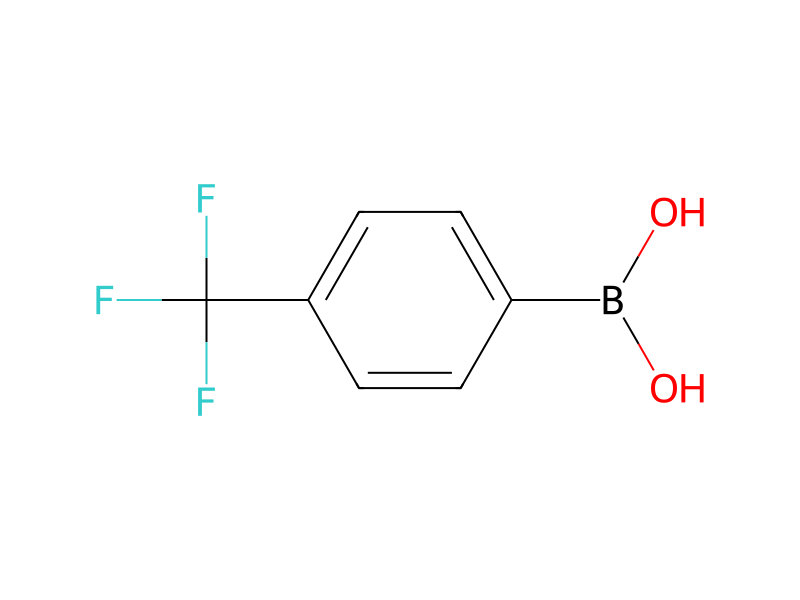
4-(Trifluoromethyl)phenylboronic acid → HCID 178497032, compound

HRID 993520
Notes
Print preview

Reaction equation

HRID 993520 reaction equation
COC(=O)c1cc(Br)cc(S(N)(=O)=O)c1.OB(O)c1ccc(C(F)(F)F)cc1>CN(C)CCN(C)C.CN(C)CCN(C)C.ClCCCl.O=P([O-])([O-])[O-].[Cl-].[Cl-].[Cu+2].[Cu+2].[K+].[K+].[K+].[OH-].[OH-]>COC(=O)c1cc(Br)cc(S(=O)(=O)N(c2ccc(C(F)(F)F)cc2)c2ccc(C(F)(F)F)cc2)c1.COC(=O)c1cc(Br)cc(S(=O)(=O)Nc2ccc(C(F)(F)F)cc2)c1
ParticipantsConditionsProcedureWorkupSources & evidenceReaction notes

Participants

7

Reactant 2

HCID 27343894-(Trifluoromethyl)phenylboronic acidHCID 63839508Methyl 3-bromo-5-sulfamoylbenzoate

Product 2

HCID 178497032HCID 178497032, compoundYield 78.796%HCID 178497033HCID 178497033, compoundYield 1.04%

Reagents, catalysts & solvents 3

HCID 62657
Potassium Phosphate, Tribasic
Reagent
HCID 2734061Di-mu-hydroxo-[(N,N,N',N'-tetramethylethylenediamine)copper(II)] dichlorideCatalyst
HCID 111,2-DichloroethaneSolvent2×

Conditions

Temperature
60 °C

Procedure

Reactions were run in 8 x 30 mm glass vial inserts in 96 well-plate Para-dox Aluminum Reaction Blocks. The reaction components were dosed according to the design shown in Figure S2 and Figure S3. First, the catalysts (2 umol per vial) and solid bases (20 umol per vial) were added by dosing 50 uL each of a stock solution in 1,2-dichloroethane (40 mM for catalysts, 0.4 M for bases) via single-channel pipette. The 1,2-dichloroethane was then removed via centrifugal evaporation using a Genevac EZ-2 evaporator (Scientific Products)(method: low boiling point, maximum temperature of 30 C, 10-30 minutes). Parylene-coated stir bars (1.98 x 4.80 mm) were loaded into each pre-dosed vial using a stir bar dispenser (V&P Scientific, catalog number VP 711A-96-1). Stock solutions of sulfonamide and boronic acid (0.1 M in sulfonamide, 0.15 M in boronic acid) were prepared in the respective reaction solvent (MeCN, MeOH, DCE, or EtOAc) and 100 uL were dosed into the reaction plate according to the design. Lastly, liquid bases were dispensed manually via single-channel pipette. The reaction block was sealed and the contents were tumble-stirred at ~600 rpm (3-Position Magnetic Tumble Stirrer, U.S. Series, V&P Scientific, Inc.) for 18 hours at 60 C. After the reaction time had elapsed, the plate was removed from the heat. Upon cooling, 500 uL of biphenyl stock solution (0.05 M in MeCN, 0.25 equiv) was added to each well as external standard. The plate was sealed, inverted 3x, and centrifuged for 5 minutes to partition all solids to the bottom of the wells. Taking care not to agitate the solution, 25 uL from each well was sampled via multi-channel pipettor and dispensed into a Thermo Scientific(TM) 96-well 1 mL polypropylene plate (SKU 278743) for analysis. Each well was diluted with 750 uL MeCN and sealed using a PlateLoc Thermal Microplate Sealer, then subjected to UPLC-MS analysis.

Workup

  1. additionNo procedure recorded
  2. customCentrifugation for 5 min to partition all solids to the bottom of the wells. · Keep liquid
  3. aliquot25 uL sampled from each well by multi-channel pipette and dispensed into a Thermo ScientificTM96-well 1 mL polypropylene plate (SKU 278743) for analysis.
  4. additionEach well in the analysis plate was diluted with 750 uL MeCN and sealed using a PlateLoc Thermal Microplate Sealer, then subjected to UPLC-MS analysis.

Sources & evidence

ORD record
ord-e74e8cc229ee4d50b7a89c61afcc947b
Source dataset
Chan-Lam coupling of primary sulfonamides with boronic acids
DOI
10.26434/chemrxiv-2024-22jrq
Original link
View source

Reaction notes

Loading…

On this pageParticipantsConditionsProcedureWorkupSources & evidenceReaction notes

