
HRID 5048反応物として
3-Nitrophenol
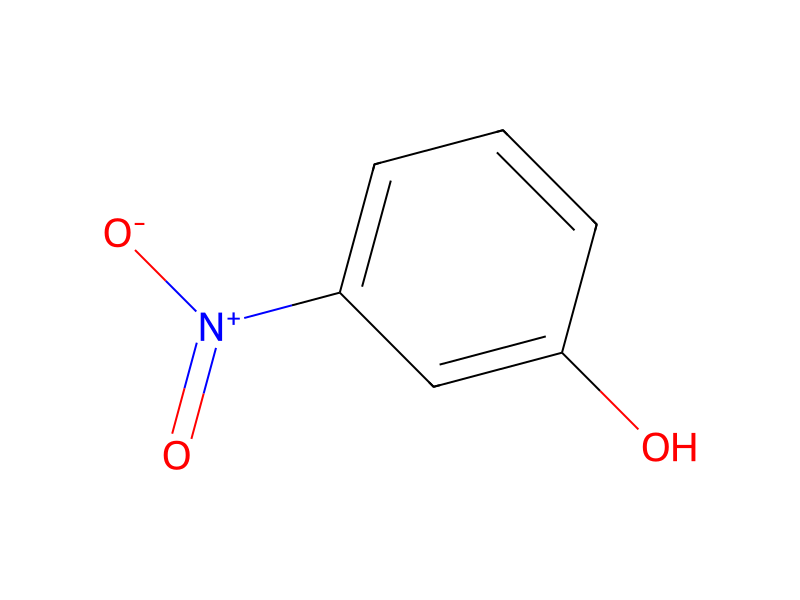
554-84-7O=[N+]([O-])c1cccc(O)c1RTZZCYNQPHTPPL-UHFFFAOYSA-NM-nitrophenol is a colorless to pale yellow crystalline solid. Sinks in and mixes with water. (USCG, 1999)
554-84-7DTXSID2025765CHEMBL13888CHEBI:34346log Kow = 2.00
1.88
1.485 at 68 °F 1.2797 at 100 °C (Liquid) (USCG, 1999) - Denser than water; will sink
1.485 at 20 °C/4 °C; 1.2797 at 100 °C/4 °C
1.485 @ 20°C
Monoclinic prisms from ether and dilute hydrochloric acid
Colorless to yellow crystals
less than 1 mg/mL at 64 °F (NTP, 1992)
Soluble in hot and dilute acids, in caustic solutions; insoluble in petroleum ether
169.35 g/100 g in acetone at 0.2 °C; 1305.9 g/100 g in acetone at 84 °C; 116.9 g/100 g in alcohol at 1 °C; 1105.25 g/100 g in alcohol at 85 °C; 105.9 g/100 g in ether at 0.2 °C; 1065.8 g/100 g in acetone at 83 °C
Very soluble in ethanol, ether, and acetone
In water, 133,000 mg/L at 90 °C
In water, 13,550 mg/L at 25 °C
381 °F at 70 mmHg (NTP, 1992)
BP: 194 °C at 70 mm Hg
安全情報は参考情報です。供給元の安全データシート(SDS)、適用法令、専門家による評価に代わるものではありません。
Danger
H302 (100%): Harmful if swallowed [Warning Acute toxicity, oral]
P260, P264, P264+P265, P270, P280, P301+P317, P302+P352, P305+P354+P338, P317, P319, P321, P330, P332+P317, P362+P364, and P501 (click each P-code to see the statement)
Aggregated GHS information provided per 56 reports by companies from 9 notifications to the ECHA C&L Inventory. Each notification may be associated with multiple companies.
Warning
H302: Harmful if swallowed [Warning Acute toxicity, oral]
Chemical: Phenol, 3-nitro-
3-Nitrophenol: Does not have an individual approval but may be used under an appropriate group standard
The New Jersey Worker and Community Right to Know Act requires public and private employers to provide information about hazardous substances at their workplaces. (N.J.S.A. 34:5A-1 et. seq.)
INHALATION: Inhalation or ingestion causes headaches, drowsiness, nausea, and blue color in lips, ears, and finger nails (cyanosis). EYES: Contact with eyes causes irritation. SKIN: Can be absorbed through intact skin to give same symptoms as for inhalation. (USCG, 1999)
Yields m-aminophenol, 4-nitrocatechol, m-nitrophenyl-beta-d-glucuronide, m-nitrophenyl sulfate, & nitroquinol in rabbit.
M-nitrophenyl-beta-d-glucoside in fly. Yields m-nitroanisole in guinea pig. /From table/
The metabolism of nitrobenzene in male Fischer-344 rats, CD rats, and B6C3F1 mice was examined. m-Nitrophenol was one of the metabolites which was excreted as the sulfate ester by Fischer-344 rats and sulfate ester and glucuronide by CD rats. B6C3F1 mice excreted the same metabolites (except the glucuronide of m-nitrophenol) in the urine as did CD rats and also excreted p-aminophenol sulfate. In all 3 animal strains, urinary excretion of nitrobenzene metabolites peaked 12-24 hr after oral admin of nitrobenzene.
In vivo studies with nitrophenols ... meta-& para-nitrophenol are reduced more readily than the ortho isomer ...
For more Metabolism/Metabolites (Complete) data for 3-NITROPHENOL (10 total), please visit the HSDB record page.
The retention of radiolabeled 3-nitrophenol by various tissues of frog and crayfish following admin of 5 mg/kg via the lymph sac in frog and 3 mg/kg via pericardial injection in crayfish gradually decr in each organ except the gall bladder of the frog and the gut contents. In frogs, biliary excretion was minor compared with renal elimination, whereas in crayfish the gills represented the major route of excretion.
The permeation of nitrophenols through epidermal cells from newborn rat skin cultured on type IV collagen-coated Millipore filters was studied under various conditions. The order of permeation through the cultured skin cells was found to be p-> m- > o-nitrophenol at both 10 and approx 37 °C. This order was the same as that of their affinities to isolated skin cells. The permeation of nitrophenols was not inhibited by the inhibitors of energy transduction 2-deoxyglucose and NaN3. These results suggest that the permeation of nitrophenols across a cultured cell layer occurs by simple diffusion. The order of permeation of nitrophenols across newborn abdominal epidermis was exactly the opposite of that of their permeation across a cultured cell layer.


When heated to decomposition it emits toxic fumes of /nitrogen oxides/
Decomposes when distilled at ordinary pressure.
205 to 208 °F (NTP, 1992)
96.8 °C
97 °C
Odor threshold = 3.0 mg/m3 (in air)
3.0 mg/cu m in air
Detection in water: 0.6 mg/L
70 mmHg at 381 °F (NTP, 1992)
0.1 [mmHg]
1.5X10⁻⁴ mm Hg at 25 °C /extrapolated from 0.09 mm Hg at 84 °C, 0.26 mm Hg at 96.1 °C/
0.1 [mm Hg] @25 °C
化学的特性yellow to brown crystalline powder
A mutagen and severe eye irritant; Causes weakness and coma in subcutaneous, lethal-dose studies of rats; [RTECS] Emergency treatment: Phenol and related agents; A skin irritant; A severe eye irritant; [HSDB] An irritant; May cause serious injury to eyes; [MSDSonline] See 4-Nitrophenol.
The major hazards encountered in the use and handling of 3-nitrophenol stem from its toxicologic properties. Toxic by all routes (ie, inhalation, ingestion, dermal absorption), exposure to this sweet-smelling, colorless to yellow, crystalline substance, may occur from its use as a fungicide for leather products or as a chemical intermediate in organic sytheses. Effects from exposure may include burns to the skin and eyes, headache, dizziness, shock, unconsciousness, and death from cardiac or pulmonary failure. Contact with 3-nitrophenol should be protected against by wearing a self-contained breathing apparatus, rubber gloves, goggles, and chemical protective clothing which is specifically recommended by the shipper or producer. If contact does occur, immediately flush affected skin or eyes with running water for at least 15 minutes, and remove and isolate contaminated clothing at the site. While 3-nitrophenol does not ignite easily, it can burn, emitting toxic oxides of nitrogen. Also, containers may explode in the heat of a fire. For small fires involving 3-nitrophenol, extinguish with dry chemical, CO2, Halon, water spray, or standard foam, and for large fires, use water spray, fog, or standard foam. Runoff from fire control water may give off poisonous gases or cause pollution, and should be controlled by diking, as necessary. 3-Nitrophenol should be stored away from oxidizing agents, in a cool, well-ventilated, fireproofed area. Small spills of 3-nitrophenol may be taken up (if liquid, with sand or other noncombustible absorbent) and placed into containers for later disposal. Large spills should be contained in pits, or other holding areas that are sealed with an impermeable flexible membrane liner. Solids should be covered with a plastic sheet. Liquids should be neutralized with slaked lime, crushed limestone, or sodium bicarbonate, and diked, if necessary, to prevent runoff from entering water sources or sewers. Spills of 3-nitrophenol in water may need to be trapped at the bottom with sand bag barriers, activated charcoal applied, and the trapped material removed with suction hoses, mechanical dredges, or lifts. Prior to implementing permanent land disposal of waste residue (including waste sludge), consult with environmental regulatory agencies for guidance.
USEPA; Ambient Water Quality Criteria Doc: Nitrophenol (1980) EPA 440/5-80-063
DEAN BJ; MUTAT RES 47: 75-97 (1978). A REVIEW WITH 90 REFERENCES ON THE MUTAGENICITY, BIOTRANSFORMATIONS, & TOXICITY OF BENZENE, TOLUENE, XYLENE, & PHENOLS INCLUDING O-NITROPHENOL.
USEPA; Ambient Water Quality Criteria Doc: Nitrophenols (1987) EPA 600/8-88/050
M-NITROPHENOL is a light-yellow, crystalline material, toxic and irritant. When heated to decomposition it emits toxic fumes of oxides of nitrogen [Lewis, 3rd ed., 1993, p. 941]. Phenols do not behave as organic alcohols, as one might guess from the presence of a hydroxyl (-OH) group in their structure. Instead, they react as weak organic acids. Phenols and cresols are much weaker as acids than common carboxylic acids (phenol has pKa = 9.88). These materials are incompatible with strong reducing substances such as hydrides, nitrides, alkali metals, and sulfides. Flammable gas (H2) is often generated, and the heat of the reaction may ignite the gas. Heat is also generated by the acid-base reaction between phenols and bases.
/GUIDE 153: SUBSTANCES - TOXIC AND/OR CORROSIVE (COMBUSTIBLE)/ Health: TOXIC; inhalation, ingestion, or skin contact with material may cause severe injury or death. Contact with molten substance may cause severe burns to skin and eyes. Avoid any skin contact. Effects of contact or inhalation may be delayed. Fire may produce irritating, corrosive and/or toxic gases. Runoff from fire control or dilution water may be corrosive and/or toxic and cause pollution. /Nitrophenols/
/GUIDE 153: SUBSTANCES - TOXIC AND/OR CORROSIVE (COMBUSTIBLE)/ Fire or Explosion: Combustible material: may burn but does not ignite readily. When heated, vapors may form explosive mixtures with air: indoors, outdoors, and sewers explosion hazards. Those substances designated with a "P" may polymerize explosively when heated or involved in a fire. Contact with metals may evolve flammable hydrogen gas. Containers may explode when heated. Runoff may pollute waterways. Substance may be transported in a molten form. /Nitrophenols/
/GUIDE 153: SUBSTANCES - TOXIC AND/OR CORROSIVE (COMBUSTIBLE)/ Public Safety: CALL Emergency Response Telephone Number ... As an immediate precautionary measure, isolate spill or leak area in all directions for at least 50 meters (150 feet) for liquids and at least 25 meters (75 feet) for solids. Keep unauthorized personnel away. Stay upwind. Keep out of low areas. Ventilate enclosed areas. /Nitrophenols/
/GUIDE 153: SUBSTANCES - TOXIC AND/OR CORROSIVE (COMBUSTIBLE)/ Protective Clothing: Wear positive pressure self-contained breathing apparatus (SCBA). Wear chemical protective clothing that is specifically recommended by the manufacturer. It may provide little or no thermal protection. Structural firefighters' protective clothing provides limited protection in fire situations ONLY; it is not effective in spill situations where direct contact with the substance is possible. /Nitrophenols/
For more DOT Emergency Guidelines (Complete) data for 3-NITROPHENOL (8 total), please visit the HSDB record page.
EYES: First check the victim for contact lenses and remove if present. Flush victim's eyes with water or normal saline solution for 20 to 30 minutes while simultaneously calling a hospital or poison control center. Do not put any ointments, oils, or medication in the victim's eyes without specific instructions from a physician. IMMEDIATELY transport the victim after flushing eyes to a hospital even if no symptoms (such as redness or irritation) develop.
If material on fire or involved in fire: Extinguish fire using agent suitable for type of surrounding fire. (Material itself does not burn or burns with difficulty.) Use water in flooding quantities as fog. Use foam, dry chemical, or carbon dioxide. Keep run-off water out of sewers and water sources. /Nitrophenols/
SMALL SPILLS AND LEAKAGE: Should a spill occur while you are handling this chemical, FIRST REMOVE ALL SOURCES OF IGNITION, then you should dampen the solid spill material with 60-70% ethanol and transfer the dampened material to a suitable container. Use absorbent paper dampened with 60-70% ethanol to pick up any remaining material. Seal the absorbent paper, and any of your clothes, which may be contaminated, in a vapor-tight plastic bag for eventual disposal. Solvent wash all contaminated surfaces with 60-70% ethanol followed by washing with a soap and water solution. Do not reenter the contaminated area until the Safety Officer (or other responsible person) has verified that the area has been properly cleaned.
SRP: The most favorable course of action is to use an alternative chemical product with less inherent propensity for occupational harm/injury/toxicity or environmental contamination. Recycle any unused portion of the material for its approved use or return it to the manufacturer or supplier. Ultimate disposal of the chemical must consider: the material's impact on air quality; potential migration in soil or water; effects on animal and plant life; and conformance with environmental and public health regulations.
SRP: Wastewater from contaminant suppression, cleaning of protective clothing/equipment, or contaminated sites should be contained and evaluated for subject chemical or decomposition product concentrations. Concentrations shall be lower than applicable environmental discharge or disposal criteria. Alternatively, pretreatment and/or discharge to a permitted wastewater treatment facility is acceptable only after review by the governing authority and assurance that "pass through" violations will not occur. Due consideration shall be given to remediation worker exposure (inhalation, dermal and ingestion) as well as fate during treatment, transfer and disposal. If it is not practicable to manage the chemical in this fashion, it must be evaluated in accordance with EPA 40 CFR Part 261, specifically Subpart B, in order to determine the appropriate local, state and federal requirements for disposal.
SRP: At the time of review, criteria for land treatment or burial (sanitary landfill) disposal practices are subject to significant revision. Prior to implementing land disposal of waste residue (including waste sludge), consult with environmental regulatory agencies for guidance on acceptable disposal practices.
The effectiveness of various wastewater treatment processes (ie, use of activated sludge, powdered activated carbon added to activated sludge, a granular activated carbon column, and a resin column) in removing the major pollutants from wastewater from the pharmaceutical industry was studied on a field pilot plant scale. The addition of powdered activated carbon to activated sludge produced a better effluent than the extended aeration of activated sludge. However, the powdered activated carbon pilot plant did not always produce a better effluent than the granular activated carbon plant. In general, the granular activated carbon pilot plant produced a better effluent than the resin column.
For more Disposal Methods (Complete) data for 3-NITROPHENOL (7 total), please visit the HSDB record page.
... Clean work clothes should be supplied daily; showers should be taken prior to changing to street clothes. ... Appropriate type respirators with organic vapor canisters should be provided in areas of concn of dust or vapors. /Nitrophenols/
Separate from combustible, organic, or other readily oxidizable materials.
SRP: Contaminated protective clothing should be segregated in such a manner so that there is no direct personal contact by personnel who handle, dispose, or clean the clothing. The completeness of the cleaning procedures should be considered before the decontaminated protective clothing is returned for reuse by the workers. Contaminated clothing should not be taken home at the end of shift, but should remain at employee's place of work for cleaning.
SRP: The scientific literature for the use of contact lenses in industry is conflicting. The benefit or detrimental effects of wearing contact lenses depend not only upon the substance, but also on factors including the form of the substance, characteristics and duration of the exposure, the uses of other eye protection equipment, and the hygiene of the lenses. However, there may be individual substances whose irritating or corrosive properties are such that the wearing of contact lenses would be harmful to the eye. In those specific cases, contact lenses should not be worn. In any event, the usual eye protection equipment should be worn even when contact lenses are in place.
For more Preventive Measures (Complete) data for 3-NITROPHENOL (6 total), please visit the HSDB record page.
1.0 [mg/m3]
11 [mg/m3]
69 [mg/m3]
Wear butyl rubber gloves, protective clothing and shoes, and self-contained breathing appartus. (USCG, 1999)
Self contained breathing apparatus for fumes; rubber gloves; goggles
LC50; Species: Daphnia magna (Water flea) age < or =24 hr; Conditions: freshwater, static, 20-22 °C, pH 7.6-7.7; Concentration: 11000 ug/L for 24 hr /formulation/
LC50; Species: Oryzias latipes (Japanese Medaka) length 3 cm, weight 0.3 g; Conditions: freshwater, static, 20 °C; Concentration: 1300 ug/L for 48 hr /formulation/
TERRESTRIAL FATE: Based on a classification scheme(1), a reported Koc of 48 in one study(2) and an estimated Koc value of 290(SRC), determined from a structure estimation method(3), indicates that 3-nitrophenol is expected to have high to moderate mobility in soil(SRC). The pKa of 3-nitrophenol is 8.36(4), indicating that this compound will partially exist in anion form in the environment and anions generally do not adsorb more strongly to soils containing organic carbon and clay than their neutral counterparts(5). Experimental Koc data for other nitrophenol isomers(6-9) indicate 3-nitrophenol may be more mobile in the anionic form than in the neutral form(SRC). Volatilization of 3-nitrophenol from moist soil surfaces is not expected to be an important fate process(SRC) given a Henry's Law constant of 2X10⁻⁹ atm-cu m/mole(10). 3-Nitrophenol is not expected to volatilize from dry soil surfaces(SRC) based upon an extrapolated vapor pressure of 1.5X10⁻⁴ mm Hg at 25 °C(11). 3-Nitrophenol was completely biodegraded in a soil inoculum obtained from a waste facility within 3-5 days(12), but it took more than 64 days to biodegrade 3-nitrophenol in a soil inoculum study(13); acclimation may be an important fate consideration with respect to biodegradation rates(SRC). 3-Nitrophenol was degraded 72% and 67% in 2 flooded soils over a 10 day incubation period(14) and 3-nitrophenol was readily biodegradable (theoretical BODs of 48-64%) in 2-week Japanaese MITI tests(15).
AQUATIC FATE: Based on a classification scheme(1), a reported Koc of 48 in one study(2) and an estimated Koc value of 290(SRC), determined from a structure estimation method(3), indicates that 3-nitrophenol is expected to have low to moderate adsorption to suspended solids and sediment in water(SRC). Volatilization from water surfaces is not expected(4) based upon the Henry's Law constant of 2X10⁻⁹ atm-cu m/mole at 25 °C(5). According to a classification scheme(6), an estimated BCF value of 10(SRC) from a log Kow of 2.00(7) and a regression-derived equation(3), and a reported experimental BCF of 25 in fish(8) suggests the potential for bioconcentration in aquatic organisms will be low(SRC). 3-Nitrophenol is not expected to undergo hydrolysis in the environment due to the lack of hydrolyzable functional groups(4). 3-Nitrophenol absorbs UV light strongly above 290 nm(9) which suggests that 3-nitrophenol may be susceptible to direct photolysis in the environment(SRC). Biodegradation is expected to be an important fate process in water(SRC). 3-Nitrophenol was degraded 90% using an activated sludge in 16 days including a 10 day lag period(10). 3-Nitrophenol was readily biodegradable (theoretical BODs of 48-64%) in 2-week Japanaese MITI tests(11) and river water die-way tests(12,13).
ATMOSPHERIC FATE: According to a model of gas/particle partitioning of semivolatile organic compounds in the atmosphere(1), 3-nitrophenol, which has an extrapolated vapor pressure of 1.5X10⁻⁴ mm Hg at 25 °C(2), is expected to exist solely as a vapor in the ambient atmosphere. At temperatures below 20 °C, the gas/particle partitioning model predicts that 3-nitrophenol will exist in both the vapor and particulate phases. Vapor-phase 3-nitrophenol is degraded in the atmosphere by reaction with photochemically-produced hydroxy radicals(SRC); the half-life for this reaction in air is estimated to be 5 days(SRC), calculated from its rate constant of 3X10-12 cu cm/molecule-sec at 25 °C, determined using a structure estimation method(3). Particulate-phase 3-nitrophenol may be removed from the air by wet or dry deposition(SRC). 3-Nitrophenol absorbs UV light strongly above 290 nm(4) which suggests that 3-nitrophenol may be susceptible to direct photolysis in the environment(SRC).
/AQUATIC SPECIES/ Toxic effect: Inhibition of chlorophyll synthesis: Chlorella pyrenoidosa 50,000 ug/L for 3 days
/AQUATIC SPECIES/ ... Examined mitotic effect of mononitrophenol isomers in root tips of Allium cepa. All three compounds induced mitosis in root tips, but only 4-nitrophenol induced detectable chromosome fragmentations.
/AQUATIC SPECIES/ 53% Mortality in Carassius auratus 24,000 ug/L for 8 hr
/AQUATIC SPECIES/ Toxicity Threshold Scenedesmus quadricauda 7,600 ug/L for 8 days
For more Ecotoxicity Excerpts (Complete) data for 3-NITROPHENOL (10 total), please visit the HSDB record page.
A single measured Koc of 48 has been reported for 3-nitrophenol(1). Using a structure estimation method based on molecular connectivity indices(2), the Koc of 3-nitrophenol can be estimated to be 290(SRC). According to a classification scheme(3), these Koc values suggest that 3-nitrophenol is expected to have high to moderate mobility in soil. The pKa of 3-nitrophenol is 8.36(4), indicating that this compound will partially exist in anion form in the environment and anions generally do not adsorb more strongly to soils containing organic carbon and clay than their neutral counterparts(5). Experimental Koc data for other nitrophenol isomers(6-9) indicate 3-nitrophenol may be more mobile in the anionic form than in the neutral form(SRC).
AEROBIC: More than 64 days were required to biodegrade 3-nitrophenol in a soil inoculum study(1) and 3-nitrophenol was completely degraded in 3-5 days in another soil inoculum study(2). 3-Nitrophenol was degraded 90% using an activated sludge in 16 days including a 10 day lag period(3). 3-Nitrophenol, present at 30 mg/L, reached 48-64% of its theoretical BOD in 2 weeks using an activated sludge inoculum at 100 mg/L in the Japanese MITI test(4), suggesting that the compound may be readily biodegradable(SRC).
ANAEROBIC: 3-Nitrophenol was completely mineralized in 1 week in an anaerobic sewage sludge(1). 3-Nitrophenol was degraded 72% and 67% in 2 flooded soils over a 10 day incubation period(2). No biodegradation of 3-nitrophenol was observed under denitrifying conditions during a 30 day incubation period(3). 3-Nitrophenol was not degraded in a primary digesting sludge under methanogenic conditions during a 90 day incubation period(4). In an anaerobic biofilter implementation, 3-nitrophenol was largely converted (65-92% removal efficiency) to aminophenol(5). Using river water from the Songhua River in China and a sealed-bottle biodegradation method, 3-nitrophenol had a 5-day theoretical BOD of 37%(6). In another sealed-bottle test using bacteria from the Songhua River in China, 3-nitrophenol was found to be readily biodegradable with a first-order degradation rate of 0.54/day(7).
3-Nitrophenol has a reported experimental BCF of 25 in fish(1). An estimated BCF of 10 was calculated in fish for 3-nitrophenol(SRC), using a log Kow of 2.00(2) and a regression-derived equation(3). According to a classification scheme(4), these BCF values suggest that bioconcentration in aquatic organisms is low.
The Henry's Law constant for 3-nitrophenol is 2X10⁻⁹ atm-cu m/mole at 25 °C(1). This Henry's Law constant indicates that 3-nitrophenol is expected to be essentially nonvolatile from water surfaces(2). The pKa of 3-nitrophenol is 8.36(3), indicating that this compound will partially exist in the ionized form in water and moist soils and the anionic form of 3-nitrophenol will not volatilize(SRC). 3-Nitrophenol is not expected to volatilize from dry soil surfaces(SRC) based upon an extrapolated vapor pressure of 1.5X10⁻⁴ mm Hg at 25 °C(4).
/GENOTOXICITY/ 3-Nitrophenol was shown to be mutagenic in a rec-assay and gave inconsistent results in Salmonella/microsome assays. One study showed it to be non-mutagenic in the Salmonella typhimurium TA98 and TA100 strains, whereas another study showed mutagenicity in both of these strains in both the presence and absence of metabolic activation. In view of the conflicting results from Salmonella/microsome assays and the absence of any data on clastogenicity, no conclusions can be made regarding the mutagenicity of 3-nitrophenol.
/OTHER TOXICITY INFORMATION/ ... /3-Nitrophenol possesses/ distinct cumulative effects. Chronic admin of any of the mononitrophenols to mammals caused alterations of neurohumoral regulation & pathological changes including colitis, enteritis, hepatitis, gastritis, hyperplasia of the spleen, & ... /neuropathy/. Limiting doses for the disruption of conditioned reflex activity were established as 0.003 mg/kg for ... 3-nitrophenol ... .
/OTHER TOXICITY INFORMATION/ ITS TOXICITY IS /SIMILAR/ /TO/ ... O-NITROPHENOL. /O-NITROPHENOL CAUSES CENTRAL & PERIPHERAL VAGUS STIMULATION, CNS DEPRESSION, METHEMOGLOBINEMIA, & DYSPNEA IN ANIMAL EXPERIMENTATION./
The rate constant for the vapor-phase reaction of 3-nitrophenol with photochemically-produced hydroxyl radicals has been estimated as 3X10-12 cu cm/molecule-sec at 25 °C(SRC) using a structure estimation method(1). This corresponds to an atmospheric half-life of about 5 days at an atmospheric concentration of 5X10+5 hydroxyl radicals per cu cm(1). 3-Nitrophenol is not expected to undergo hydrolysis in the environment due to the lack of hydrolyzable functional groups(2). 3-Nitrophenol absorbs UV light strongly above 290 nm(3) which suggests that 3-nitrophenol may be susceptible to direct photolysis in the environment(SRC). The rate constant for the reaction between singlet oxygen and 3-nitrophenol in surface waters was measured as 2.7X10+6 L/mol-s at 27 °C(4); this corresponds to a half-life of about 74 days at a singlet oxygen concn of 4X10-14 mol/L(4).
Persons in charge of vessels or facilities are required to notify the National Response Center (NRC) immediately, when there is a release of this designated hazardous substance, in an amount equal to or greater than its reportable quantity of 100 lb or 45.4 kg. The toll free number of the NRC is (800) 424-8802. The rule for determining when notification is required is stated in 40 CFR 302.4 (section IV. D.3.b).
3-Nitrophenol is designated as a hazardous substance under section 311(b)(2)(A) of the Federal Water Pollution Control Act and further regulated by the Clean Water Act Amendments of 1977 and 1978. These regulations apply to discharges of this substance. This designation includes any isomers and hydrates, as well as any solutions and mixtures containing this substance.
Toxic pollutant designated pursuant to section 307(a)(1) of the Federal Water Pollution Control Act and is subject to effluent limitations. /Nitrophenols (including 2,4-dinitrophenol, dinitrocresol)/
Used as a pH indicator and a fungicide to control mold/mildew, dry rot, and dry rot fungi on leather, leather surfaces, and leather products; Also used to make dyestuffs and other intermediates; [HSDB]
Leather Tanning and Processing [Category: Industry]
As indicator in 0.3% solution in 50% alcohol. pH: 6.8 colorless, 8.6 yellow.
Used in synthesizing some dyestuffs and drugs
Used as a fungicide to control mold/mildew, dry rot, and dry rot fungi on leather, leather surfaces, and leather products. /Crump leather lasting dressing/ /Former US/
CHEMICAL INTERMEDIATE; CHEMICAL INDICATOR FOR SLIGHTLY BASIC SOLN; CHEM INTERMEDIATE FOR OTHER ORG CMPD (EG, M-AMINOPHENOL)
3-Nitroaniline is diazotized in aqueous sulfuric acid and then hydrolyzed by being added gradually to boiling dilute sulfuric acid. The crude product solidifies on cooling and is filtered off in 90% yield.
Preparation by boiling diazotized m-nitroaniline with water and H2SO4
用途指示薬または、染料と医薬品の原料として使用
一般的な説明Colorless to pale yellow crystalline solid. Sinks in and mixes with water.
3-Nitroaniline is diazotized in aqueous sulfuric acid and then hydrolyzed by being added gradually to boiling dilute sulfuric acid. The crude product solidifies on cooling and is filtered off in 90 % yield.
純化方法Crystallise 3-nitrophenol from water, CHCl3, CS2, EtOH or pet ether (b 80-100o), and dry it under vacuum over P2O5 at room temperature. It can also be distilled at low pressure. The 4-nitrobenzoate had m 174o (from EtOH). [Beilstein 6 IV 1269.]
定義ChEBI: A member of the class of 3-nitrophenols that is phenol in which one of the hydrogens that is meta to the hydroxy group has been replaced by a nitro group.