
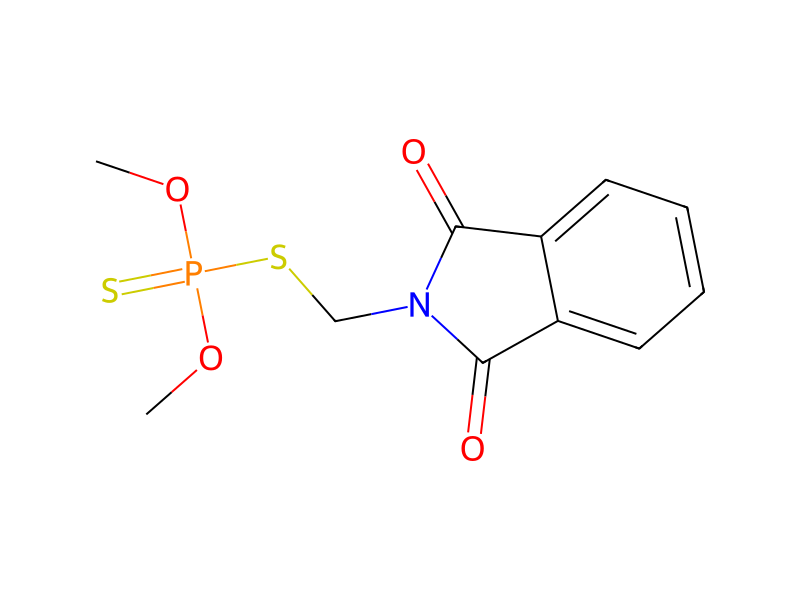
基本情報
- 標準SMILES
COP(=S)(OC)SCN1C(=O)c2ccccc2C1=O- InChIKey
LMNZTLDVJIUSHT-UHFFFAOYSA-N- 分子式
- C11H12NO4PS2
- 平均分子量
- 317.3 g/mol
- 単同位体質量
- 316.99453721
名称と識別子
- 優先名称
- Phosmet
- IUPAC
- 2-(dimethoxyphosphinothioylsulfanylmethyl)isoindole-1,3-dione
- 現地名
- ホスメット
- 英語名
- Phosmet
- 分子式
- C11H12NO4PS2
- 分子量
- 317.32
名称と別名
Phosmet732-11-6FosmetDecemthionPhthalophosProlateIMIDANImidathionPercolateFtalophosKemolateSafidon
名称をさらに表示
フタロホスジチオりん酸O,O-ジメチルS-(フタルイミジルメチル)プロレートプロラートPMP剤ホスメットイミダンジチオりん酸S-(1,3-ジオキソイソインドリン-2-イル)メチルO,O-ジメチルジチオりん酸O,O-ジメチルS-[(1,3-ジヒドロ-1,3-ジオキソ-2H-イソインドール-2-イル)メチル]ホスメット標準品ジメチルフタリルイミドメチルジチオホスフェイトS-[(1,3-ジオキソイソインドリン-2-イル)メチル]=O,O-ジメチル=ホスホロジチオアートCS_N-12207-100MG_ホスメットPMP標準品イミダン STANDARDイミダン (ホスメット)イミダン (ホスメット), 1000 µg/mL in Hexaneイミダン Standard, 100 µg/mL in MeOHO,O-ジメチル {[(1,3-ジオキソ-2,3-ジヒドロ-1H-イソインドール-2-イル)メチル]スルファニル}ホスホノチオアートO,O-ジメチル-S-(フタルイミドメチル)ホスホロジチオエート標準品PMPIMIDNINOVATFOSDANR-1504CEKUMET
SimidanSmidanDecemthion P-6PMP (Pesticide)PhtalofosProlate EStauffer R 1504Imidan WP
データベース識別子
- CAS
732-11-6- PubChem CID
- 12901
- DTXSID
DTXSID5024261- ChEMBL
CHEMBL1481873- ChEBI
CHEBI:38786- UNII
- VN04LI540Y
- EC Number
- 211-987-4
- Nikkaji
- J2.108C
物性
構造計算による物性
- XLogP
- 2.8
- 極性表面積
- 113 Ų
- 水素結合供与体数
- 0
- 水素結合受容体数
- 6
- 回転可能結合数
- 5
- 重原子数
- 19
- 形式電荷
- 0
- 複雑度
- 399
実験および物理化学的性質
LogP
log Kow = 2.95
2.83
OdorOFFENSIVE ODOR
Density
1.03 at 20 °C/4 °C
1.03 g/cm³
1.03 @ 20°C
Color/Form
Off-white crystalline solid
Colorless crystals
Solubility
100 G/KG IN DICHLOROMETHANE, 4-METHYLPENT-3-EN-2-ONE, BUTANONE
At 25 °C: 25 mg/L water; 650 g/L acetone; 600 g/L benzene; 5 g/L kerosene; 50 g/L methanol; 300 g/L toluene, methyl isobutyl ketone; 250 g/L xylene.
In water, 24.4 mg/L at 20 °C
Solubility in water, g/100ml at 20 °C: 0.003
CorrosivitySLIGHTLY CORROSIVE TO METALS
Boiling PointDecomposes below boiling point (EPA, 1998)
Decomposition
When heated to decomposition it emits very toxic fumes of /nitrogen oxides, phosphorus oxides, and sulfur oxides./
100 °C
Melting Point
161 °F (EPA, 1998)
72-72.7 °C
72 °C
71.9 °C
Vapor Pressure
0.001 mmHg at 122 °F (EPA, 1998)
0.00000049 [mmHg]
4.9X10⁻⁷ mm Hg at 20-25 °C
Vapor pressure at 20 °C: negligible
0.00054 [mm Hg] @25 °C
Physical Description
Phosmet is an off-white crystalline solid with an offensive odor. Used as an insecticide and acaricide. (EPA, 1998)
Colorless to off-white solid; [ICSC] Technical product is off-white or pink solid with an offensive odor; [HSDB] Colorless solid; [MSDSonline]
COLOURLESS-TO-OFF-WHITE CRYSTALS WITH CHARACTERISTIC ODOUR.
Stability/Shelf Life
Stable under normal storage conditions.
IN BUFFERED SOLN (20 MG/L) @ 20 °C, 50% HYDROLYZED 13 DAYS AT PH 4.5, IN LESS THAN 12 HR AT PH 7, IN LESS THAN 4 HR AT PH 8.3.
STORAGE ABOVE 45 °C MAY LEAD TO DECOMPOSITION.
... Rapidly decomposed with hypochlorite.
Relatively stable in acidic conditions. Decomposes rapidly above 100 °C.
物理化学的性質
- 融点
- 72.5 °C · 72.5°C
- 沸点
- 412.6 · 412.6±47.0 °C(Predicted)
- 比重(密度)
- 1.03 g/cm3 · 1.03 g/cm3
- 蒸気圧
- 6.5 · 6.5×10-5 Pa (25°C)
- 闪点
- 100 °C · >100 °C
- 貯蔵温度
- 0 · 0-6°C
- 溶解性
- Chloroform: Slightly Soluble,Methanol: Slightly Soluble
- 酸解離定数(Pka)
- -2.63 · -2.63±0.20(Predicted)
- 水溶解度
- 25 mg · 25 mg l-1 (25°C)
- 外見
- 個体
- BRN
- 264869 · 264869
- Henry's Law Constant
- 1.2 · 1.2×103 mol/(m3Pa) at 25℃, HSDB (2015)
- 主な用途
- 農業環境
- InChI
- 1S/C11H12NO4PS2/c1-15-17(18,16-2)19-7-12-10(13)8-5-3-4-6-9(8)11(12)14/h3-6H,7H2,1-2H3
- InChIKey
- LMNZTLDVJIUSHT-UHFFFAOYSA-N
- SMILES
- COP(=S)(OC)SCN1C(=O)c2ccccc2C1=O
- LogP
- 2.78 · 2.780
- CAS データベース
- 732 · 732-11-6(CAS DataBase Reference)
- NISTの化学物質情報
- Phosmet(732-11-6)
- EPAの化学物質情報
- Phosmet (732-11-6)
化学的性質
化学的特性Phosmet is a white crystalline solid
安全と法規制
GHS分類
GHS Classification
Danger
H301: Toxic if swallowed [Danger Acute toxicity, oral];H332: Harmful if inhaled [Warning Acute toxicity, inhalation];H361f: Suspected of damaging fertility [Warning Reproductive toxicity];H370: Causes damage to organs [Danger Specific target organ toxicity, single exposure];H400: Very toxic to aquatic life [Warning Hazardous to the aquatic environment, acute hazard];H410: Very toxic to aquatic life with long lasting effects [Warning Hazardous to the aquatic environment, long-term hazard]
P203, P260, P261, P264, P270, P271, P273, P280, P301+P316, P304+P340, P308+P316, P317, P318, P321, P330, P391, P405, and P501 (click each P-code to see the statement)
Danger
危険有害性情報
Regulatory Information
Hazard Traits - Developmental Toxicity; Neurotoxicity;Authoritative List - CECBP - Priority Chemicals;Report - if used as a fragrance or flavor ingredient
Regulation (EC) No 396/2005 (amended)
Phosmet is listed in the dataset of EPA Human Health Benchmarks for Pesticides under the Safe Drinking Water Act (40 eCFR 141)
07/25/EC, Reg. (EU) 2018/917, Reg. (EU) 2019/707, Reg. (EU) 2020/869, Reg. (EU) 2021/745, Reg. (EU) 2022/94, Reg. (EU) No 540/2011
Phosmet: Does not have an individual approval but may be used as a component in a product covered by a group standard. It is not approved for use as a chemical in its own right.
The New Jersey Worker and Community Right to Know Act requires public and private employers to provide information about hazardous substances at their workplaces. (N.J.S.A. 34:5A-1 et. seq.)
Other Safety Information
IMAP assessments - Phosphorodithioic acid, S-[(1,3-dihydro-1,3-dioxo-2H-isoindol-2-yl)methyl] O,O-dimethyl ester: Environment tier I assessment;IMAP assessments - Phosphorodithioic acid, S-[(1,3-dihydro-1,3-dioxo-2H-isoindol-2-yl)methyl] O,O-dimethyl ester: Human health tier I assessment
DOT LabelClass 9
Fire Hazards
(Non-Specific -- Organophosphorus Pesticide, n.o.s.). Container may explode in heat of fire. Fire and runoff from fire control water may produce irritating or poisonous gases. Storage above 113F, may lead to decomposition. (EPA, 1998)
Combustible. Liquid formulations containing organic solvents may be flammable. Gives off irritating or toxic fumes (or gases) in a fire. Risk of fire and explosion if formulations contain flammable/explosive solvents.
Fire PotentialThis material may burn but does not ignite readily. /Organophosphorus pesticide NOS/
Health Hazards
It is an organophosphorus pesticide. This material is very toxic; the probable oral lethal dose for humans is 50-500 mg/kg, or between 1 teaspoon and 1 oz. for a 150 lb. person. It is a cholinesterase inhibitor and has central nervous system effects. Oral lethal doses in humans have been reported at 50 mg/kg. (EPA, 1998)
Hazards Summary
A cholinesterase inhibitor that may cause CNS effects resulting in convulsions and respiratory depression; Can be absorbed through skin; [ICSC] Highly toxic cholinesterase inhibitor; [CAMEO] A man who attempted suicide by ingestion was brought by friend to emergency room with symptoms including oral and bronchial secretions and respiratory distress requiring intubation; Within an hour health care personal began developing symptoms of poisoning; A nursing assistant who had contact with the patients skin and bodily fluids required intubation and was hospitalized for 9 days; Two nurses who were exposed only by inhalation in close proximity to the patient developed symptoms including confusion, nausea, abdominal cramps, and dyspnea; Many poisoning cases have been reported from the use of animal dips and shampoos by pet owners, groomers, and veterinary assistants; [HSDB] Not likely to be teratogenic, based on animal studies; [REPROTOX] The average of two baseline respective cholinesterase activity determinations three days apart, with no exposures to enzyme inhibiting pesticides for at least 30 days, is recommended for each worker prior to exposure to cholinesterase inhibitors because of large inter-individual differences in published baseline values. To be established at least once a year. Removal from workplace exposures is recommended until the cholinesterase activity returns to within 20% of baseline. [TLVs and BEIs]
Reactive GroupAmides and Imides;Esters, Sulfate Esters, Phosphate Esters, Thiophosphate Esters, and Borate Esters
EC ClassificationSymbol: Xn, N; R: 21/22-50/53; S: (2)-22-36/37-60-61
UN ClassificationUN Hazard Class: 6.1; UN Pack Group: III
Special Reports
USEPA/Office of Pesticide Programs; Interim Reregistration Eligibility Decision - Phosmet. EPA 738-R-01-010 (October 2001) This document assesses the risk of exposure to the various registrated uses of phosmet and determines whether these uses are eligible for reregistration. The document is considered \"interim\" pending completion of the review of all organophosphorus pesticides registered in the U.S.[Available from, as of May 18, 2007: http://www.epa.gov/pesticides/reregistration/status.htm]
EPA/Office of Pesticide Programs; Organophosphorus Cumulative Risk Assessment - 2006 Update. p.209-10. (August 2006) avail as zipped pdf from at http://www.epa.gov/pesticides/cumulative/2006-op/index.htm. This report evaluates the relative toxicity and individual exposure scenarios for a group of organophosphate pesticides determined to share a common mode of action.
FIFRA Requirements
Tolerances are established for the sum of the residues for the insecticide N-(mercaptomethyl) phthalimide S-(O,O-dimethyl phosphorodithioate) and its oxygen analog N-(mercaptomethyl) phthalimide S-(O,O-dimethyl phosphorothioate) in or on the following raw agricultural commodities: [Table#3508]
Tolerances with regional registration, as defined in §180.1(n), are established for the sum of the residue for the insecticide N-(mercaptomethyl) phthalimide S-(O,O-dimethyl phosphorodithioate) and its oxygen analog N-(mercaptomethyl) phthalimide S-(O,O-dimethyl phosphorothioate) in or on the following raw agricultural commodity: [Table#3509]
As the federal pesticide law FIFRA directs, EPA is conducting a comprehensive review of older pesticides to consider their health and environmental effects and make decisions about their future use. Under this pesticide reregistration program, EPA examines health and safety data for pesticide active ingredients initially registered before November 1, 1984, and determines whether they are eligible for reregistration. In addition, all pesticides must meet the new safety standard of the Food Quality Protection Act of 1996. Phosmet is found on List A, which contains most food use pesticides and consists of the 194 chemical cases (or 350 individual active ingredients) for which EPA issued registration standards prior to FIFRA, as amended in 1988. Case No: 0242; Pesticide type: herbicide; Registration Standard Date: 09/26/86; Case Status: OPP is reviewing data from the pesticide's producers regarding its human health and/or environmental effects, or OPP is determining the pesticide's eligibility for reregistration and developing the Reregistration Eligibility Decision (RED) document. Active ingredient (AI): Phosmet; Data Call-in (DCI) Date(s): 08/30/91, 10/13/95; AI Status: The producers of the pesticide has made commitments to conduct the studies and pay the fees required for reregistration, and are meeting those commitments in a timely manner.
安全と保護具
Fire Fighting
(Non-Specific -- Organophosphorus Pesticide, n.o.s.). Stay upwind; keep out of low areas. Move container from fire area if you can do it without risk. Fight fire from maximum distance. Dike fire control water for later disposal; do not scatter material. Wear positive pressure breathing apparatus and special protective clothing.;(Non-Specific -- Organophosphorus Pesticide, n.o.s.) This material may burn but does not ignite readily. For small fires, use dry chemical, carbon dioxide, water spray, or foam. For large fires, use water spray, fog, or foam. (EPA, 1998)
Use water spray, powder, foam, carbon dioxide.
First Aid Measures
Fresh air, rest. Refer for medical attention.
Remove contaminated clothes. Rinse and then wash skin with water and soap.
First rinse with plenty of water for several minutes (remove contact lenses if easily possible), then refer for medical attention.
Rinse mouth. Give a slurry of activated charcoal in water to drink. Induce vomiting (ONLY IN CONSCIOUS PERSONS!). Rest. Refer for medical attention .
First Aid
Note: Phosmet is a cholinesterase inhibitor.;Signs and Symptoms of Acute Phosmet Exposure: Acute exposure to phosmet may produce the following signs and symptoms: pinpoint pupils, blurred vision, headache, dizziness, muscle spasms, and profound weakness. Vomiting, diarrhea, abdominal pain, seizures, and coma may also occur. The heart rate may decrease following oral exposure or increase following dermal exposure. Chest pain may be noted. Hypotension (low blood pressure) may occur, although hypertension (high blood pressure) is not uncommon. Dyspnea (shortness of breath) may be followed by respiratory collapse. Giddiness is common.;Emergency Life-Support Procedures: Acute exposure to phosmet may require decontamination and life support for the victims. Emergency personnel should wear protective clothing appropriate to the type and degree of contamination. Air-purifying or supplied-air respiratory equipment should also be worn, as necessary. Rescue vehicles should carry supplies such as plastic sheeting and disposable plastic bags to assist in preventing spread of contamination.;Inhalation Exposure:;1. Move victims to fresh air. Emergency personnel should avoid self-exposure to phosmet.;2. Evaluate vital signs including pulse and respiratory rate, and note any trauma. If no pulse is detected, provide CPR. If not breathing, provide artificial respiration. If breathing is labored, administer oxygen or other respiratory support.;3. Obtain authorization and/or further instructions from the local hospital for administration of an antidote or performance of other invasive procedures.;4. Transport to a health care facility.;Dermal/Eye Exposure:;1. Remove victims from exposure. Emergency personnel should avoid self- exposure to phosmet.;2. Evaluate vital signs including pulse and respiratory rate, and note any trauma. If no pulse is detected, provide CPR. If not breathing, provide artificial respiration. If breathing is labored, administer oxygen or other respiratory support.;3. Remove contaminated clothing as soon as possible.;4. If eye exposure has occurred, eyes must be flushed with lukewarm water for at least 15 minutes.;5. Wash exposed skin areas three times with soap and water.;6. Obtain authorization and/or further instructions from the local hospital for administration of an antidote or performance of other invasive procedures.;7. Transport to a health care facility.;Ingestion Exposure:;1. Evaluate vital signs including pulse and respiratory rate, and note any trauma. If no pulse is detected, provide CPR. If not breathing, provide artificial respiration. If breathing is labored, administer oxygen or other respiratory support.;2. Obtain authorization and/or further instructions from the local hospital for administration of an antidote or performance of other invasive procedures.;3. Vomiting may be induced with syrup of Ipecac. If elapsed time since ingestion of phosmet is unknown or suspected to be greater than 30 minutes, do not induce vomiting and proceed to Step
Safe StorageProvision to contain effluent from fire extinguishing. Separated from food and feedstuffs.
Exposure Control and Personal Protection
Biological Exposure Indices (BEI) [ACGIH] - Acetylcholinesterase activity in red blood cells = 70% of individual's baseline; Butylcholinesterase activity in serum or plasma = 60% of individual's baseline; Sample at end of shift; [TLVs and BEIs]
Fire Fighting Procedures
This material may not burn but does ignite readily. For small fires, use dry chemical, carbon dioxide, water spray, or foam. For large fires, use water spray, fog, or foam. Stay upwind; keep out of low areas. Move container from fire area if you can do it without risk. Fight fire from maximum distance. Dike fire control water for later disposal; do not scatter material. Wear positive pressure breathing apparatus and special protective clothing. Poisonous gases are produced in fire including nitrogen oxides, phosphorus oxides, and sulfur oxides. If material or contaminated runoff enters waterways, notify downstream users of potentially contaminated waters. Notify local health and fire officials and pollution control agencies. Containers may explode in fire. From a secure, explosion-proof location, use water spray to cool exposed containers. If cooling streams are ineffective (venting sound increases in volume and pitch, tank discolors, or shows any signs of deforming), withdraw immediately to a secure position. If employees are expected to fight fires, they must be trained and equipped in OSHA 1910.156.
For small fires, use dry chemical, carbon dioxide, water spray, or foam. For large fires, use water spray, fog, or foam. /Organophosphorus pesticide NOS/
Storage Conditions
Store in tightly closed containers in a cool, well vented area away form other pesticide, alkaline conditions, water and other forms of moisture. Where possible, automatically transfer material from drums or other storage containers to process containers. Sources of ignition such as smoking and open flames are prohibited where this chemical is handled, used, or stored. Metal containers involving the transfer of this chemical should be grounded and bonded. Whenever this chemical is used, handled, manufactured, or stored, use explosion-proof electrical equipment and fittings.
Cleanup Methods
Evacuate persons not wearing protective equipment from area of spill or leak until clean-up is complete. Remove all ignition sources. As for other organophosphorus pesticides stay upwind; keep out of low areas. Ventilate closed spaces before entering them. Remove and isolate contaminated clothing at the site. Do not touch spilled material. Use water spray to reduce vapors. Take up small spills with sand or other noncombustible absorbent material and place in containers for later disposal. Take up small dry spills with clean shovel and place in clean, dry container. Dike far ahead of large spills for later disposal. Ventilate area after clean-up is complete. It may be necessary to contain and dispose of this chemical as a hazardous waste. If material or contaminated runoff enters waterways, notify downstream users of potentially contaminated waters. Contact your Department of Environmental Protection or your regional office of the federal EPA for specific recommendations. If employees are required to clean-up spills, they must be properly trained and equipped. OSHA 1910.120(q) may be applicable.
Nonfire Spill Response
Caution : Phosmet may produce toxic gases when heated; containers may explode in the heat of fire. Avoid sources of extreme heat.;This is an organophosphorus pesticide. As for other organophosphorus pesticides stay upwind; keep out of low areas. Ventilate closed spaces before entering them. Remove and isolate contaminated clothing at the site. Do not touch spilled material. Use water spray to reduce vapors. Take up small spills with sand or other noncombustible absorbent material and place in containers for later disposal. Take up small, dry spills with clean shovel and place in clean, dry container. Dike far ahead of large spills for later disposal. (EPA, 1998)
Disposal Methods
SRP: The most favorable course of action is to use an alternative chemical product with less inherent propensity for occupational exposure or environmental contamination. Recycle any unused portion of the material for its approved use or return it to the manufacturer or supplier. Ultimate disposal of the chemical must consider: the material's impact on air quality; potential migration in soil or water; effects on animal, aquatic, and plant life; and conformance with environmental and public health regulations.
Consult with environmental regulatory agencies for guidance on acceptable disposal practices. Generators of waste containing this contaminant (> or = 100 kg/mo) must conform with EPA regulations governing storage, transportation, treatment, and waste disposal. In accordance with 40CFR165 recommendations for the disposal of pesticides and pesticide containers. Must be disposed of properly by following package label directions or be contacting your state regional office. Small amounts may be decomposed with hypochlorite. For large amounts, incineration with effective gas scrubbing is recommended.
Pesticide Disposal - Pesticide wastes are acutely hazardous. Improper disposal of excess pesticide, spray mixture, or rinsate is a violation of Federal Law. If these wastes cannot be disposed of by use according to label instructions, contact your State Pesticide or Environmental Control Agency or the Hazardous Waste Representative at the nearest EPA Regional Office for guidance. Container Disposal - Triple rinse (or equivalent). Then offer for recycling or reconditioning, or puncture and dispose of in a sanitary landfill, or by other procedures approved by state and local authorities. /Prolate-Lintox -HD/
Spillage Disposal
Personal protection: chemical protection suit including self-contained breathing apparatus. Do NOT let this chemical enter the environment. Sweep spilled substance into covered containers. If appropriate, moisten first to prevent dusting. Carefully collect remainder. Then store and dispose of according to local regulations.
Preventive Measures
Follow manufacturers instructions for cieaning and maintainlng PPE. If no such instructions for washables exist, use detergent and hot water. Keep and wash PPE separately from other laundry. Discard clothing and other absorbent materials that have been drenched or heavily contaminated with this product's concentrate. Do not reuse them. /Imidan 70-WP/
USER SAFETY RECOMMENDATIONS. Users should: - Wash hands before eating, drinking, chewing gum, using tobacco, or using the toilet. Remove ctothing and PPE immediately if pesticide gets inside. Then wash thoroughly and put on clean clothing. Users should remove PPE immediately after handling this product. Wash the outside of gloves before removing. As soon as possible, wash thoroughly and change into clean clothing. /Imidan 70-WP/
This pesticide is toxic to fish and aquatic invertebrates. Do not apply directly to water or to areas where surface water is present or to intertidal areas below the mean high-water mark. Drift and runoff may be hazardous to aquatic organisms in neighboring areas. Do not contaminate water when disposing of equipment washwater or rinsate. This product is highly toxic to bees exposed directly to treatment of residues on crops. Do not apply this product or allow it to drift to blooming crops or weeds if bees are visiting the treatment area. Protective information may be obtained from your cooperative Agricultural Extension Service. /Imidan 70-WP/
AGRICULTURAL USE REQUIREMENTS. Use this product only In accordance with its labeling and with the Worker Protection Standard, 40 CFR Part 170. ... The requirements in this /statement/ only apply to uses of this product that are covered by the Worker Protection Standard. Do not enter or allow entry into treated areas during the restricted entry interval (REI). The REI for each crop is listed in the directions for use associated with each crop. PPE required for early entry to treated areas that is permitted under the Worker Protection Standard and that involves contact with anything that has been treated, such as plants, soil, or water is: Coveralls, Shoes plus socks, Chemical-resistant gloves made of any waterproof material, and Chemical-resistant headgear for overhead exposure. /Imidan 70-WP/
For more Preventive Measures (Complete) data for PHOSMET (10 total), please visit the HSDB record page.
毒性情報
InteractionsSLIGHT INCR OF LETHAL EFFECT WITH LINDANE-PHOSMET IN MALE RATS.
Target OrgansHepatic;Nervous
Ecotoxicity Values
LD50 Pheasant female oral 237 mg/kg, 3-4 mo old (95% confidence limit 171-329 mg/kg)
LD50 Pheasant male oral greater than 250 mg/kg, 3 mo old
LD50 ANAS PLATYRHYNCHOS, MALLARD DUCK ORAL 1830 MG/KG, 3-4 MO OLD MALES (95% CONFIDENCE LIMIT 1270-2630 MG/KG)
LC50 CHINOOK SALMON 180 UG/L/24 HR. FLOW-THROUGH BIOASSAY. (TECHNICAL GRADE)
For more Ecotoxicity Values (Complete) data for PHOSMET (49 total), please visit the HSDB record page.
Environmental Fate
TERRESTRIAL FATE: Based on a classification scheme(1), Koc values of 500-820 measured in soil(2), indicate that phosmet is expected to have low mobility in soil(SRC). Volatilization of phosmet from moist soil surfaces is not expected to be an important fate process(SRC) given an estimated Henry's Law constant of 8.4X10⁻⁹ atm-cu m/mole(SRC), derived from its vapor pressure of 4.9X10⁻⁷ mm Hg(3) and water solubility of 25 mg/L(3). Volatilization from dry soil surfaces is not expected(SRC) based on the vapor pressure of this compound(3). The field dissipation half-life of phosmet was reported to range from 4-20 days(2). Phosmet undergoes hydrolysis rapidly in aqueous solutions(2,3), indicating it will also hydrolyze in moist soils(SRC). Biodegradation data were not available(SRC, 2007).
AQUATIC FATE: Based on a classification scheme(1), Koc values of 500-820 measured in soil(2), indicate that phosmet is expected to adsorb to suspended solids and sediment(SRC). Volatilization from water surfaces is not expected to be an important environmental fate process(3) based upon an estimated Henry's Law constant of 8.4X10⁻⁹ atm-cu m/mole(SRC), derived from its vapor pressure of 4.9X10⁻⁷ mm Hg(4) and water solubility of 25 mg/L(4). According to a classification scheme(5), BCF values of 32-44 measured in fish(6), suggest the bioconcentration in aquatic organisms is moderate(SRC). Phosmet hydrolyzes rapidly in water with half-lives of 13 days at pH 4.5, 12 hours at pH 7 and 4 hours at pH 8.3(4). Biodegradation data were not available(SRC, 2007).
ATMOSPHERIC FATE: According to a model of gas/particle partitioning of semivolatile organic compounds in the atmosphere(1), phosmet, which has a vapor pressure of 4.9X10⁻⁷ mm Hg at 25 °C(1) is expected to exist in both the vapor and particulate phases in the ambient atmosphere. Vapor-phase phosmet is degraded in the atmosphere by reaction with photochemically-produced hydroxyl radicals(SRC). The half-life for this reaction in air is estimated to be 2 hours(SRC), calculated from its rate constants of 1.5X10⁻¹⁰ cu cm/molecule-sec at and 25 °C(SRC) that was derived using a structure estimation method(3). Particulate-phase phosmet may be removed from the air by wet or dry deposition(SRC). Direct photolysis from sunlight is also an important fate process based on a half-life of about 70 minutes(4).
Food Survey Values
In a summary of pesticide residue findings of the US Food and Drug Admin's regulatory monitoring of domestic foods which may be eaten by infants/children for fiscal years 1985-1991, phosmet was detected (max concn of 1.6 ppm) in 187 of 2464 apple samples and in 71 of 571 pear samples(1); in imported foods, phosmet was detected (max concn of 1.1 ppm) in 36 of 735 apple samples and in 29 of 816 pear samples(1). In a US monitoring survey of 6970 produce samples (fruits and vegetables) collected between 1989 and 1991, phosmet was not detected in any sample at a detection limit of 1.0 ppm(2). During a 5 yr study conducted during 1981-1986, the Los Angeles District Office of the FDA analyzed 19,851 samples of domestic and imported food for pesticide residues(3,4); phosmet was detected in 74 samples at concns ranging from 0.05 to >2.0 ppm (all but 18 samples has concns of 2.0 ppm or less)(3,4). In fruit monitoring studies conducted in Ontario, Canada during 1980 to 1984, phosmet was detected in sweet cherries (6 of 26 composite samples) and peaches (24 of 36 composite samples)(5). Phosmet was detected at a max concn of 0.25 mg/kg in fresh and canned peaches(6). Phosmet was detected in 225 out of 1,536 vegetable and 802 fruit samples analyzed from 1991-1995 in Ontario, Canada(7). No single detection of phosmet in these foods exceeded 10 mg/kg(7). The mean (range of positive samples) of phosmet in food samples from the 1991-1999 FDA Market Basket Surveys were: blueberry muffins, 0.006 ppm (0.006-0.006 ppm); red apples, 0.0095 ppm (0.002-0.03 ppm); raw peaches, 0.0447 ppm (0.012-0.189 ppm); raw pears, 0.0548 ppm (0.003-0.573 ppm); grapes, 0.026 ppm (0.026-0.026 ppm); plumbs, 0.0055 ppm (0.003-0.008 ppm); sweet cherries, 0.007 ppm (0.007-0.007 ppm); raisins, 0.007 ppm (0.007-0.007 ppm); applesauce , 0.004 ppm (0.004-0.004 ppm); strained pears, 0.0112 ppm (0.004-0.02 ppm); apricots, 0.2541 ppm (0.006-0.662 ppm)(8).
Adverse EffectsOccupational hepatotoxin - Secondary hepatotoxins: the potential for toxic effect in the occupational setting is based on cases of poisoning by human ingestion or animal experimentation.;Other Poison - Organophosphate
Exposure RoutesThe substance can be absorbed into the body by inhalation, through the skin and by ingestion.
Average Daily Intake
Based upon regulatory monitoring conducted by the US Food and Drug Adminstration phosmet Food Intake (in ug/kg body wt/day) in 1990 was as follows(1): 0.0029 for 6-11 mo age group, 0.001 for 14-16 yr old males, and 0.0016 for 60-65 yr old females(1); in 1989, phosmet food intake was as follows(2): 0.0019 for 6-11 mo age group, 0.0008 for 14-16 yr old males, and 0.0009 for 60-65 yr old females(2); in 1988, phosmet food intake was as follows(3): 0.0111 for 6-11 mo age group, 0.0032 for 14-16 yr old males, and 0.0064 for 60-65 yr old females(3).
Ecotoxicity Excerpts
/BIRDS and MAMMALS/ Peripheral neuropathy was induced by the long-term administration of organo-phosphorus compounds (phtalimid/phosmet) in quails (Coturnix coturnix japponica). After 4 weeks, the first symptoms of organophosphorus (OPC) poisoning (apathy, diarrhea) were present. During the second month of a daily administration of the toxic substance using the probe, an apparent clinical autonomic and peripheral neuropathy with ataxia had developed. Toxic disturbance of the nervous system was confirmed by the examination of spinal and cortical somatosensory evoked potentials (SEP) after tibial nerve stimulation. The prolongation of the peripheral conduction time (wave P6 and N9 represent the response from the ischiadic nerve and the entry of the stimulus to spinal cord, respectively) confirmed a peripheral nerve lesion. /The authors/ suggest that these clinical and electrophysiological changes, displayed by the disturbed nervous system, are caused by either slowing or stoppage of the axonal flow, transport of proteins and other substances, as well as by axon demyelination.
/BIRDS and MAMMALS/ Signs of intoxication /in mallards & pheasants from acute oral admin/: regurgitation & polydipsia (in mallards), ataxia, excessive preening, hyperactivity, falling, ptosis, salivation, prostration, dyspnea, tremors, wings spread, convulsions, tetanic seizures, & terminal wing-beat convulsions. Signs appeared as soon as 10 min & mortalities usually occurred between 0.5 & 17 hr after treatment; two pheasants, however, died at 18 & 24 hr after treatment. In mallards, treatment levels as low as 96 mg/kg produced signs of intoxication, & 768 mg/kg produced some mortalities. /Sample purity 97.2%/
/BIRDS and MAMMALS/ Apple orchards occupy approximately 12,565 ha of land in Ontario, Canada, and are treated with the greatest number and applications of pesticides among all agricultural crops within the province. The potential for exposure to wildlife from frequent organophosphorus (OP) spray applications is therefore considerable. This study investigated the impact of agricultural spray applications of azinphos-methyl, diazinon, phosalone, and phosmet in apple orchards on the cholinesterase (ChE) activity of wild birds nesting in orchards. These four OP pesticides ranked among the most widely used insecticides used on all fruit crops in Ontario in 1988. Tree swallows (Tachycineta bicolor) and eastern bluebirds (Sialia sialis) were chosen as monitor species because they commonly breed and forage within apple orchards, utilize different feeding strategies, and are readily attracted to nest boxes. Brain and plasma ChE activities were determined for nestling bluebirds and swallows, and plasma ChE was measured in adult swallows for comparison with nestling data. In adult tree swallows, mean plasma ChE levels were significantly inhibited 41% compared to controls 12 hr after a second application of azinphos-methyl. Mean plasma ChE activity in another group of adult tree swallows dropped by 21 and 19% following a multiple phosmet application. In nestlings, brain ChE activities obtained postspray often fell below predicted activities calculated from control siblings. This trend was especially apparent in the younger nestlings, <6 days old. However, for bluebirds the rates of increase of brain ChE with age in nestlings from treated sites was significantly lower than in nestlings from control sites. Brain ChE activity of two nestlings found dead following a phosalone application gave no indication that insecticide exposure was responsible. No other dead or moribund birds were discovered during the course of the study. Sequential plasma sampling of siblings, before and afte
/AQUATIC SPECIES/ Moderately hazardous to fish.
For more Ecotoxicity Excerpts (Complete) data for PHOSMET (6 total), please visit the HSDB record page.
Signs and Symptoms
Pupillary constriction, muscle cramp, excessive salivation. Sweating. Nausea. Dizziness. Laboured breathing. Weakness.
MAY BE ABSORBED! See Inhalation.
Redness.
Abdominal cramps. Vomiting. Diarrhoea. Convulsions. Unconsciousness. Further see Inhalation.
Acute Toxicity LinkChemical: PHOSMET
Effluent ConcentrationsLeachate samples collected near a pesticide manufacturing facility in Barcelona, Spain during the summer of 1984 contained phosmet concns of 5-10 ppm(1).
法規制情報
Regulatory Information
Hazard Traits - Developmental Toxicity; Neurotoxicity;Authoritative List - CECBP - Priority Chemicals;Report - if used as a fragrance or flavor ingredient
Regulation (EC) No 396/2005 (amended)
Phosmet is listed in the dataset of EPA Human Health Benchmarks for Pesticides under the Safe Drinking Water Act (40 eCFR 141)
07/25/EC, Reg. (EU) 2018/917, Reg. (EU) 2019/707, Reg. (EU) 2020/869, Reg. (EU) 2021/745, Reg. (EU) 2022/94, Reg. (EU) No 540/2011
Phosmet: Does not have an individual approval but may be used as a component in a product covered by a group standard. It is not approved for use as a chemical in its own right.
The New Jersey Worker and Community Right to Know Act requires public and private employers to provide information about hazardous substances at their workplaces. (N.J.S.A. 34:5A-1 et. seq.)
FIFRA Requirements
Tolerances are established for the sum of the residues for the insecticide N-(mercaptomethyl) phthalimide S-(O,O-dimethyl phosphorodithioate) and its oxygen analog N-(mercaptomethyl) phthalimide S-(O,O-dimethyl phosphorothioate) in or on the following raw agricultural commodities: [Table#3508]
Tolerances with regional registration, as defined in §180.1(n), are established for the sum of the residue for the insecticide N-(mercaptomethyl) phthalimide S-(O,O-dimethyl phosphorodithioate) and its oxygen analog N-(mercaptomethyl) phthalimide S-(O,O-dimethyl phosphorothioate) in or on the following raw agricultural commodity: [Table#3509]
As the federal pesticide law FIFRA directs, EPA is conducting a comprehensive review of older pesticides to consider their health and environmental effects and make decisions about their future use. Under this pesticide reregistration program, EPA examines health and safety data for pesticide active ingredients initially registered before November 1, 1984, and determines whether they are eligible for reregistration. In addition, all pesticides must meet the new safety standard of the Food Quality Protection Act of 1996. Phosmet is found on List A, which contains most food use pesticides and consists of the 194 chemical cases (or 350 individual active ingredients) for which EPA issued registration standards prior to FIFRA, as amended in 1988. Case No: 0242; Pesticide type: herbicide; Registration Standard Date: 09/26/86; Case Status: OPP is reviewing data from the pesticide's producers regarding its human health and/or environmental effects, or OPP is determining the pesticide's eligibility for reregistration and developing the Reregistration Eligibility Decision (RED) document. Active ingredient (AI): Phosmet; Data Call-in (DCI) Date(s): 08/30/91, 10/13/95; AI Status: The producers of the pesticide has made commitments to conduct the studies and pay the fees required for reregistration, and are meeting those commitments in a timely manner.
State Drinking Water Guidelines(FL) FLORIDA 140 ug/L
安全データ
- wgk
- 3
- rtecs
- TE2275000
- ridadr
- UN 2811
- 毒性
- LD50 in male, female rats (mg/kg): 113, 160 orally (Gaines)
- risk_code
- 21/22-50/53
- hazard_code
- Xn;N,N,Xn
- safety_code
- 22-36/37-60-61
- hazard_class
- 6.1(b)
- packing_group
- III
- 毒劇物取締法
- III
- Hazard Classifications
- Acute Tox. 3 OralAcute Tox. 4 InhalationAquatic Acute 1Aquatic Chronic 1Repr. 2STOT SE 1
- ストレージクラス
- 6.1A - Combustible acute toxic Cat. 1 and 2very toxic hazardous materials
- 有毒物質データの
- 732-11-6(Hazardous Substances Data)
化学と産業
薬理情報
ATC Code
QP - Antiparasitic products, insecticides and repellents;QP53 - Ectoparasiticides, insecticides and repellents;QP53B - Ectoparasiticides for systemic use;QP53BB - Organophosphorous compounds;QP53BB03 - Phosmet
QP - Antiparasitic products, insecticides and repellents;QP53 - Ectoparasiticides, insecticides and repellents;QP53A - Ectoparasiticides for topical use, incl. insecticides;QP53AF - Organophosphorous compounds;QP53AF06 - Phosmet
Mechanism of Action
OPs including Phosmet exert their neurotoxicity by binding to and phosphorylating the enzyme acetylcholinesterase in both the central (brain) and peripheral nervous systems. There are laboratory animal data on OPs for cholinesterase activity in plasma, red blood cell (RBC) and brain, as well as behavioral or functional neurological effects ... Measures of acetylcholinesterase inhibition in the peripheral nervous system (PNS) are very limited for the OP pesticides. As a matter of /EPA/ science policy, blood cholinesterase data (plasma and RBC) are considered appropriate surrogate measures of potential effects on PNS acetylcholinesterase activity and of potential effects on the central nervous system (CNS) when brain cholinesterase data are lacking.
Metabolism/Metabolites
After dermal application, Imidan was moderately absorbed by skin of steer. ... Paper chromatography and electrophoresis indicated that primary metabolic products were phthalamic & phthalic acids. ... after oral admin of labeled
... Imidan to rats, the aq fraction remaining after extraction of urine with benzene contained 98% of the labeled Imidan metabolites excreted in urine. Using paper chromatography, the following metabolites were found: phthalic acid and a derivative, phthalamic acid, and about 8 other unidentified cmpd. In benzene fraction, imidoxon, n-hydroxymethylphthalimide and phthalimide were observed. ... in rat feces, imidoxon and unchanged Imidan were found.
In plants & mammals the initial step in metabolism appears to proceed via cleavage of the sulfur-methylene or nitrogen-methylene bond. Cleavage at sulfur-methylene bond is supported by tentative identification of n-hydroxymethyl-phthalimide ... from cotton plants.
Excretion-retention studies of Imidan ... in rats ... in all cases major metabolite was phthalamic acid, prodn of which involved amidase cleavage & removal of phosphorus-containing n-substituent group of Imidan.
For more Metabolism/Metabolites (Complete) data for PHOSMET (6 total), please visit the HSDB record page.
MeSH Pharmacological ClassificationPesticides designed to control insects that are harmful to man. The insects may be directly harmful, as those acting as disease vectors, or indirectly harmful, as destroyers of crops, food products, or textile fabrics.
Absorption, Distribution and Excretion
After dermal application, imidan was moderately absorbed by skin of steer. Approx 9.6% ... was recovered in excreta within 7 days and less than 2% from blood. Principal route of elimination was via urine in which almost 8% of ... dose was recovered within 7 days. ... in rats, 79% of admin dose was eliminated via urine and 19% via feces. About 2% remained in tissues.
Excretion of oral dose of (14C)-Imidan ... was nearly complete within 48 hr in rats. In 72 hr, 79% was excreted in urine, 16% in feces, and 3% was retained, maximally in blood and kidneys.
用途と製造
Uses
Used as non-systemic acaricide and insecticide for fruits, nuts, berries, cotton, ornamentals, other crops, and livestock; [HSDB]
Cancelled--no longer registered for residential pesticide uses (domestic pets and home gardens) in the US; [HSDB]
Farming (Pesticides) [Category: Industry]
For phosmet (USEPA/OPP Pesticide Code: 59201) ACTIVE products with label matches. /SRP: Registered for use in the U.S. but approved pesticide uses may change periodically and so federal, state and local authorities must be consulted for currently approved uses./
Presently registered in the U.S. for application to kiwifruit, green peas, lowbush blueberries, sweet cherries, tart cherries, pears, grapes, pistachios, peacans, walnuts, filberts, brazil nuts, beechnuts, butternuts, cashew, chestnut, chinquapin, hickory nuts, and macadamia nuts. Residential uses - domestic pets, household ornamentals, household fruit trees - cancelled.
Prolate/Lintox -HD Insecticidal Spray & Backrubber for Livestock (contains phosmet) controls horn flies, lice, mange, and ticks on cattle, and lice and mange on swine.
U.S. Production(1974) 1.14X10+9 GRAMS (CONSUMPTION)
Consumption Patterns
Approximately 1,250,000 pounds active ingredient (a.i.) of phosmet /were/ used annually, according to /EPA in 2001/ and registrant estimates /supplied to EPA for their 2001 report/.
Annual US usage 1990-1999. [Table#3507]
50% AS AN INSECTICIDE FOR WEEVILS ON ALFALFA, ON FRUIT, ON POTATOES & FOR CATTLE GRUBS & HORN FLIES ON BEEF CATTLE; 50% AS AN INSECTICIDE FOR WEEVILS ON SWEET POTATOES IN STORAGE, AND ON WOODY SHRUBS, TREES & VINES (1976)
Methods of Manufacturing
Phosmet is produced by reaction of N-chloromethylphthalimide with dimethyldithiophosphoric acid.
Phthalimide is condensed with formaldehyde and the product converted to chloride which is reacted with sodium dimethylphosphorodithioate.
Prepn: Fancher, US 2767194 (1956 to Stauffer)
Formulations/Preparations
ZOECON RF-43 EMULSIFIABLE LIQUID Active Ingredient 11.75% N-(Mercaptomethyl)phthalimide S-(O,O-dimethyl phosphorodithioate)
IMIDAN 5 DUST Active Ingredient 5.0% N-(Mercaptomethyl)phthalimide S-(O,O-dimethyl phosphorodithioate); IMIDAN 70-WP AGRICULTURAL INSECTICIDE Active Ingredient 70.0% N-(Mercaptomethyl)phthalimide S-(O,O-dimethyl phosphorodithioate); IMIDAN 1-E INSECTICIDE Active Ingredient 11.7% N-(Mercaptomethyl)phthalimide S-(O,O-dimethyl phosphorodithioate); IMIDAN TECHNICAL ORGANOPHOSPHORUS INSECTICIDE Active Ingredient 94.0% N-(Mercaptomethyl)phthalimide S-(O,O-dimethyl phosphorodithioate); FIREBAN FIRE ANT INSECTICIDE Active Ingredient 12.4% N-(Mercaptomethyl)phthalimide S-(O,O-dimethyl phosphorodithioate); IMIDAN 50-WSB Active Ingredient 50.0% N-(Mercaptomethyl)phthalimide S-(O,O-dimethyl phosphorodithioate); IMIDAN 70-WSB Active Ingredient 70.0% N-(Mercaptomethyl)phthalimide S-(O,O-dimethyl phosphorodithioate); IMIDAN 2.5-EC Active Ingredient 27.5% N-(Mercaptomethyl)phthalimide S-(O,O-dimethyl phosphorodithioate)
EMULSIFIABLE CONCENTRATE 29.5 AND 20.2% WT/WT; 50% WETTABLE POWDER.
... AVAILABLE AS A ...GRANULAR FORMULATION (10G, 10% IMIDAN BY WT) & EMULSIFIABLE LIQUID (3E, 3 LB/GAL).
'Prolate E', emulsifiable concentrate (120 g ai/L); 'Prolate 8-OS', soluble concentrate (80 g/L); 'Imidan WP', wettable powder (125 or 500 g/kg); 'Imidan 5 Dust', 'Prolate 5 Dust', dustable powder (50 g/kg).
Use Classification
Animal Drugs -> FDA Approved Animal Drug Products (Green Book) -> Active Ingredients
Environmental transformation -> Pesticides (parent, predecessor)
INSECTICIDES
General Manufacturing Information
The WHO Recommended Classification of Pesticides by Hazard identifies Phosmet (technical grade) as Class II: moderately hazardous; Main Use: insecticide, acaricide.
Phosmet was first registered in the United States in 1966 as a broad-spectrum insecticide for control of a wide variety of pests including the alfalfa weevil, boll weevil, codling moth, grape berrymoth, leafrollers, plum curculio, and oriental fruit moth. In addition, phosmet is registered for direct animal treatments to control fleas, lice, hornflies, sarcoptic mange, and ticks on cattle, swine and dogs. There are other uses such as in forestry and for ornamental plants, including residential sites that can be treated by professional applicators. ...
All residential uses of phosmet, including treatment of dogs, are being voluntarily cancelled. However, Pest Control Operators will be permitted to apply phosmet to fire ant mounds in a residential setting, because fire ants are a public health pest and risks to mixers, loaders, applicators and residents are not of concern.
応用分野
説明Phosmet is an organophosphate insecticide and acaricide. It reduces apple damage by a large variety of insects, including apple maggots, codling moths, and obliquebanded leafrollers when used as either a border or cover spray at a concentration of 1.9 kg AI/hectare. Phosmet is effective in controlling S. scabiei in pigs when applied as a 20% pour-on solution. It is toxic to rats via oral administration (LC50 = 230 mg/kg). Formulations containing phosmet have been used in the control of insects and mites in agriculture.
使用Phosmet is used as a pesticide to protect crops and vegetation. Insecticide.
一般的な説明Off-white crystalline solid with an offensive odor. Used as an insecticide and acaricide.
上流・下流製品情報
上流原料
サプライヤー41 社
阿诺西(上海)生物技术有限公司400-1107768 15058188853 · [email protected]
上海阿拉丁生化科技股份有限公司400-6206333 13167063860 · [email protected]
Hebei Chuanghai Biotechnology Co., Ltd+86-17732866630 · [email protected]
梯希爱(上海)化工贸易有限公司021-61109150 · [email protected]
南通合润生物科技有限公司18362409333 · [email protected]
上海稳同科技有限公司02151600108 13062666369 · [email protected]
上海毕楷科技有限公司18516304666
四川库利南科技有限公司400-1166-196 18981987031 · [email protected]
艾科试剂4008-755-333 18080918076 · [email protected]
成都思天德生物科技有限公司028-83243028 19136088901 · [email protected]
Shanghai Hanhong Scientific Co., Ltd.+undefined17612118332 · [email protected]
天津阿尔塔科技有限公司022-65378550-8551 · [email protected]
天津普西唐生物医药科技有限公司010-60605840 · [email protected]
天津荣燊化工有限公司18317763565; 18317763565 · [email protected]
广东翁江化学试剂有限公司0751-2886766 13927870850 · [email protected]
艾吉析科技(上海)有限公司17721401538;17717235263 17721401538 · [email protected]
江西普欣生物科技有限公司15867635987
陕西缔都医药化工有限公司029-029-81120477 17792793610 · [email protected]
南通市苏北化工原料有限公司0513-85290972 18762756250 · [email protected]
上海源叶生物科技有限公司13636370518 · [email protected]
上海新平精细化学品有限公司18221735425 · [email protected]
上海贤鼎生物科技有限公司021-021-52271985 17721149837 · [email protected]
Shaanxi Didu New Materials Co. Ltd+86-86-17392712779 +86-13289823923 · [email protected]
杭州洁汉化工有限公司+86-571-86217390; +8618058761490 · [email protected]
厦门盈融达化工有限公司+86-0592-6210733 · [email protected]
career henan chemical co+86-0371-86658258 · [email protected]
北京坛墨质检科技有限公司010-52889049 · [email protected]
深圳聚合生化科技有限公司+86-400-002-6226 · [email protected]
海蔚化学86-21-51086038 · [email protected]
Aladdin Scientific[email protected]
爆牛贸易重庆有限公司+86-023-6139-8061 +86-86-13650506873 · [email protected]
XIAMEN AMITY INDUSTRY AND TRADE CO., LTD.+8618950047208 · [email protected]
青岛腾龙微波科技有限公司0532-83818797 17669478191 · [email protected]
SUZHOU SENFEIDA CHEMICAL CO.,LTD+86-0512-83500002 +86-15195660023 · [email protected]
上海安谱实验科技股份有限公司18502138905 · [email protected]
上海杰股生物科技有限公司021-51698675 · [email protected]
重庆卡兰医药有限公司[email protected]
烟台盛凯伦化学科技有限公司开发区第一分公司13356901049 · [email protected]
湖北仙隆化工股份有限公司[email protected]
亚索试剂400-873-6778 18660992876 · [email protected]
南通众合化工新材料有限公司0513-85666561 15950816326 · [email protected]
関連反応
1 件
関連ノート
読み込み中…