
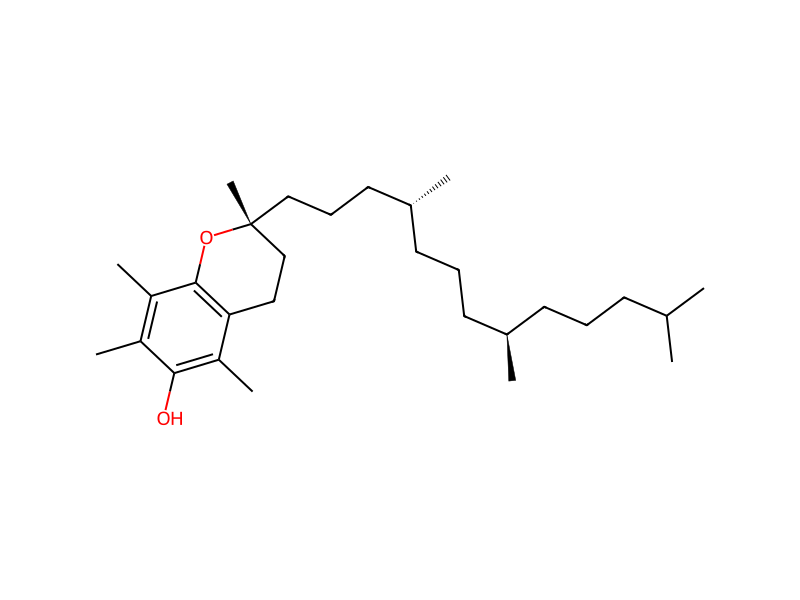
基本情報
- 標準SMILES
Cc1c(C)c2c(c(C)c1O)CC[C@@](C)(CCC[C@H](C)CCC[C@H](C)CCCC(C)C)O2- InChIKey
GVJHHUAWPYXKBD-IEOSBIPESA-N- 分子式
- C29H50O2
- 平均分子量
- 430.7 g/mol
- 単同位体質量
- 430.38108084
概要
(R,R,R)-alpha-tocopherol is an alpha-tocopherol that has R,R,R configuration. The naturally occurring stereoisomer of alpha-tocopherol, it is found particularly in sunflower and olive oils. It has a role as an antioxidant, an antiviral agent, a micronutrient, an EC 2.7.11.13 (protein kinase C) inhibitor, an anticoagulant, a nutraceutical, an immunomodulator, an antiatherogenic agent, a plant metabolite and an algal metabolite. It is an enantiomer of a (S,S,S)-alpha-tocopherol.
名称と識別子
- 優先名称
- alpha-Tocopherol
- IUPAC
- (2R)-2,5,7,8-tetramethyl-2-[(4R,8R)-4,8,12-trimethyltridecyl]-3,4-dihydrochromen-6-ol
- 現地名
- 天然ビタミン E
- 英語名
- Tocopherol
- 分子式
- C29H50O2
- 分子量
- 430.71
名称と別名
alpha-Tocopherol59-02-9D-alpha-Tocopherol5,7,8-Trimethyltocol(+)-alpha-Tocopherol2074-53-5PhytogermineEprolin(R,R,R)-alpha-Tocopherola-Vitamin EDenamoneViteolin
名称をさらに表示
エレビットホルトエビオントコフェロールエクアソールE天然ビタミン EビタミンEMixed TocopherolsA-TOCOPHEROLDL-TOCOPHEROLRAC-ALPHA-TOCOPHEROLALL-RAC-ALPHA-TOCOPHEROLDL-ALPHA TOCOPHERYL ACETATE 500(2R)-2,5,7,8-tetramethyl-2-[(4R,8R)-4,8,12-trimethyltridecyl]-3,4-dihydrochromen-6-olErevit forteIRGANOX E 201DL-PROFECUNDIN
EtavitEsorb(2R,4'R,8'R)-alpha-Tocopherolalpha Tocopherolalpha-Vitamin EAquasol Ealpha-Tocopherol, D-Vitamin-E
データベース識別子
- CAS
1406-18-4、2074-53-5、59-02-9- PubChem CID
- 14985
- DTXSID
DTXSID0026339- ChEMBL
CHEMBL47- ChEBI
CHEBI:18145- UNII
- N9PR3490H9
- EC Number
- 200-412-2、215-798-8、218-197-9、606-803-8
- Nikkaji
- J24.260H
物性
構造計算による物性
- XLogP
- 10.7
- 極性表面積
- 29.5 Ų
- 水素結合供与体数
- 1
- 水素結合受容体数
- 2
- 回転可能結合数
- 12
- 重原子数
- 31
- 形式電荷
- 0
- 複雑度
- 503
実験および物理化学的性質
Chemical ClassesBiological Agents -> Vitamins and Derivatives
DrugsPharmaceuticals -> Listed in ZINC15
LipidsLipids -> Prenol Lipids [PR] -> Quinones and hydroquinones [PR02] -> Vitamin E [PR0202]
SpringerMaterials PropertiesChemical diffusion
FragrancesFragrance Ingredient (2H-1-Benzopyran-6-ol, 3,4-dihydro-2,5,7,8-tetramethyl-2-[(4R,8R)-4,8,12-trimethyltridecyl]-, (2R)-) -> IFRA transparency List
Endocrine DisruptorsPotential endocrine disrupting compound
Melting Point3 °C
Vapor Pressure0.00000001 [mmHg]
Physical Description
Liquid
Transparent solid; mp = 2.5-3.5 deg C; [Merck Index] Pale yellow viscous liquid; [HSDB] Light yellow viscous liquid; [Sigma-Aldrich MSDS]
Liquid
Collision Cross Section
208.52 Ų [M-H]- [CCS Type: DT; Method: single field calibrated with Agilent tune mix (Agilent)]
208.9 Ų [M-H]-
物理化学的性質
- 融点
- 292 °C · 292 °C
- 貯蔵温度
- 0 · 0-6°C
- 溶解性
- 3 · 可溶((CH3)2CO, エタノール, CHCl3, (C2H5)2O), 不溶(水)
- 臭い (Odor)
- 代表的な植物油
- 化粧品成分の機能
- 香料皮膚コンディショニング - 閉塞性スキンコンディショニング - その他抗酸化物質
- LogP
- 10.962 · 10.962 (est)
- CAS データベース
- 1406 · 1406-18-4(CAS DataBase Reference)
- NISTの化学物質情報
- «alpha»-Tocopherol(1406-18-4)
- EPAの化学物質情報
- Vitamin E (1406-18-4)
化学的性質
化学的特性Viscous oils. Soluble in fats; insoluble in water. Stable to heat in the absence of oxygen, to strong acids, and to visible light; unstable to UV light, alkalies, and oxidation.
化学性质トコフェロールはフェノール性の水酸基を持つクロマノール環という特徴的な構造を持っていますこの構造によりトコフェロールは細胞膜を保護することにより細胞を酸化ストレスから守る能力を持っていますまたトコフェロールは脂溶性であり体内の脂質と容易に結びつくことができます
安全と法規制
GHS分類
GHS Classification
This chemical does not meet GHS hazard criteria for 92.8% (270 of 291) of all reports.
Not Classified
Aggregated GHS information provided per 291 reports by companies from 4 notifications to the ECHA C&L Inventory.
This chemical does not meet GHS hazard criteria for 31.8% (7 of 22) of reports.
Warning
H317 (68.2%): May cause an allergic skin reaction [Warning Sensitization, Skin]
危険有害性情報
Regulatory Information
Chemical: 2H-1-Benzopyran-6-ol, 3,4-dihydro-2,5,7,8-tetramethyl-2-(4,8,12-trimethyltridecyl)-, [2R-[2R*(4R*,8R*)]]-
Chemical: 2H-1-Benzopyran-6-ol, 3,4-dihydro-2,5,7,8-tetramethyl-2-(4,8,12-trimethyltridecyl)-, [2R*(4R*,8R*)]-(.+-.)-
Regulation (EC) No 1831/2003 (amended)
2H-1-Benzopyran-6-ol, 3,4-dihydro-2,5,7,8-tetramethyl-2-[(4R,8R)-4,8,12-trimethyltridecyl]-, (2R)- is listed on the EPA's Chemical Data Reporting (CDR) system. Manufacturers and importers of 2H-1-Benzopyran-6-ol, 3,4-dihydro-2,5,7,8-tetramethyl-2-[(4R,8R)-4,8,12-trimethyltridecyl]-, (2R)- are required to report information about their production and use of this chemical to the EPA under the Toxic Substances Control Act (TSCA). (40 eCFR Part 711)
Status: Active Update: 13-11-2019 https://echa.europa.eu/registration-dossier/-/registered-dossier/11202
2H-1-Benzopyran-6-ol, 3,4-dihydro-2,5,7,8-tetramethyl-2-(4R,8R)-4,8,12-trimethyltridecyl-, (2R)-rel-: Does not have an individual approval but may be used under an appropriate group standard
Other Safety Information
Evaluation - Tocopherols and their salts and esters
Evaluation - Tocopherols and their salts and esters
Hazards SummaryAcceptable daily intake (ADI) of 0.15-2 mg/kg; [JECFA] Excessive, chronic ingestion can cause nausea, headaches, and weakness. [Olson, p. 446] May cause irritation; [Sigma-Aldrich MSDS]
EPA Safer ChemicalChemical: alpha-Tocopherol
Hazard Classes and Categories
Skin Sens. 1B (68.2%)
Not Classified
毒性情報
Exposure RoutesOral, Topical, Intramuscular
50 to 80% absorbed from gastrointestinal tract.
Toxicity Summary
Although all forms of Vitamin E exhibit antioxidant activity, it is known that the antioxidant activity of vitamin E is not sufficient to explain the vitamin's biological activity. <br/>Vitamin E's anti-atherogenic activity involves the inhibition of the oxidation of LDL and the accumulation of oxLDL in the arterial wall. It also appears to reduce oxLDL-induced apoptosis in human endothelial cells. Oxidation of LDL is a key early step in atherogenesis as it triggers a number of events which lead to the formation of atherosclerotic plaque. In addition, vitamin E inhibits protein kinase C (PKC) activity. PKC plays a role in smooth muscle cell proliferation, and, thus, the inhibition of PKC results in inhibition of smooth muscle cell proliferation, which is involved in atherogenesis. <br/>Vitamin E's antithrombotic and anticoagulant activities involves the downregulation of the expression of intracellular cell adhesion molecule(ICAM)-1 and vascular cell adhesion molecule(VCAM)-1 which lowers the adhesion of blood components to the endothelium. In addition, vitamin E upregulates the expression of cytosolic phospholipase A2 and cyclooxygenase (COX)-1 which in turn enhances the release of prostacyclin. Prostacyclin is a vasodilating factor and inhibitor of platelet aggregation and platelet release. It is also known that platelet aggregation is mediated by a mechanism involving the binding of fibrinogen to the glycoprotein IIb/IIIa (GPIIb/IIIa) complex of platelets. GPIIb/IIIa is the major membrane receptor protein that is key to the role of the platelet aggregation response. GPIIb is the alpha-subunit of this platelet membrane protein. Alpha-tocopherol downregulates GPIIb promoter activity which results in reduction of GPIIb protein expression and decreased platelet aggregation. Vitamin E has also been found in culture to decrease plasma production of thrombin, a protein which binds to platelets and induces aggregation. A metabolite of vitamin E called vitamin E quinone or alpha-tocopheryl quinone (TQ) is a potent anticoagulant. This metabolite inhibits vitamin K-dependent carboxylase, which is a major enzyme in the coagulation cascade.<br/>The neuroprotective effects of vitamin E are explained by its antioxidant effects. Many disorders of the nervous system are caused by oxidative stress. Vitamin E protects against this stress, thereby protecting the nervouse system. <br/>The immunomodulatory effects of Vitamin E have been demonstrated in vitro, where alpha-tocopherol increases mitogenic response of T lymphocytes from aged mice. The mechanism of this response by vitamin E is not well understood, however it has been suggested that vitamin E itself may have mitogenic activity independent of its antioxidant activity. <br/>Lastly, the mechanism of action of vitamin E's antiviral effects (primarily against HIV-1) involves its antioxidant activity. Vitamin E reduces oxidative stress, which is thought to contribute to HIV-1 pathogenesis, as well as to the pathogenesis of other viral infections. Vitamin E also affects membrane integrity and fluidity and, since HIV-1 is a membraned virus, altering membrane fluidity of HIV-1 may interfere with its ability to bind to cell-receptor sites, thus decreasing its infectivity.
Carcinogen ClassificationNo indication of carcinogenicity to humans (not listed by IARC).
安全データ
- tsca
- TSCA listed
化学と産業
薬理情報
Metabolism/MetabolitesHepatic.
Tissue LocationsAdipose Tissue
Cellular LocationsCytoplasm
用途と製造
Uses
The bioactive natural form of vitamin E found in green vegetables, grains, and oils (especially palm, safflower, and sunflower); Used as an antioxidant in oils and as a vitamin E supplement; [Merck Index] Used as a medication and animal feed additive; [HSDB]
Farming (Feed Additives) [Category: Industry]
Vitamin E, known for its antioxidant activities, is protective against cardiovascular disease and some forms of cancer and has also demonstrated immune-enhancing effects. It may be of limited benefit in some with asthma and rheumatoid arthritis. It may be helpful in some neurological diseases including Alzheimer's, some eye disorders including cataracts, and diabetes and premenstrual syndrome. It may also help protect skin from ultraviolet irradiation although claims that it reverses skin aging, enhances male fertility and exercise performance are poorly supported. It may help relieve some muscle cramps.
U.S. Production2023: 21,006 lb
Consumer UsesFragrance
Industry UsesFragrance
Use Classification
EPA Safer Chemical Functional Use Classes -> Preservatives and Antioxidants
Safer Chemical Classes -> Green circle - The chemical has been verified to be of low concern
Fragrance Ingredients
Food Additives -> ANTIOXIDANT; NUTRIENT_SUPPLEMENT -> JECFA Functional Classes
Food Additives -> ANTIOXIDANT; NUTRIENT_SUPPLEMENT -> JECFA Functional Classes
Food Additives -> ANTIOXIDANT; NUTRIENT_SUPPLEMENT -> JECFA Functional Classes
General Manufacturing Information
Soap, Cleaning Compound, and Toilet Preparation Manufacturing
2H-1-Benzopyran-6-ol, 3,4-dihydro-2,5,7,8-tetramethyl-2-[(4R,8R)-4,8,12-trimethyltridecyl]-, (2R)-: ACTIVE
応用分野
解説動物の健全な妊娠分娩に必要な,ビタミンE作用を有するトコールのメチル誘導体.メチル基の数と位置により,α-,β-,γ-,δ-トコフェロールなどとよばれる.小麦胚芽油,綿実油,大豆油などの植物油に0.1~0.3% 含まれている.2位の不斉炭素に関し,天然品はR形である.α-,β-,そのほかのトコフェロールのビタミンE活性は約100:33:1である.ビタミンEの国際単位は(±)-α-トコフェロールの酢酸エステル1 mg に相当する.
使用Fat-soluble vitamin E, which is a light yellow oil readily degradable by heat. As a vitamin, it is essential for normal muscle growth and prevents vitamin A destruction by deterioration. It also functions as an antioxidant. It prevents the oxidation of certain fatty acids and is stable unless the food becomes rancid. Vegetable oils contain a higher concentration of natural antioxidants, including tocopherols, than animal fats and are thus more stable. Tocopherol is obtained from vegetable oils, beans, eggs, and milk. It is also termed alpha-tocopherol.
使用用途トコフェロールの主な使用用途は、サプリメントの主成分、動物用飼料の添加剤などです。その他、酸化防止のための微量添加物として使用される場合もあります。例として、食品または化粧品の酸化防止剤などが挙げられます。 トコフェロールは、酸化防止効果を利用して、アンチエイジングを目的とした製品に使用される場合があります。1日あたりの推奨摂取量は、年齢や性別によって異なりますが6.0mg~6.5mg/日です。油溶性で体内に蓄積しやすく、過剰に摂取すると健康被害をおよぼす可能性があるため注意が必要です。
調製方法
製造方法Tocopherol is synthesised in two ways. One is to extract it from natural plant sources and the other is to obtain it by chemical synthesis. The following are the chemical synthesis routes:The most important natural raw materials for production of tocopherols by extraction are deodoriser sludges, which are distillates obtained in the deodorisation of vegetable oils. Such distillates contain sterols, sterol esters and triacylglycerols, as well as tocopherols and tocotrienols. The concentration of tocopherols depends on the deodorisation parameters (temperature, vacuum, quantity of injected steam and equipment) but their amount is lower than 10%, usually 8–9 %, of unsaponifiable matter present. Separation of tocopherol from the other distilled compounds is possible by several methods: (1) by esterification with a lower alcohol, washing and vacuum distillation; (2) by saponification, or (3) by fractional liquid–liquid extraction. The concentrates obtained in this way may be purified further by molecular distillation, extraction, crystallisation, or combinations of these procedures.The tocopherol concentrates recommended as antioxidants are mixtures with relatively high contents of γ-tocopherol and δ-tocopherol (being obtained from soybean oil), but α-tocopherol is also present. The total tocopherol concentration usually lies between 30 and 80%. The rest is constituted of triacylglycerols.
上流・下流製品情報
上流原料
サプライヤー50 社
北京华美互利生物化工010-56205725 · [email protected]
湖北永阔科技有限公司027-59223108 15972152991 · [email protected]
湖北万得化工有限公司15377098680 15377098680 · [email protected]
深圳市星凯越生物科技有限公司0755-18589069862 18589069862 · [email protected]
HebeiShuoshengImportandExportco.,Ltd+86-18532138899 · [email protected]
江苏智芯廷科技有限公司18221391031 · [email protected]
河北创之源生物科技有限公司13012111162
湖北金梭生物科技有限公司00123456789 · [email protected]
Hubei Lidu New Material Technology Co., Ltd+86-19307248857 +86-19307248857 · [email protected]
河北创海生物科技有限公司+86-86-13131129325 · [email protected]
陕西帕尼尔生物科技有限公司029-84385017; +8613259417953 · [email protected]
Shanghai Enviko Biotechnologyg Co.,Ltd+86-13918629532 +86-13918629532 · [email protected]
湖南瑞威尔生物科技有限公司15608648206 13297919155 · [email protected]
江西瑞威尔生物科技有限公司18502728206 · [email protected]
广州蒂嚎医药科技有限公司18602015453
梯希爱(上海)化工贸易有限公司021-61109150 · [email protected]
江苏索腾新材料科技有限公司0510-86686637; 13806163055 · [email protected]
淄博容纳生物科技有限公司+86-86-13583358881 +8618560316533 · [email protected]
上海相辉医药科技有限公司13761987713; 13761987713 · [email protected]
上海艾梯西生物科技有限公司18721763493
山东沃德森生物科技有限公司0531-88723173 18596073690 · [email protected]
湖北广奥生物科技有限公司027-02702759223056 18162699093 · [email protected]
湖北成海化工有限公司027-59220433 18327245847 · [email protected]
贵州迪大科技有限责任公司0851-8475-2296 18096062265 · [email protected]
南京唯博特医药科技有限公司18066048793; 18014498793 · [email protected]
台州市裕欣生物科技有限公司+86-0576--88902229 +86-13968687450
ZHEJIANG JIUZHOU CHEM CO., LTD+86-0576225566889 +86-13454675544 · [email protected];[email protected];[email protected]
济南睿通生物科技有限公司+86-16615778970 +86-16615778970 · [email protected]
南京生利德生物科技有限公司025-57798810 18652991625 · [email protected]
湖北鑫源顺医药化工有限公司13971561712, 13995564702, 027-50664929 · [email protected]
杭州大海生物医药有限公司63811159 18906514933
上海卓因生物科技有限公司021-61317773 · [email protected]
Chongqing jooe co., ltd+86-15223382610 · [email protected]
湖北宝凌化工科技有限公司13129969326 · [email protected]
池州凯隆进出口贸易有限公司[email protected]
上海一研生物科技有限公司021-69985186 13611928337 · [email protected]
上海昕凯医药科技有限公司21-619849051-1 18521059765 · [email protected]
湖北恒绿源科技有限公司027-88188016 18717196322 · [email protected]
Alfa Chemistry+1-5166625404 · [email protected]
Qiuxian Baitai New Material Co., LTD+86-19932103556 · [email protected]
武汉福鑫化工有限公司+86-2759207851; +86-18007136271 · [email protected]
南京熙朗化工产品有限公司18936048580 · [email protected]
上海源叶生物科技有限公司13636370518 · [email protected]
上海西格生物科技有限公司021-57810052 18930344717 · [email protected]
湖南瑞威尔生物科技有限公司18502762003
成都标样生物科技有限公司028-81700200 13308200041 · [email protected]
湖北齐飞医药化工有限公司027-59322506 18071128681 · [email protected]
河北贞佳新材料有限公司0319-5925599 13315915972
武汉魔力生物科技有限公司18872289958、027-52304252、3400508168 · [email protected]
郑州汇聚化工有限公司0371-55900031 18137872243 · [email protected]
補足説明
定義本品は、ビタミンEであり、次の化学式で表される。
定義(vitamin E). Any of a group of related substances (α-, β-, γ-, andΔ-tocopherol) that constitute vitamin E. The α-form (which occurs naturally as the d-isomer) is the most potent. Occurs naturally in plants, especially wheat germ. All are derivatives of dihydrobenzo-γ-pyran and differ from each other only in the number and position of methyl groups. Vitamin E is required by certain rodents for normal reproduction. Muscular and central nervous system depletion along with generalized edema are deficiency symptoms in all animals. It is not required as a dietary supplement for humans.
関連反応
60 件


関連ノート
読み込み中…