
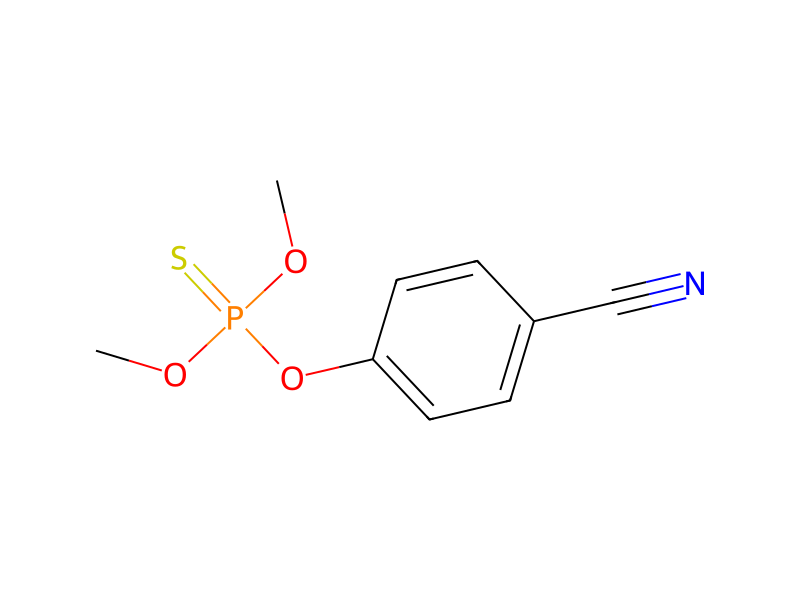
基本情報
- 標準SMILES
COP(=S)(OC)Oc1ccc(C#N)cc1- InChIKey
SCKHCCSZFPSHGR-UHFFFAOYSA-N- 分子式
- C9H10NO3PS
- 平均分子量
- 243.22 g/mol
- 単同位体質量
- 243.01190135
名称と識別子
- 優先名称
- Cyanophos
- IUPAC
- 4-dimethoxyphosphinothioyloxybenzonitrile
- 現地名
- チオりん酸O,O-ジメチルO-[p-シアノフェニル]
- 英語名
- CYANOPHOS
- 分子式
- C9H10NO3PS
- 分子量
- 243.22
名称と別名
CYANOPHOS2636-26-2CiafosCyanoxCYAPCynockSumitomo S 4084Bayer 34727BAY 34727O-(4-Cyanophenyl) O,O-dimethyl phosphorothioateO,O-Dimethyl-O-p-cyanophenyl phosphorothioateO-p-Cyanophenyl O,O-dimethyl phosphorothioate
名称をさらに表示
サイアノックスシアノホスチオりん酸O,O-ジメチルO-[p-シアノフェニル]シアホスCYAP剤シアノックスチオりん酸O-(4-シアノフェニル)O,O-ジメチルO-(4-シアノフェニル)O,O-ジメチルホスホロチオアートシアノホス標準品O(4シアノフェニル)O,OジメチルホスホロチオアトO,O-ジメチル=O-(4-シアノフェニル)=ホスホロチオアート[別名:シアノホス(CYAP)]CS_N-11517-100MG_シアノホスシアノホス STANDARDCYAP標準品シアノホス Standard, 100 µg/mL in MeOHO-4-シアノフェニル O,O-ジメチル ホスホロチオアートO,O-ジメチル-O-4-シアノフェニルホスホロチオエート標準品ジメチルパラシアンフエニル-チオホスフエイトs4084oms226oms869S-4084Cynodk
OMS 226OMS 869O,O-Dimethyl O-(4-cyanophenyl) thionophosphate4-(Dimethoxyphosphinothioyloxy)benzonitrilePhosphorothioic acid, O-(4-cyanophenyl) O,O-dimethyl esterO,O-Dimethyl O-4-cyanophenyl phosphorothioateENT 25,675S 4084
データベース識別子
- CAS
2636-26-2- PubChem CID
- 17522
- DTXSID
DTXSID0041806- ChEMBL
CHEMBL2271089- ChEBI
CHEBI:38621- UNII
- 2AB0Z99OXP
- EC Number
- 220-130-3
- Nikkaji
- J3.394D
物性
構造計算による物性
- XLogP
- 2.7
- 極性表面積
- 83.6 Ų
- 水素結合供与体数
- 0
- 水素結合受容体数
- 5
- 回転可能結合数
- 4
- 重原子数
- 15
- 形式電荷
- 0
- 複雑度
- 285
実験および物理化学的性質
LogPlog Kow = 2.71
OdorFaint characteristic odor
Density
1.255 to 1.265 at 77 °F H2O = 1 (EPA, 1998)
1.255-1.265 at 25 °C
1.255-1.265 @25 °C
Color/Form
Yellow to reddish-yellow transparent liquid
Clear amber liquid
Solubility
Solubility: 46 mg/l water at 30 °C; 27 g/kg hexane at 20 °C /Technical grade/
Very soluble in methanol, ethanol, acetone & chloroform. Sparingly soluble in n-hexane, kerosene.
In water at 30 °C, 46 mg/l. In n-hexane 27, methanol 1000, xylene 1000 (all in g/kg) at 20 °C.
Miscible in alcohols, benzene, chloroform, ketones, toluene, xylene.
In water 46 mg/l at 30 °C; in methanol, acetone, chloroform >50% at 20 °C.
Flash Point104 °C
Boiling Point
246 to 248 °F at 0.09 mmHg Decomposes (EPA, 1998)
119-120 °C (decomp) at 0.09 mm Hg
Decomposition
Rapidly decomposes under alkaline conditions and upon exposure to light.
Decomposes at 119-120 °C.
Melting Point
57 to 59 °F (EPA, 1998)
14-15 °C
Vapor Pressure
0.0008 mmHg at 68 °F (EPA, 1998)
0.000788 [mmHg]
Vapor pressure: 105 mPa at 20 °C /Technical grade/
105 mPa at 20 °C
Refractive IndexIndex of refraction: 1.5404 at 32.5 °C/D
Physical Description
Cyanophos is a yellow to reddish-yellow transparent liquid. Used as an insecticide against rice stem borers and house flies. Not registered as a pesticide in the U.S. (EPA, 1998)
Yellow to reddish-yellow transparent liquid; Rapidly decomposed by light and alkalinity; mp = 14-15 deg C; [Merck Index] Colorless liquid; [MSDSonline]
物理化学的性質
- 融点
- 14 · 14-15°
- 沸点
- 0.09 · bp0.09 119-120° (dec)
- 比重(密度)
- 1.255 · 1.255-1.265 g/cm3(Temp: 25 °C)
- 蒸気圧
- 1.05 x · 1.05 x 10-1 Pa (20 °C)
- 屈折率
- 32.5 · nD32.5 1.5404
- 闪点
- 100 °C · >100 °C
- 貯蔵温度
- 0 · 0-6°C
- 水溶解度
- 46 mg · 46 mg l-1 (30 °C)
- 外見
- 液体
- 比重
- 1.255 · 1.255~1.265
- Merck
- 13 · 13,2283
- BRN
- 2695901 · 2695901
- Henry's Law Constant
- 1.8 · 1.8×100 mol/(m3Pa) at 25℃, HSDB (2015)
- 主な用途
- 農業環境
- InChI
- 1S/C9H10NO3PS/c1-11-14(15,12-2)13-9-5-3-8(7-10)4-6-9/h3-6H,1-2H3
- InChIKey
- SCKHCCSZFPSHGR-UHFFFAOYSA-N
- SMILES
- COP(=S)(OC)Oc1ccc(cc1)C#N
- EPAの化学物質情報
- Cyanophos (2636-26-2)
化学的性質
化学的特性Cyanophos is a yellow to reddish-yellow or amber liquid.
安全と法規制
GHS分類
GHS Classification
Warning
H302: Harmful if swallowed [Warning Acute toxicity, oral];H312: Harmful in contact with skin [Warning Acute toxicity, dermal];H400: Very toxic to aquatic life [Warning Hazardous to the aquatic environment, acute hazard];H410: Very toxic to aquatic life with long lasting effects [Warning Hazardous to the aquatic environment, long-term hazard]
P264, P270, P273, P280, P301+P317, P302+P352, P317, P321, P330, P362+P364, P391, and P501 (click each P-code to see the statement)
Warning
危険有害性情報
Regulatory InformationThe New Jersey Worker and Community Right to Know Act requires public and private employers to provide information about hazardous substances at their workplaces. (N.J.S.A. 34:5A-1 et. seq.)
DOT LabelPoison
Fire Hazards
(Non-Specific -- Organophosphorus Pesticide, Liquid, n.o.s.) Container may explode in heat of fire. Fire and runoff from fire control water may produce irritating or poisonous gases. Unstable. Rapidly decomposes under alkaline conditions and upon exposure to light. (EPA, 1998)
Health HazardsCyanophos is an organophosphorus insecticide. It is a cholinesterase inhibitor. Death may occur after a massive oral dose; with smaller accidental doses, onset of illness may be delayed. (EPA, 1998)
Hazards Summary
A cholinesterase inhibitor; [Merck Index] Effects in high-dose animal studies include convulsions and spastic paralysis; [RTECS] The average of two baseline respective cholinesterase activity determinations three days apart, with no exposures to enzyme inhibiting pesticides for at least 30 days, is recommended for each worker prior to exposure to cholinesterase inhibitors because of large inter-individual differences in published baseline values. To be established at least once a year. Removal from workplace exposures is recommended until the cholinesterase activity returns to within 20% of baseline. [TLVs and BEIs]
Reactive GroupEsters, Sulfate Esters, Phosphate Esters, Thiophosphate Esters, and Borate Esters;Nitriles
Reactivity Profile
Organophosphates, such as CYANOPHOS, are susceptible to formation of highly toxic and flammable phosphine gas in the presence of strong reducing agents such as hydrides. Partial oxidation by oxidizing agents may result in the release of toxic phosphorus oxides.
DOT Hazard Classification
Cyanophos
Marine pollutant
Air and Water ReactionsNo rapid reaction with air. No rapid reaction with water.
Other Hazardous Reactions
A portion of even the most flammable materials is likely to be lost by vaporization. ... The smoke from an open fire used to destroy pesticides will contain some of the poison. Burning should be attempted only in an isolated place. Inhalation of smoke must be avoided. /Pesticides/
Hazard Classes and Categories
Acute Tox. 4 (97.7%);Acute Tox. 4 (97.7%);Aquatic Acute 1 (100%);Aquatic Chronic 1 (100%)
Acute toxicity - category 4;Acute toxicity - category 4;Hazardous to the aquatic environment (acute) - category 1;Hazardous to the aquatic environment (chronic) - category 1
Acute toxicity (Oral) - Category 4;Acute toxicity (Dermal) - Category 3;Reproductive toxicity - Category 2;Specific target organ toxicity - Single exposure - Category 1 (nervous system);Specific target organ toxicity - Repeated exposure - Category 1 (nervous system);Hazardous to the aquatic environment (Acute) - Category 1
Self-reactive substances and mixtures - Type G;Acute toxicity (Oral) - Category 4;Acute toxicity (Dermal) - Category 3;Specific target organ toxicity - Single exposure - Category 1 (nervous system, cardiovascular system, respiratory organs);Specific target organ toxicity - Repeated exposure - Category 1 (nervous system);Hazardous to the aquatic environment (Acute) - Category 1;Hazardous to the aquatic environment (Long-term) - Category 1
Acute Tox. 4 *;Acute Tox. 4 *;Aquatic Acute 1;Aquatic Chronic 1
Standard Transportation Number
49 216 74; Organophosphorus pesticide, liquid, not otherwise specified (compounds and preparations) (insecticides, other than agricultural, NEC)
49 216 75; Organophosphorus pesticide, liquid, not otherwise specified (compounds and preparations) (agricultural insecticides, NEC, liquid)
49 105 44; Organophosphorus pesticide, liquid, not otherwise specified (compounds and preparations) (insecticides, other than agricultural, NEC)
49 105 45; Organophosphorus pesticide, liquid, not otherwise specified (compounds and preparations) (agricultural insecticides, NEC, liquid)
安全と保護具
Fire Fighting
(Non-Specific -- Organophosphorus Pesticide, Liquid, n.o.s.) Stay upwind; keep out of low areas. Move container from fire area if you can do it without risk. Fight fire from maximum distance. Dike fire control water for later disposal; do not scatter the material. Wear positive pressure breathing apparatus and special protective clothing.;(Non-Specific -- Organophosphorus Pesticide, Liquid, n.o.s.) This material may burn, but does not ignite readily. For small fires, use dry chemical, carbon dioxide, water spray, or foam. For large fires, use water spray, fog, or foam. (EPA, 1998)
First Aid
Warning: Effects may be delayed up to 12 hours. Caution is advised.;Note: Cyanophos is a cholinesterase inhibitor.;Signs and Symptoms of Cyanophos Exposure: Acute exposure to cyanophos may produce the following signs and symptoms: sweating, pinpoint pupils, blurred vision, headache, dizziness, profound weakness, muscle spasms, seizures, and coma. Mental confusion and psychosis may occur. Excessive salivation, nausea, vomiting, anorexia, diarrhea, and abdominal pain may also occur. The heart rate may decrease following oral exposure or increase following dermal exposure. Chest pain may be noted. Hypotension (low blood pressure) may be observed, although hypertension (high blood pressure) is not uncommon. Respiratory symptoms include dyspnea (shortness of breath), pulmonary edema, respiratory depression, and respiratory paralysis.;Emergency Life-Support Procedures: Acute exposure to cyanophos exposure may require decontamination and life support for the victims. Emergency personnel should wear protective clothing appropriate to the type and degree of contamination. Air-purifying or supplied-air respiratory equipment should also be worn, as necessary. Rescue vehicles should carry supplies such as plastic sheeting and disposable plastic bags to assist in preventing spread of contamination.;Inhalation Exposure:;1. Move victims to fresh air. Emergency personnel should avoid self-exposure to cyanophos.;2. Evaluate vital signs including pulse and respiratory rate, and note any trauma. If no pulse is detected, provide CPR. If not breathing, provide artificial respiration. If breathing is labored, administer 100% humidified oxygen or other respiratory support.;3. Obtain authorization and/or further instructions from the local hospital for administration of an antidote or performance of other invasive procedures.;4. Transport to a health care facility.;Dermal/Eye Exposure:;1. Remove victims from exposure. Emergency personnel should avoid self-exposure to cyanophos.;2. Evaluate vital signs including pulse and respiratory rate, and note any trauma. If no pulse is detected, provide CPR. If not breathing, provide artificial respiration. If breathing is labored, administer 100% humidified oxygen or other respiratory support.;3. Remove contaminated clothing as soon as possible.;4. If eye exposure has occurred, eyes must be flushed with lukewarm water for at least 15 minutes.;5. Wash exposed skin areas three times with soap and water.;6. Obtain authorization and/or further instructions from the local hospital for administration of an antidote or performance of other invasive procedures.;7. Transport to a health care facility.;Ingestion Exposure:;1. Evaluate vital signs including pulse and respiratory rate, and note any trauma. If no pulse is detected, provide CPR. If not breathing, provide artificial respiration. If breathing is labored, administer 100% humidified oxygen or other respiratory support.;2. Obtain authorization and/or further instructions from the local hospital for administration of an antidote or performance of other invasive procedures.
Exposure Control and Personal Protection
Biological Exposure Indices (BEI) [ACGIH] - Acetylcholinesterase activity in red blood cells = 70% of individual's baseline; Butylcholinesterase activity in serum or plasma = 60% of individual's baseline; Sample at end of shift; [TLVs and BEIs]
Fire Fighting Procedures
Use water, foam, carbon dioxide, or dry chemical to extinguish fires. /Malathion/
AREA SURROUNDING FIRE SHOULD BE DIKED TO PREVENT WATER RUNOFF. /MALATHION/
WEAR SELF CONTAINED BREATHING APPARATUS (OR RESPIRATOR FOR ORGANOPHOSPHATE PESTICIDES) AND RUBBER CLOTHING WHILE FIGHTING FIRES OF MALATHION WITH CHLORINE BLEACH SOLN. ALL CLOTHING CONTAMINATED BY FUMES AND VAPORS MUST BE DECONTAMINATED. /MALATHION/
If material on fire or involved in fire: Do not extinguish fire unless flow can be stopped or safely confined. Use water in flooding quantities as fog. Solid streams of water may be ineffective. Cool all affected containers with flooding quantities of water. Apply water from as far a distance as possible. Use "alcohol" foam, carbon dioxide or dry chemical. /Organophosphorus pesticides, liquid, NOS/
Storage Conditions
Rooms used for storage only should be soundly constructed & fitted with secure locks. Floors should be kept clear & pesticides clearly identified. If repacking is carried out in storage rooms, adequate light should be available; floors should be impervious & sound ... . /Pesticides/
Pesticides containers must be provided with labels indicating the degree of toxicity of the product they contain. The labels must not only give a short description of how to use the prepn, but also state basic precautions to be taken when applying it. /Organophosphorus pesticides/
Pesticides of any degree of toxicity should be transported in containers which are clearly labelled, leak-proof, and not easily damaged. They should never be transported /or stored/ beside, or above any type of food, and all spillages should be immediately reported. /Pesticides/
Cleanup Methods
1. VENTILATE AREA OF SPILL OR LEAK. 2. COLLECT FOR RECLAMATION OR ABSORB IN VERMICULITE, DRY SAND, EARTH, OR A SIMILAR MATERIAL. /MALATHION/
Spills of malathion on floors shall be absorbed with absorbing clay. Sweeping compound may be utilized to facilitate the removal of all visible traces of malathion contaminated clay. Equipment and fixtures contaminated with malathion shall be decontaminated with an alkaline solution (5% sodium hydroxide). /Malathion/
... Alternative treatment process for spent filter cake from malathion mfr requires the following steps: (1) hydrolysis; (2) steam stripping; (3) decantation; (4) composting; & (5) biological treatment. /Malathion/
Ultraviolet radiation in conjunction with ozone is a highly effective degradation technique for malathion ... /Malathion/
Nonfire Spill Response
(Non-Specific -- Organophosphorus Pesticide, Liquid, n.o.s.) Stay upwind; keep out of low areas. Ventilate closed spaces before entering them. Remove and isolate contaminated clothing at the site. Do not touch spilled material. Use water spray to reduce vapors. Take up small spills with sand or other noncombustible absorbent material and place in containers for later disposal. Dike far ahead of large spills for later disposal. (EPA, 1998)
Disposal Methods
SRP: At the time of review, criteria for land treatment or burial (sanitary landfill) disposal practices are subject to significant revision. Prior to implementing land disposal of waste residue (including waste sludge), consult with environmental regulatory agencies for guidance on acceptable disposal practices.
MALATHION MAY BE DISPOSED OF BY ABSORBING IN VERMICULITE, DRY SAND, EARTH, OR A SIMILAR MATERIAL ... & /DISPOSING OF SO AS TO MEET LOCAL, STATE, & FEDERAL REGULATIONS/. /MALATHION/
Incineration together with flammable solvent in furnace equipped with afterburner and scrubber is recommended. /Malathion/
The following wastewater treatment technologies have been investigated for Malathion: Biological treatment and reverse osmosis. /Malathion/
For more Disposal Methods (Complete) data for CYANOPHOS (9 total), please visit the HSDB record page.
Preventive Measures
In some situations where personnel may become accidently contaminated ... it is necessary to provide shower bath in addition to the usual washing facilities. Special arrangements for cleaning clothing & overalls may be necessary ... /Pesticides/
Special aircraft should preferably be used for spraying or dusting toxic organophosphorus pesticides. ... aerial spraying or dusting gives rise to clouds which spread over larger surfaces than clouds produced by ground application. Aerial spraying should therefore be carried out on windless days only. Residential areas, water supply sources, etc must be avoided. ... When aircraft approaches, signalmen /guiding the aircraft/ should leave the windward side. ... The local population should be informed about the site & time of aerial pesticide treatment. Access of unauthorized persons & especially children to the area to be treated must be ... forbidden. Warning signs should be placed at the limits of the area. Ground spraying must be carried out with compressed-air spraying equipment towed by tractors with closed cabs. /Organophosphorus pesticides/
Small packages of pesticides are preferable for individual application in order to limit the quantities to be weighed & metered. A special vessel with long stirring rod for dilution & suspension of the poison must be available in order to reduce manual handling to a minimum. The strict observance of hygiene rules--no smoking & no food intake during work. Thorough washing with soap after work, changing protective clothing before going home--is of utmost importance. /Organophosphorus pesticides/
Containers ... should be cleaned with a suspension of bleaching powder in water or with other alkaline soln after soaking for 24 hr and then be rinsed with hot water. /Organophosphorus pesticides/
For more Preventive Measures (Complete) data for CYANOPHOS (8 total), please visit the HSDB record page.
Isolation and Evacuation
Excerpt from ERG Guide 152 [Substances - Toxic (Combustible)]:;IMMEDIATE PRECAUTIONARY MEASURE: Isolate spill or leak area in all directions for at least 50 meters (150 feet) for liquids and at least 25 meters (75 feet) for solids.;SPILL: Increase the immediate precautionary measure distance, in the downwind direction, as necessary.;FIRE: If tank, rail tank car or highway tank is involved in a fire, ISOLATE for 800 meters (1/2 mile) in all directions; also, consider initial evacuation for 800 meters (1/2 mile) in all directions. (ERG, 2024)
Protective Action Criteria (PAC)
2.3 [mg/m3]
25 [mg/m3]
43 [mg/m3]
Personal Protective Equipment (PPE)
For emergency situations, wear a positive pressure, pressure-demand, full facepiece self-contained breathing apparatus (SCBA) or pressure- demand supplied air respirator with escape SCBA and a fully-encapsulating, chemical resistant suit. (EPA, 1998)
Respirator selection: Upper limit devices recommended by NIOSH: At 150 mg/cu m: Any supplied air respirator; or any self contained breathing apparatus; or any chemical cartridge respirator with organic vapor cartridge(s) in combination with a dust, mist, and fume filter. At 375 mg/cu m: Any supplied air respirator operated in a continuous flow mode; or any powered air purifying respirator with organic vapor cartridge(s) in combination with a dust, mist, and fume filter. At 750 mg/cu m: Any supplied-air respirator with a full facepiece; or any self contained breathing apparatus with a full facepiece; or any chemical cartridge respirator with a full facepiece and organic vapor cartridge(s) in combination with a high efficiency particulate filter; or any air purifying full facepiece respirator (gas mask) with a chin-style or front- or back-mounted organic vapor canister having a high efficiency particulate filter; or any powered air purifying respirator with a tight fitting facepiece and organic vapor cartridge(s) in combination with a high efficiency particulate filter; or any supplied air respirator with a tight fitting facepiece operated in a continuous flow mode. 5000 mg/cu m: Any supplied air respirator with a full facepiece and operated in a pressure demand or other positive pressure mode. Emergency or planned entry in unknown concentration or Immediately Dangerous to Life or Health (IDLH) conditions: Any self contained breathing apparatus with a full facepiece and operated in a pressure demand or other positive pressure mode; or any supplied air respirator with a full face piece and operated in pressure demand or other positive pressure mode in combination with an auxiliary self contained breathing apparatus operated in pressure demand or other positive pressure mode. Escape: Any air purifying full facepiece respirator (gas mask) with a chin-style or front- or back mounted organic vapor canister having a high efficiency particulate filter; or any appropriate esc
Employees should be provided with and required to use ... face shields (eight inch minimum), and other appropriate protective clothing necessary to prevent repeated, or prolonged skin contact with malathion. /Malathion/
Any employee whose work involves likely exposure of the skin to malathion or malathion formulations, eg, mixing or formulating, shall wear full body coveralls, or the equivalent, impervious gloves, and footwear. When there is danger of malathion coming in contact with the eyes, safety goggles shall be provided and worn. /Malathion/
Respiratory protection (supplied-air respirator with full facepiece or self-contained breathing apparatus) should be available where these compounds are manufactured or used and should be worn in case of emergency and overexposure. /Phosphorus compounds/
WORKERS HANDLING AND APPLYING ORGANOPHOSPHATE PESTICIDES (OPP) MUST ... BE GIVEN PERSONAL PROTECTIVE EQUIPMENT COMPRISING OVERALLS MADE OF A TIGHT FABRIC OR POLYVINYL CHLORIDE, GLOVES, AND RUBBER BOOTS. THEY MUST WEAR A RESPIRATOR WITH AN ACTIVATED-CARBON GAS FILTER CARTRIDGE AFFORDING PROTECTION FOR A DETERMINED NUMBER OF WORKING HOURS. THE EYES SHOULD BE PROTECTED BY GOGGLES. THE SIGNALMEN FOR AERIAL DUSTING OPERATIONS SHOULD BE EQUIPPED WITH A HAT AND CAPE MADE OF POLYVINYL CHLORIDE OR A FABRIC IMPREGNATED WITH A WATER REPELLENT. /PESTICIDES, ORGANOPHOSPHORUS/
毒性情報
Interactions
Some phenothiazines may antagonize & some may potentiate the toxic anticholinesterase effects of ... /organophosphorus insecticides/. /Organophosphate cholinesterase inhibitors/
In long term therapy, adrenocorticoids antagonize the antiglaucoma effects of anticholinesterases (incr ocular pressure). ... Anticholinergics antagonize the miotic (antiglaucoma) & other muscarinic effects of anticholinesterases on the autonomic & central nervous systems. Tricyclic antidepressants (anticholinergic effects) antagonize the antiglaucoma (miotic) effects of anticholinesterases in glaucoma. ... Antihistamines with anticholinergic effects antagonize the miotic (antiglaucoma) & CNS effects of anticholinesterases. Anticholinesterases potentiate tranquilizing & behavioral changes induced by antihistamines. The actions of anticholinesterase agents on autonomic effector cells, & to some extent those on CNS, are antagonized by atropine, an antidote of choice. Barbiturates are potentiated by anticholinesterases. ... Dexpanthenol potentiates the effects of anticholinesterases. Fluorophosphate insecticides potentiate the effects of other anticholinesterases. /Anticholinesterases/
BARBITURATES ARE POTENTIATED BY ANTICHOLINESTERASES. ALTHOUGH BARBITURATES MAY BE USED CAUTIOUSLY IN TREATING CONVULSIONS, EXTREME CARE IS ESSENTIAL IN HANDLING POISONINGS DUE TO ANTICHOLINESTERASES, PARTICULARLY ORGANOPHOSPHORUS PESTICIDES. ECHOTHIOPHATE, A CHOLINESTERASE INHIBITOR USED AS MIOTIC, POTENTIATES OTHER SUCH INHIBITORS ... USED FOR OTHER PURPOSES (ADDITIVE EFFECTS) OR POSSIBLY SYNERGISTIC. THOSE EXPOSED TO ORGANOPHOSPHATE INSECTICIDES MUST TAKE STRICT PRECAUTIONS. ... ORGANOPHOSPHORUS INSECTICIDES: ADDITIVE ANTICHOLINESTERASE EFFECTS. HAZARDOUS. PATIENTS ON ANTICHOLINESTERASES (EVEN TOPICAL, SUCH AS EYE DROPS) SHOULD AVOID AREAS WHERE ORGANOPHOSPHORUS INSECTICIDES ... RECENTLY ... USED. /ANTICHOLINESTERASE/
ANTICHOLINESTERASE (ORGANOPHOSPHORUS) INSECTICIDES ANTAGONIZE POLARIZING MUSCLE RELAXANTS. PHENOTHIAZINES /AND THIOXANTHENES/: ... MAY ENHANCE TOXIC EFFECTS OF ORGANOPHOSPHORUS INSECTICIDES. /INSECTICIDES, ORGANOPHOSPHORUS/
Ecotoxicity Values
LC50 Carp 5 mg/L (48 hr) /Conditions of bioassay not specified/
LC50 Harlequin fish 36 mg/L/24 hr, Flow-through
Environmental Fate
TERRESTRIAL FATE: Based on a recommended classification scheme(1), an estimated Koc value of 710(SRC), determined from an experimental log Kow of 2.71(2) and a recommended regression-derived equation(3), indicates that cyanophos is expected to have low mobility in soil(SRC). Volatilization of cyanophos from moist soil surfaces is expected(SRC) given an estimated Henry's Law constant of 5.5X10⁻⁶ atm-cu m/mole(SRC), determined from experimental values for vapor pressure, 7.9X10⁻⁴ mm Hg at 20 °C(4) and water solubility, 46 mg/l at 30 °C(5). Cyanophos is not expected to volatilize from dry soil surfaces based on the measured vapor pressure(4,SRC). After two weeks, measurable radioactivity in C14-cyanophos treated soils decreased to 6%(6). 4-Cyanophenol, desmethylcyanophos, and desmethylcyanophoson were identified as degradation products in soil(6). Photodecomposition products of cyanophos on soil TL plates exposed to sunlight were cyanophoson, desmethylcyanophoson, and 4-cyanophenol(7).
The half-life of cyanophos on bean foliage was less than 1 day(1).
AQUATIC FATE: Based on a recommended classification scheme(1), an estimated Koc value of 710(SRC), determined from an experimental log Kow of 2.71(2) and a recommended regression-derived equation(3), indicates that cyanophos is expected to adsorb to suspended solids and sediment in water(SRC). Cyanophos is expected to volatilize from water surfaces(3,SRC) based on an estimated Henry's Law constant of 5.5X10⁻⁶ atm-cu m/mole(SRC), determined from experimental values for vapor pressure, 7.9X10⁻⁴ mm Hg at 20 °C(4) and water solubility, 46 mg/l at 30 °C(5). Estimated half-lives for a model river and model lake are 11 and 82 days, respectively(3,SRC). According to a classification scheme(6), an estimated BCF value of 64(3,SRC), from an experimental log Kow of 2.71(2), suggests that bioconcentration in aquatic organisms is moderate, not high(SRC). A bioconcentration factor of 417 was measured in guppies under steady-state conditions(2). Photodecomposition products of cyanophos in water exposed to sunlight were cyanophoson, desmethylcyanophoson, and 4- cyanophenol(7).
ATMOSPHERIC FATE: According to a model of gas/particle partitioning of semivolatile organic compounds in the atmosphere(1), cyanophos, which has a measured vapor pressure of 7.9X10⁻⁴ mm Hg at 20 °C(2,SRC), is expected to exist solely as a vapor in the ambient atmosphere. Vapor-phase cyanophos is degraded in the atmosphere by reaction with photochemically-produced hydroxyl radicals(SRC); the half-life for this reaction in air is estimated to be about 6.5 hours(3,SRC).
Adverse EffectsOther Poison - Organophosphate
Medical Surveillance
Workers handling & applying pesticides must undergo an annual medical examination at the beginning of each agricultural season. Contraindications /meaning further clinical evaluations/ for work with /organophosphorus pesticides/ are organic diseases of the central nervous system, mental disorders & epilepsy, pronounced endocrine & vegetative disorders, pulmonary tuberculosis, bronchial asthma, chronic respiratory diseases, cardiovascular diseases & circulatory disorders, gastrointestinal diseases (peptic ulcer), gastroenterocolitis, diseases of liver & kidneys, eye diseases (chronic conjunctivitis & keratitis). The blood cholinesterase activity must be determined before work starts. In the event of prolonged work periods, this activity should be determined at intervals of 3-4 days. Persons exhibiting a fall in cholinesterase activity of 25% or more must be transferred to other work where they are not exposed to organophosphorus pesticides until this activity is completely restored. Persons with initial signs of indisposition should /be protected from exposure from/ pesticides. /Organophosphorus pesticides/
... Surveillance of workers could be carried out through measurement of blood or urinary levels of the cmpd to which they are exposed, or through measurement of a metabolite. /Organic phosphorus pesticides/
... There is no change in red blood cell cholinesterase activity in adults associated with age. ... Activity of this enzyme increases progressively during the first year of life, it is higher in children under 3 yr of age than in older children, and it is markedly higher in 5 yr old children than in 3 yr olds. /Organic phosphorus pesticides/
Cholinesterase activity of plasma is significantly higher in men than in women, and this is true no matter which of several choline esters are used as substrate in measuring the enzyme activity. According to some, the difference is confined to young people. There is no sex difference in the red cell enzyme activity. Serum cholinesterase activity of blacks tends to be lower than whites of the same sex. /Organic phosphorus pesticides/
Soil Adsorption/Mobility
The Koc of cyanophos is estimated as approximately 710(SRC), using a measured log Kow of 2.71(1) and a regression-derived equation(2,SRC). According to a recommended classification scheme(3), this estimated Koc value suggests that cyanophos is expected to have low mobility in soil(SRC).
Human Toxicity Excerpts
Symptomatology: 1. Nausea ... vomiting, abdominal cramps, diarrhea, excessive salivation ... 2. Headache, giddiness, vertigo & weakness. 3. Rhinorrhea & sensation of tightness in chest are common in inhalation exposure. 4. Blurring or dimness of vision, miosis ... Tearing, ciliary muscle spasm, loss of accommodation & ocular pain ... Mydriasis ... sometimes seen ... probably due to sympatho-adrenal discharge. 5. Bradycardia or tachycardia. Varying degrees of AV heart block are described, as well as atrial arrhythmias. 6. Loss of muscle coordination, slurring of speech, fasciculations & twitching of muscles (particularly of tongue & eyelids, & generalized profound weakness. 7. Mental confusion, disorientation & drowsiness. 8. Difficulty in breathing, excessive secretion of saliva & of resp tract mucus, oronasal frothing, cyanosis, pulmonary rales & rhonchi & hypertension (presumably due to asphyxia). 9. Random jerky movements, incontinence, convulsions, & coma. 10. Death primarily due to resp arrest arising from failure of resp center, paralysis of resp muscles, intense bronchoconstriction or all three. /Parathion/
All the organophosphorus insecticides have a cumulative effect by progressive inhibition of cholinesterase ... /Organophosphorus insecticides/
The symptoms of chronic poisoning due to organophosphorus pesticides include headache, weakness, feeling of heaviness in head, decline of memory, quick onset of fatigue, disturbed sleep, loss of appetite, & loss of orientation. Psychic disorders, nystagmus, trembling of the hands & other nervous system disorders can be observed in certain cases. Sometimes neuritis, paresis & paralysis develop. /Organophosphorus pesticides/
Organophosphate insecticides ... are potent cholinesterase enzyme inhibitors that act by interfering with the metabolism of acetylcholine, which results in accumulation of acetylcholine at neuroreceptor transmission sites. Exposure produces a broad spectrum of clinical effects indicative of massive overstimulation of the chlorinergic system, including muscarinic effects (parasympathetic), nicotinic effects (sympathetic and motor), and CNS effects. These effects present clinically as feeling of headache, weakness, dizziness, blurred vision, psychosis, respiratory difficulty, paralysis, convulsions, and coma. Typical findings are given by the mnemonic "SLUD." which stands for salivation, lacrimation, urination, and defecation. A small percentage of patients may fail to demonstrate miosis, a classic diagnostic hallmark. Onset of clinical manifestation of organophosphate poisoning usually occurs within 12 hr of exposure. /Organophosphate insecticides/
For more Human Toxicity Excerpts (Complete) data for CYANOPHOS (18 total), please visit the HSDB record page.
Artificial Pollution SourcesCyanophos' use as an insecticide(1) will result in its release to the environment(SRC).
Environmental BiodegradationAfter two weeks, measurable radioactivity in C14-cyanophos treated soils decreased to 6%(1). 4-Cyanophenol, desmethylcyanophos, and desmethylcyanophoson were identified as degradation products in soil(1).
Environmental Bioconcentration
An estimated BCF value of 68 was calculated for cyanophos(SRC), using a measured log Kow of 2.71(1,SRC) and a recommended regression-derived equation(2). According to a classification scheme(3), this BCF value suggests that bioconcentration in aquatic organisms is moderate, not high(SRC). A bioconcentration factor of 417 ml/g was measured in guppies under steady-state conditions(1). According to a classification scheme(3), this BCF value suggests that bioconcentration in aquatic organisms is high(SRC).
Volatilization from Water/Soil
The Henry's Law constant for cyanophos is estimated as 5.5X10⁻⁶ atm-cu m/mole(SRC) from its experimental values for vapor pressure, 7.9X10⁻⁴ mm Hg(1), and water solubility, 46 mg/l(2). This value indicates that cyanophos will volatilize from water surfaces(3,SRC). Based on this Henry's Law constant, the volatilization half-life from a model river (1 m deep, flowing 1 m/sec, wind velocity of 3 m/sec) is estimated as approximately 11 days(3,SRC). The volatilization half-life from a model lake (1 m deep, flowing 0.05 m/sec, wind velocity of 0.5 m/sec) is estimated as approximately 82 days(3,SRC). Cyanophos' Henry's Law constant(1,2,SRC) indicates that volatilization from moist soil surfaces is expected (SRC). Cyanophos is not expected to volatilize from dry soil surfaces based on a measured vapor pressure of 7.9X10⁻⁴ mm Hg(1).
Non-Human Toxicity Excerpts
Toxic to honeybees.
Cyanophos was tested for the ability to inhibit the specific binding to brain synaptic membranes of 3-((+-)-2-carboxypiperazin-4-yl)-(1,2-3H)propyl-1-phosphonic acid, a selective antagonist of N-methyl-D-aspartate receptors. Cyanophos is a relatively potent inhibitor of 3-((+-)-2-carboxypiperazin-4-yl)-(1,2-3H)propyl-1-phosphonic acid binding to synaptic membranes.
In adult cattle the minimum toxic oral dose of organophosphate pesticides varies from 1 to 125 mg/kg; the minimum toxic dermal concentration varies from 0.5 to 3%, but these figures are not sacred. The literature is not complete with regard to animal toxicity of organophosphates; even if it were, toxicity values would not be reliable because of the number of factors that influence toxicity of these chemicals under different conditions of use. /Organophosphorus pesticides/
Biologic factors also influence toxicity of organophosphates. Species is very important here. ... Age of the animal is another biologic factor that alters toxicity of organophosphate pesticides. Compounds that do not require enzymatic activation are more toxic in very young animals in which the enzymes of pesticide degradation are deficient. Compounds that require enzymatic activation are not so toxic for very young animals because the enzymes of activation are deficient during the early weeks of life. Sex of the animals can also alter toxicity of organophosphates ... . /Organophosphate pesticides/
For more Non-Human Toxicity Excerpts (Complete) data for CYANOPHOS (8 total), please visit the HSDB record page.
法規制情報
Regulatory InformationThe New Jersey Worker and Community Right to Know Act requires public and private employers to provide information about hazardous substances at their workplaces. (N.J.S.A. 34:5A-1 et. seq.)
安全データ
- wgk
- 3
- rtecs
- TF7600000
- ridadr
- 3018
- 毒性
- LD50 in mice (mg/kg): 1000 orally; 880 i.p. (Yamamoto)
- hs_code
- 29269090
- risk_code
- 21/22-50/53
- 化審法
- 3-2625
- 消防法
- 危-4-3-III
- hazard_code
- Xn,N
- safety_code
- 36/37-60-61
- hazard_class
- 6.1(b)
- packing_group
- III
- Hazard Classifications
- Acute Tox. 3 DermalAcute Tox. 3 OralAquatic Acute 1Aquatic Chronic 1
- ストレージクラス
- 6.1C - Combustible acute toxic Cat.3toxic compounds or compounds which causing chronic effects
- 有毒物質データの
- 2636-26-2(Hazardous Substances Data)
化学と産業
薬理情報
Mechanism of Action
Cholinesterase inhibitor
The signs of poisoning due to organophosphorus cmpd are those due to accumulation of acetylcholine & hence overstimulation of parasympathetic nervous system. It is usual to divide them under 3 headings: muscarinic, nicotinic & central. Muscarinic signs ... consist of hypersalivation, lacrimation, sweating & nasal discharge. Miosis, dyspnea, vomiting, diarrhea & frequency of urination ... Nicotinic effects consist of fasciculation of muscles, weakness & paralysis. Central nervous system effects include nervousness, apprehension, ataxia, convulsions & coma. Death is due to resp failure, or sometimes cardiac arrest. There is little difference between signs produced by different organophosphorus compounds, but route of absorption may influence one system more than another. /Organophosphorus cmpd/
The characteristic pharmacological effects of the anti-ChE agents are due primarily to the prevention of hydrolysis of ACh by AChE at sites of cholinergic transmission. Transmitter thus accumulates, and the response to ACh that is liberated by cholinergic impulses or that is spontaneously released from the nerve ending is enhanced. With most of the organophosphorus agents ... virtually all the acute effects of moderate doses are attributable to this action. /Anticholinesterase agents/
The cardiovascular actions of anticholinesterase agents are complex, since they reflect both ganglionic and postganglionic effects of accumulated ACh on the heart and blood vessels. The predominant effect on the heart from the peripheral action of accumulated ACh is bradycardia, resulting in a fall in cardiac output. Higher doses usually cause a fall in blood pressure, often as a consequence of effects of anticholinesterase agents on the medullary vasomotor centers of the CNS. /Anticholinesterase agents/
For more Mechanism of Action (Complete) data for CYANOPHOS (8 total), please visit the HSDB record page.
Metabolism/Metabolites
Plasma and tissue enzymes are responsible for hydrolysis /of organophosphorus compounds/ to the corresponding phosphoric and phosphonic acids. However, oxidative enzymes are also involved in the metabolism of some organophosphorus compounds. /Anticholinesterase agents/
The organophosphorus anticholinesterase agents are hydrolyzed in the body by a group of enzymes known as A-esterases or paraoxonases. These enzymes are found in the plasma and liver and hydrolyze a large number of organophosphorus compounds ... by cleaving the phosphoester, anhydride, P-F, or P-CN bonds. /Anticholinesterase agents/
Absorption, Distribution and Excretion
Most organophosphate compounds are ... absorbed from skin, conjunctiva, gastrointestinal tract, & lung. /Organophosphate compounds/
The rate of dermal absorption /of organophosphorus pesticides/ may be ... influenced by the solvent used. /Organophosphorus pesticides/
Many of the organophosphorus insecticides are excreted in the milk ... /Organophosphorus insecticides/
Following their absorption, most organophosphorus cmpd are excreted almost entirely as hydrolysis products in the urine. /Anticholinesterase agents/
For more Absorption, Distribution and Excretion (Complete) data for CYANOPHOS (7 total), please visit the HSDB record page.
用途と製造
Uses
Used as insecticide for fruits, vegetables, and cotton; Also used to control public health pests (i.e. cockroaches and mosquitoes) and to protect grain; [HSDB]
Not registered with the EPA for use as pesticide in the US; [CAMEO]
Farming (Pesticides) [Category: Industry]
Insecticide
For fruits, vegetables; controls lepidopterous larvae on apples, vegetables; grain protectant.
Insecticide used at 25-50 g a.i./hectoliter to control Aphididae, Coccidae, Diaspididae, Lepidoptera, and Margarodidae in cotton, fruit, and vegetables. Used to control locusts and sanitary pests such as Blattidea, Culicidae and Muscidae.
Formulations/Preparations
Dust, emulsifiable concentrate, oil-based liquid spray.
Dispersible concentrate; emulsifiable concentrate; ultra-low volume liquid; wettable powder.
応用分野
解説シアノホス (英: Cyanophos) とは、シアノ基(-C≡N)を有するリン系化合物で、農薬の主成分です。 外見は黄色または赤みを帯びた黄色の透明な液体です。シアノホスは、乳剤、水和剤および粉剤として加工され農薬や殺虫剤として市販されています。適用される農作物は、野菜類、果樹類、豆類および花き類です。 太陽光によって分解される性質がありますが、水生生物への急性毒性等が確認されている有害物質です。日本、アメリカ、ヨーロッパ等にて、主要な農作物に対して残留基準が設定されています。
説明Cyanophos is an amber liquid, decomposes at 119–120 C, vp 105 mPa (20 C). Solubility in water is 46 mg/L (30 C). It is soluble in most organic solvents. Log Kow = 2.65. Cyanophos is effective in controlling a variety of insect pests including rice stem borers. Major formulation types are dustable powder, emulsifiable concentrate, wettable powder, and ultra low volume liquid.
使用Cyanophos is used to control a number of chewing and sucking pests in cotton, fruit and vegetables and public health pests.
一般的な説明Yellow to reddish-yellow transparent liquid. Used as an insecticide against rice stem borers and house flies. Not registered as a pesticide in the U.S.
使用用途シアノホスの主な使用用途は、農薬・殺虫剤です。 殺虫効果を発揮する一例は以下のとおりです。 アオムシ アブラムシ ヨトウムシ コナガ タマナギンウワバ フキノメイガ キスジノミハムシ成虫 マメシンクイガ アザミウマ テントウムシダマシ インゲンテントウ そのほか、害虫の卵に対する殺卵効果もあります。
上流・下流製品情報
上流原料
下流製品
サプライヤー33 社
湖北威德利化学试剂有限公司181-6332-1995 18062128043 · [email protected]
Syntechem Co.,Ltd[email protected]
梯希爱(上海)化工贸易有限公司021-61109150 · [email protected]
山东洛克化工有限公司17653113209 13065062079 · [email protected]
上海艾梯西生物科技有限公司18721763493
上海毕楷科技有限公司18516304666
四川库利南科技有限公司400-1166-196 18981987031 · [email protected]
艾科试剂4008-755-333 18080918076 · [email protected]
上海将来实业股份有限公司400-0066400 13621662912 · [email protected]
上海将来实业股份有限公司021-61552785 · [email protected]
天津阿尔塔科技有限公司022-65378550-8551 · [email protected]
天津阿尔塔科技有限公司022-6537-8550 15522853686 · [email protected]
安耐吉化学&3A(安徽泽升科技股份有限公司)400-0056266 · [email protected]
山东智尚新材料有限公司+8617653113209 · [email protected]
湖北万业众诚化学试剂有限责任公司18671296875 · [email protected]
上海西陇生化科技有限公司021-52907766-8042
上海陶术生物科技股份有限公司13564774135 · [email protected]
山东小野化学股份有限公司0539-6362799 20)
北京科易通达科技发展有限公司17743531240 · [email protected]
Shaanxi Didu New Materials Co. Ltd+86-86-17392712779 +86-13289823923 · [email protected]
深圳市丽晶生化科技有限公司0755-85201366 18938635012 · [email protected]
厦门盈融达化工有限公司+86-0592-6210733 · [email protected]
深圳聚合生化科技有限公司+86-400-002-6226 · [email protected]
SHANDONG ZHI SHANG CHEMICAL CO.LTD0531-68652808 18953170293 · [email protected]
爆牛贸易重庆有限公司+86-023-6139-8061 +86-86-13650506873 · [email protected]
TargetMol中国(陶术生物)4008200310 15002144251 · [email protected]
SUZHOU SENFEIDA CHEMICAL CO.,LTD+86-0512-83500002 +86-15195660023 · [email protected]
上海安谱实验科技股份有限公司18502138905 · [email protected]
上海杰股生物科技有限公司021-51698675 · [email protected]
重庆卡兰医药有限公司[email protected]
北京百灵威科技有限公司18210857532 18210857532 · [email protected]
Hefei TNJ Chemical Industry Co.,Ltd.+86-0551-65418671 +86-189 4982 3763 · [email protected]
亚索试剂400-873-6778 18660992876 · [email protected]
関連反応
3 件


関連ノート
読み込み中…