
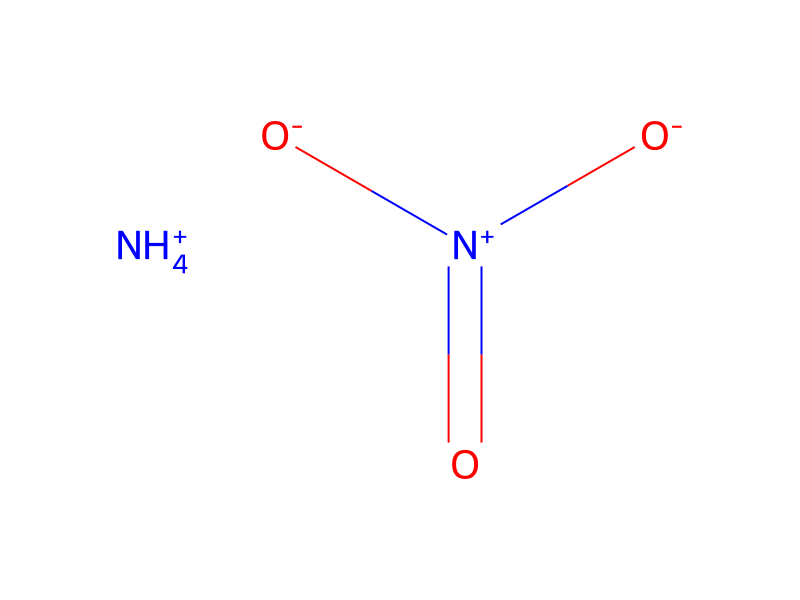
基本情報
- 標準SMILES
O=[N+]([O-])[O-].[NH4+]- InChIKey
DVARTQFDIMZBAA-UHFFFAOYSA-O- 分子式
- H3N.HNO3
- 平均分子量
- 80.044 g/mol
- 単同位体質量
- 80.02219199
概要
Ammonium nitrate is commercially available both as a colorless crystalline solid and processed into prills for specific applications. Soluble in water. Does not readily burn but will do so if contaminated with combustible material. Accelerates the burning of combustible material. Produces toxic oxides of nitrogen during combustion. Used to make fertilizers and explosives, and as a nutrient in producing antibiotics and yeast.
名称と識別子
- 優先名称
- Ammonium nitrate
- IUPAC
- azanium nitrate
名称と別名
AMMONIUM NITRATE6484-52-2Norway saltpeterAmmonium nitricumNitramAmmonium saltpeterNitrate of ammoniaNitrato amonicoHerco prillsGerman saltpeterMerco PrillsVarioform I
名称をさらに表示
Nitrate d'ammoniumNitric acid ammonium saltNitric acid, ammonium saltCaswell No. 045Ammonium(I) nitrate (1:1)DTXSID2029668Nitric acid ammonium salt (1:1)Ammonium hydrogendinitrate
データベース識別子
- CAS
54378-28-8、6484-52-2- PubChem CID
- 22985
- DTXSID
DTXSID2029668- ChEMBL
CHEMBL1500032- ChEBI
CHEBI:63038- UNII
- T8YA51M7Y6
- EC Number
- 229-347-8、682-080-2
物性
構造計算による物性
- 極性表面積
- 63.9 Ų
- 水素結合供与体数
- 1
- 水素結合受容体数
- 3
- 回転可能結合数
- 0
- 重原子数
- 5
- 形式電荷
- 0
- 複雑度
- 18.8
実験および物理化学的性質
Chemical Classes
Nitrogen Compounds -> Nitrates and Nitrites
Reactive agents - 3rd degree
pH0.1 M solution in water: 5.43
SpringerMaterials Propertiescrystal structure
OdorOdorless
Density
1.72 at 68 °F (USCG, 1999) - Denser than water; will sink
1.72 at 25 °C
1.7 g/cm³
1.725 @25 °C
Color/Form
White hygroscopic crystals; orthorhombic
Transparent, hygroscopic, deliquescent crystals or white granules. Five solid phases exist at normal pressure. Orthorhombic at room temperature.
Colorless crystals
Colorless (pure) to gray or brown (fertilizer grade).
Solubility
213 g/100 g water at 25 °C
Slightly soluble in methanol
Soluble in alcohol and alkalies
118.3 g/100 cc of H2O at 0 °C, 871 g at 100 °C; 3.8 g/100 cc ethanol at 20 °C; soluble in acetone; 17.1 g/100 cc methanol at 20 °C; soluble in ammonia; insoluble in ether
Solubility in water, g/100ml at 20 °C: 200
Boiling PointDecomposes at 200-260 °C
Decomposition
Decomposes @ 210 °C, with evolution of nitrous oxide.
Decomposition creates toxic gases containing ammonia and nitrogen oxides. The resulting nitrogen oxides will support combustion, even in the absence of other oxygen. The resulting heat and pressure from the decomposition of ammonium nitrate may build up if the reaction takes place in a confined space and the heat and gases created are not able to dissipate. As the temperature rises, the rate of decomposition increases. In a confined space, the pressure can reach dangerous levels and cause an explosion that will include the detonation of the ammonium nitrate. When dealing with a large quantity of ammonium nitrate, localized areas of high temperature may be sufficiently confined by the mass of material to initiate an explosion. The explosion of a small quantity of ammonium nitrate in a confined space (e.g., a pipe) may act as a booster charge and initiate the explosion of larger quantities (e.g., in an associated vessel).
Decomposition of sodium hypochlorite takes place within a few seconds with the following salts: ammonium acetate, ammonium carbonate, ammonium nitrate, ammonium oxalate, and ammonium phosphate.
The decomposition of ammonium nitrate in the presence of ammonium chloride (0.1%) becomes violent around 175 °C. The gases liberated contain chlorine.
The nitrate containing 0.1% of ammonium chloride decomposes vigorously below 175 deg. Presence of 0.1% of calcium chloride or iron(III) chloride in the nitrate lowers its initiation temperature sufficiently to give violent or explosive decomposition.
Ammonium nitrate melts at 337 °F (170 °C) and begins to undergo decomposition when molten. Hazardous scenarios with ammonium nitrate can involve simple thermal decomposition initiated by external fire or other heating, self-sustained decomposition also known as "cigar burning," and detonation.
Melting Point
337.8 °F (USCG, 1999)
169.7 °C
170 °C
169.6 °C
Vapor Pressure2.3 kPa at 20 °C in water solution; 1.5 kPa at 20 °C in saturated NH4NOs solution
Food Contact Substances
FCS -> FDA Cumulative Estimated Daily Intake (CEDI)
FCS -> FDA Inventory of Food Contact Substances Listed in 21 CFR
安全と法規制
GHS分類
GHS Classification
This chemical does not meet GHS hazard criteria for 2.3% (25 of 1096) of reports.
Danger
H272 (94.2%): May intensify fire; oxidizer [Danger Oxidizing liquids; Oxidizing solids]
P210, P220, P261, P264+P265, P271, P280, P304+P340, P305+P351+P338, P319, P337+P317, P370+P378, P403+P233, P405, and P501 (click each P-code to see the statement)
Aggregated GHS information provided per 1096 reports by companies from 30 notifications to the ECHA C&L Inventory. Each notification may be associated with multiple companies.
Not Classified
危険有害性情報
Regulatory Information
Chemical: Nitric acid, ammonium salt
Nitric acid ammonium salt (1:1) is listed on the EPA's Chemical Data Reporting (CDR) system. Manufacturers and importers of Nitric acid ammonium salt (1:1) are required to report information about their production and use of this chemical to the EPA under the Toxic Substances Control Act (TSCA). (40 eCFR Part 711)
Status: Active Update: 31-03-2023 https://echa.europa.eu/registration-dossier/-/registered-dossier/15999
Restricted substance: Ammonium nitrate (AN)
Nitric acid, ammonium salt: HSNO Approval: HSR001310 Approved with controls
The New Jersey Worker and Community Right to Know Act requires public and private employers to provide information about hazardous substances at their workplaces. (N.J.S.A. 34:5A-1 et. seq.)
Other Safety InformationIMAP assessments - Nitric acid, ammonium salt: Human health tier II assessment
DOT Label
Oxidizer
Oxidizer Class 9
Oxidizer
Oxidizer
Explosive 1.1D
Fire Hazards
Excerpt from ERG Guide 140 [Oxidizers]:
Excerpt from ERG Guide 140 [Oxidizers]:
Excerpt from ERG Guide 140 [Oxidizers]:
Excerpt from ERG Guide 140 [Oxidizers]:
Excerpt from ERG Guide 112 [Explosives - Division 1.1, 1.2, 1.3 or 1.5]:
CAUTION: Ammonium nitrate products may explode if involved in fire or contaminated with hydrocarbons (fuels), organic matter, other contaminants or when hot molten and contained. Treat as an explosive (GUIDE 112).
Health Hazards
Excerpt from ERG Guide 140 [Oxidizers]:
Excerpt from ERG Guide 140 [Oxidizers]:
Excerpt from ERG Guide 140 [Oxidizers]:
Excerpt from ERG Guide 140 [Oxidizers]:
Excerpt from ERG Guide 112 [Explosives - Division 1.1, 1.2, 1.3 or 1.5]:
· Inhalation, ingestion or contact (skin, eyes) with vapors or substance may cause severe injury, burns or death.
Hazards Summary
Listed in table of Methemoglobinemia-inducing agents: industrial, environmental, and pharmaceutical; [Sullivan, p. 729] Ruminants may develop methemoglobinemia from the ingestion of nitrate compounds (Nitrates are converted into nitrites in the rumen.) [HSDB] A skin, eye, and respiratory tract irritant; Can induce methemoglobinemia; [ICSC] See NITRATES and NITRITES.
DOT ID and Guide
2426 140
1942 140
Reactive Group
Salts, Acidic
Salts, Acidic
Salts, Acidic
Salts, Acidic
Salts, Acidic
UN ClassificationUN Hazard Class: 5.1; UN Pack Group: III
Special Reports
The Environmental Protection Agency (EPA), the Occupational Safety and Health Administration (OSHA), and the Bureau of Alcohol, Tobacco, Firearms, and Explosives (ATF) ("we") are issuing this advisory as part of an ongoing federal effort to improve chemical risk management, and to advance safety and protect human health and the environment. This advisory contains information on recent and past accidents involving AMMONIUM NITRATE (commonly referred to as AN), on the hazards of AN, how to manage these hazards, and appropriate steps for community emergency planning and proper emergency response. It is focused primarily on safe handling and storage of higher density, solid AN pellets and prills (a prill is a small bead) used in fertilizers. This advisory is intended to broadly disseminate lessons learned from recent incidents involving AN so that such incidents can be prevented in the future. Also provided is a list of information resources, including relevant codes and standards, industry publications, and applicable statutes and regulations that will help facilities handling AN and first responders better understand the hazards so they can effectively manage the risks. The information provided is not intended to cover all the hazards, safe practices or technical challenges associated with the manufacturing of AN; liquid fertilizers containing AN; manufacturing, storage or use of explosives or blasting agents containing AN; or the transportation of AN. For these particular situations, please consult other sources including the appropriate references, standards and regulations, cited at the end of this document.[EPA/OSHA/ATF; Chemical Advisory: Safe Storage, Handling, and Management of Ammonium Nitrate EPA 550-S-13-001, p.6 (August 2013). Available from, as of November 21, 2013: http://www.epa.gov/oem/docs/chem/AN_advisory.pdf]
Environment Canada; Tech Info for Problem Spills: Ammonium Nitrate (Draft) (1981)
EPA Safer ChemicalChemical: Ammonium nitrate
FIFRA Requirements
Residues of ammonium nitrate are exempted from the requirement of a tolerance when used as a adjuvant/intensifier for herbicides in accordance with good agricultural practice as inert (or occasionally active) ingredients in pesticide formulations applied to growing crops only.
安全と保護具
Fire Fighting
Excerpt from ERG Guide 140 [Oxidizers]:
Excerpt from ERG Guide 140 [Oxidizers]:
Excerpt from ERG Guide 140 [Oxidizers]:
Excerpt from ERG Guide 140 [Oxidizers]:
Excerpt from ERG Guide 112 [Explosives - Division 1.1, 1.2, 1.3 or 1.5]:
Use water in large amounts. NO other agents. In case of fire in the surroundings, use appropriate extinguishing media. In case of fire: keep drums, etc., cool by spraying with water. Combat fire from a sheltered position.
First Aid Measures
Fresh air, rest. Seek medical attention if you feel unwell.
Rinse skin with plenty of water or shower. Remove contaminated clothes.
First rinse with plenty of water for several minutes (remove contact lenses if easily possible), then refer for medical attention.
Rinse mouth. Refer for medical attention .
Accidental Release Measures
· CALL 911. Then call emergency response telephone number on shipping paper. If shipping paper not available or no answer, refer to appropriate telephone number listed on the inside back cover.
· Keep combustibles (wood, paper, oil, etc.) away from spilled material.
· CALL 911. Then call emergency response telephone number on shipping paper. If shipping paper not available or no answer, refer to appropriate telephone number listed on the inside back cover.
· Keep combustibles (wood, paper, oil, etc.) away from spilled material.
First Aid
Excerpt from ERG Guide 140 [Oxidizers]:
Excerpt from ERG Guide 140 [Oxidizers]:
Excerpt from ERG Guide 140 [Oxidizers]:
Excerpt from ERG Guide 140 [Oxidizers]:
Excerpt from ERG Guide 112 [Explosives - Division 1.1, 1.2, 1.3 or 1.5]:
General First Aid:
Safe StorageSeparated from combustible substances and reducing agents. Dry. Well closed.
Firefighting Hazards
If subjected to strong shocks or heated under confinement causing a pressure buildup, may undergo detonation.
Ammonium nitrate by itself does not burn, but in contact with other combustible materials, it increases the fire hazard. It can support and intensify a fire even in the absence of air. Fires involving ammonium nitrate can release toxic nitrogen oxides and ammonia. A fire involving ammonium nitrate in an enclosed space could lead to an explosion. Closed containers may rupture violently when heated.
During a fire in a facility where ammonium nitrate is present, the ammonium nitrate can become hot and molten which makes the material very sensitive to shock and detonation, particularly if it becomes contaminated with incompatible material such as combustibles, flammable liquids, acids, chlorates, chlorides, sulfur, metals, charcoal, sawdust, etc. If a molten mass becomes confined (e.g., in drains, pipes or machinery), it can explode.
Solid ammonium nitrate readily absorbs moisture, which can lead to caking, self-compression and self confinement. This in turn increases susceptibility to explosion in a fire.
Exposure Control and Personal Protection
· Wear positive pressure self-contained breathing apparatus (SCBA).
· Wear positive pressure self-contained breathing apparatus (SCBA).
Fire Fighting Procedures
Cool exposed containers with water. Continue cooling after fire has been extinguished.
Use flooding quantities of water. Fight fire from protected location or maximum possible distance. Approach fire from upwind to avoid hazardous vapors & toxic decomposition products. Fire situations may require evacuation.
If material on fire or involved in fire: Dangerously explosive. Do not fight fires in a cargo of explosives. Evacuate area and let burn. /explosives/
If material on fire or involved in fire: Flood with water. Cool all affected containers with flooding quantities of water. Apply water from as far a distance as possible. /oxidizer and liquid (oxidizer)/
For more Fire Fighting Procedures (Complete) data for AMMONIUM NITRATE (7 total), please visit the HSDB record page.
Storage Conditions
Closed containers may rupture violently when heated.
KEEP WELL CLOSED.
Separate from acids, alkalies, reducing agents, combustible materials. Store in a cool, dry, well ventilated location.
Fire protection: Ammonium nitrate storage areas should be equipped with an automatic sprinkler system, or have an automatic fire detection and alarm system if the areas are not continuously occupied. This is especially important when the facility in question is close to the public surrounding the facility. Facilities should NOT store more than 2500 tons of bagged ammonium nitrate without an automatic sprinkler system. An automatic sprinkler system, if installed, should be provided in accordance with NFPA 13, Standard for the Installation of Sprinkler Systems. Suitable fire control devices such as hoses and appropriate portable fire extinguishers (ammonium nitrate is an oxidizer and not all fire extinguishers are appropriate) shall be provided throughout the warehouse and loading areas. Water supplies and fire hydrants should be available. Store ammonium nitrate fertilizer in separate buildings or separated by approved fire walls from organic, combustible or reactive materials, such as grains, wood or other organic materials, urea and urea compounds, flammable liquids or gases, corrosive acids, chlorates, chromates nitrites, permanganates or finely divided metals or sulfur. Ammonium nitrate fertilizer should NOT be stored in the same building with explosives or blasting agents unless conditions in ATF's Table of Separation Distances of Ammonium Nitrate and Blasting Agents from Explosives and Blasting Agents, 27 CFR 555.220, are met. Prohibit smoking in ammonium nitrate storage areas.
For more Storage Conditions (Complete) data for AMMONIUM NITRATE (8 total), please visit the HSDB record page.
Cleanup MethodsPrompt cleanup and removal are necessary in order to prevent contamination with combustible materials.
Nonfire Spill Response
Excerpt from ERG Guide 140 [Oxidizers]:
Excerpt from ERG Guide 140 [Oxidizers]:
Excerpt from ERG Guide 140 [Oxidizers]:
Excerpt from ERG Guide 140 [Oxidizers]:
Excerpt from ERG Guide 112 [Explosives - Division 1.1, 1.2, 1.3 or 1.5]:
Disposal Methods
SRP: Wastewater from contaminant suppression, cleaning of protective clothing/equipment, or contaminated sites should be contained and evaluated for subject chemical or decomposition product concentrations. Concentrations shall be lower than applicable environmental discharge or disposal criteria. Alternatively, pretreatment and/or discharge to a permitted wastewater treatment facility is acceptable only after review by the governing authority and assurance that "pass through" violations will not occur. Due consideration shall be given to remediation worker exposure (inhalation, dermal and ingestion) as well as fate during treatment, transfer and disposal. If it is not practicable to manage the chemical in this fashion, it must be evaluated in accordance with EPA 40 CFR Part 261, specifically Subpart B, in order to determine the appropriate local, state and federal requirements for disposal.
Remove slowly into a large container of water. Add Na2CO3 /sodium carbonate/ slightly by stirring. After 24 hr, decant or siphon into another container. Neutralize with 6 M-HCL /6 M-hydrochloric acid/ ... .
毒性情報
Treatment
Methemoglobinemia can be treated with supplemental oxygen and methylene blue 1% solution administered intravenously slowly over five minutes followed by IV flush with normal saline. Methylene blue restores the iron in hemoglobin to its normal (reduced) oxygen-carrying state. (L1613)
Interactions
... The objective of our study was to examine how realistic, sublethal environmental levels of ammonium nitrate fertilizer (0, 10, 20 mg/L and ammonium chloride control) and the common insecticide carbaryl (0 or 2.5 mg/L) individually and interactively affect the development, size, and survival of green frog (Rana clamitans) tadpoles. /The authors/ reared tadpoles for 95 days in outdoor 1,000-L polyethylene ponds. /They/ found that the combination of carbaryl and nitrate had a negative effect on development and mass of tadpoles compared to the positive effect that either contaminant had alone. Presence of carbaryl was generally associated with short-term increases in algal resources, including ponds exposed to both carbaryl and nitrate. However, with exposure to nitrate and carbaryl, tadpole mass and development were not positively affected as with one chemical stressor alone...
Health EffectsNitrate and nitrite poisoning causes methemoglobinemia. Nitrites may cause pregnancy complications and developmental effects. They may also be carcinogenic. (L1137)
Ecotoxicity Values
LC50; Species: /Oncorhynchus mykiss (Rainbow trout)/ 6000 mg/L for 96 hr /Conditions of bioassay not specified/
LC50; Species: Xenopus laevis (African clawed frog) tadpoles age 14 days, weight 17 mg, gosner stage 26-27; Conditions: freshwater, static-renewal, 22 °C, pH 7.0-7.6, hardness 58.4 mg/L CaCO3, alkalinity 52.0 mg/L CaCO3, conductivity 156.0 uS/cm, dissolved oxygen 7.2 mg/L; Concentration: 52.9 mg/L for 10 days (95% confidence interval: 46.6-60.0 mg/L) /99% pure/
LC50; Species: Xenopus laevis (African clawed frog) tadpoles age 14 days, weight 17 mg, gosner stage 26-27; Conditions: freshwater, static-renewal, 22 °C, pH 7.0-7.6, hardness 58.4 mg/L CaCO3, alkalinity 52.0 mg/L CaCO3, conductivity 156.0 uS/cm, dissolved oxygen 7.2 mg/L; Concentration: 100.7 mg/L for 96 hr (95% confidence interval: 87.8-115.4 mg/L) /99% pure/
LC50; Species: Cyprinus carpio (common carp) fry, weight 33.6 g; Conditions: freshwater, renewal, 13.5 °C (12.0-15.2 °C), pH 7.6 (7.2-8.2), dissolved oxygen 9.4 mg/L (9.0-9.8 mg/L); Concentration: 74 mg/L for 48 hr (95% confidence interval: 65-85 mg/L) /99% pure/
For more Ecotoxicity Values (Complete) data for AMMONIUM NITRATE (13 total), please visit the HSDB record page.
Environmental Fate
Ammonium nitrate is quite soluble in water (250 g/100 mL at 20 °C). Thus, if precipitation occurs prior to clean up, or if water is used to disperse the spilled chemical, the solution of ammonium nitrate produced can infiltrate the soil and migrate downward.
Adverse EffectsMethemoglobinemia - The presence of increased methemoglobin in the blood; the compound is classified as secondary toxic effect
Exposure Routes
The substance can be absorbed into the body by inhalation and by ingestion.
Oral (L1137) ; inhalation (L1137)
Toxicity Summary
Nitrate's toxicity is a result of it's conversion to nitrite once in the body. Nitrite causes the autocatalytic oxidation of oxyhemoglobin to hydrogen peroxide and methemoglobin. This elevation of methemoglobin levels is a condition known as methemoglobinemia, and is characterized by tissue hypoxia, as methemoglobin cannot bind oxygen. (A2450, L1613)
Ecotoxicity Excerpts
/AQUATIC SPECIES/ Temporary ponds where many amphibians breed experience a gradual desiccation that leads to growing larval densities, which can reduce tadpole survival rates and increase cannibalistic interactions among carnivorous salamander larvae. Concentrations of many agrochemicals, including nitrogenous fertilizers, can also increase as the water volume decreases. /The investigators/ analyzed the effects of ammonium nitrate fertilizer at two larval densities on growth and survival of Rana dalmatina /agile frog/ tadpoles, and on cannibalistic behaviors of Salamandra salamandra /fire salamander/ larvae. /The investigators/ observed synergistic lethal effects until day 17 of exposure, when ammonium nitrate-related mortality of tadpoles was five times greater at high than at low density. The fertilizer impaired tadpole growth. This effect was stronger at low density than at high density. In the absence of ammonium nitrate, the incidence of cannibalism was higher at high than at low larval density. However, fertilizer exposure removed this density-dependent effect, which, under field conditions, would negate some potentially advantageous effects of cannibalism such as reduced intraspecific competition and the stimulation of defensive behaviors.
/AQUATIC SPECIES/ In static renewal experiments, ...how developmental stage influences the effect of ammonium nitrate on embryonic and larval stages of anuran amphibians /was studied/. The observed lethal effects caused by ammonium nitrate increased with both concentration and duration of exposure. Significant differences were observed in sensitivity to ammonium nitrate as a function of developmental stage in Discoglossus galganoi /Iberian painted frog/, Pelobates cultripes /western spadefoot toad/, and Bufo calamita /natterjack toad/. In D. galganoi and P. cultripes, younger individuals displayed greater acute effects from the chemical fertilizer compared with older individuals. For example, 100% of P. cultripes hatchlings died after 4 days of exposure to a nominal concentration of 225.8 mg N-NO3NH4/L, whereas <40% of individuals from older larval stages died when exposed to this concentration. A delay of 4 days in the beginning of the exposure to the chemical was enough to cause significant differences in sensitivity. Bufo calamita showed a higher sensitivity in later larval stages after 12 days of exposure. Hyla meridionalis /Mediterranean tree frog/ and B. calamita were less sensitive than the other two species. Peak ammonium nitrate concentrations usually occur when amphibians are breeding and, thus, when the most sensitive aquatic stage is in the water. The developmental stage of the test animals should be considered when evaluating the risk of ammonium nitrate to amphibians.
/AQUATIC SPECIES/ The min lethal toxicity of ... ammonium nitrate ... for Rana temporaria chensinensis /Chinese brown frog/ tadpoles was 0.91 g/L, and the max tolerance concn was 0.83 g/L. In field experiments, ammonium nitrate at concn of 0.25 g/L had no adverse effect on the tadpoles as reflected by their growth rate.
/AQUATIC SPECIES/ The effects of ammonium nitrate, ammonium chloride, ammonium sulfate, and sodium nitrate on survival and growth of Pacific treefrog (Pseudacris regilla [Baird and Girard]) and African clawed frog (Xenopus laevis [Daudin]) tadpoles were determined in static-renewal tests. The 10-day ammonium nitrate and ammonium sulfate LC50s for P. regilla were 55.2 and 89.7 mg/L NH4-N, respectively. The 10-day LC50s for X. laevis for the three ammonium compounds ranged from 45 to 64 mg/L NH4-N. The 10-day sodium nitrate LC50s were 266.2 mg/L NO3-N for P. regilla and 1,236.2 mg/L NO3-N for X. laevis. The lowest observed adverse effect level (LOAEL) of ammonium compound based on reduced length or weight was 24.6 mg/L NH4-N for P. regilla and 99.5 mg/L NH4-N for X. laevis. The lowest sodium nitrate LOAELs based on reduced length or weight were <30.1 mg/L NO3-N for P. regilla and 126.3 mg/L NO3-N for X. laevis. Calculated un-ionized NH3 comprised 0.3 to 1.0% of measured NH4-N concentrations. Potential harm to amphibians could occur if sensitive life stages were impacted by NH4-N and NO3-N in agricultural runoff or drainage for a sufficiently long period.
For more Ecotoxicity Excerpts (Complete) data for AMMONIUM NITRATE (11 total), please visit the HSDB record page.
Signs and Symptoms
Cough.
Redness.
Redness. Pain.
Vomiting. Diarrhoea. Blue lips, fingernails and skin. Weakness.
Nitrate and nitrite poisoning causes methemoglobinemia. Symptoms include cyanosis, cardiac dysrhythmias and circulatory failure, and progressive central nervous system (CNS) effects. CNS effects can range from mild dizziness and lethargy to coma and convulsions. (L1137)
Ongoing Test Status
The following link will take the user to the National Toxicology Program (NTP) Test Agent Search Results page, which tabulates all of the "Standard Toxicology & Carcinogenesis Studies", "Developmental Studies", and "Genetic Toxicity Studies" performed with this chemical. Clicking on the "Testing Status" link will take the user to the status (i.e., in review, in progress, in preparation, on test, completed, etc.) and results of all the studies that the NTP has done on this chemical.[Available from, as of November 11, 2013: http://ntp-apps.niehs.nih.gov/ntp_tox/index.cfm?fuseaction=ntpsearch.searchresults&searchterm=6484-52-2]
ICSC Environmental DataAvoid release to the environment in circumstances different to normal use.
法規制情報
FIFRA Requirements
Residues of ammonium nitrate are exempted from the requirement of a tolerance when used as a adjuvant/intensifier for herbicides in accordance with good agricultural practice as inert (or occasionally active) ingredients in pesticide formulations applied to growing crops only.
DHS Chemicals of Interest (COI)
Ammonium nitrate, [with more than 0.2 percent combustible substances, including any organic substance calculated as carbon, to the exclusion of any other added substance]
A Commercial Grade
5,000
A Commercial Grade
400
Explosive chemical that can be released at a facility.
化学と産業
薬理情報
Metabolism/Metabolites
Intake of some amount of nitrates and nitrites is a normal part of the nitrogen cycle in humans. In vivo conversion of nitrates to nitrites can occur in the gastrointestional tract under the right conditions, significantly enhancing nitrates' toxic potency. The major metabolic pathway for nitrate is conversion to nitrite, and then to ammonia. Nitrites, nitrates, and their metabolites are excreted in the urine. (L1137)
MeSH Pharmacological Classification
Substances or mixtures that are added to the soil to supply nutrients or to make available nutrients already present in the soil, in order to increase plant growth and productivity.
Substances that are energetically unstable and can produce a sudden expansion of the material, called an explosion, which is accompanied by heat, pressure and noise. Other things which have been described as explosive that are not included here are explosive action of laser heating, human performance, sudden epidemiological outbreaks, or fast cell growth.
Absorption, Distribution and Excretion
12 Healthy volunteers ingested orally 7-10.5 g ammonium nitrate in a single dose & 12 others received 9.5 g of sodium nitrate iv in approx 60 min. Samples of blood, saliva & urine were collected just before a 24 hr period. Saliva and urine were analyzed for volatile N-nitrosamines, nitrate & nitrite. Blood was analyzed for nitrate. Neither in urine nor in saliva were N-nitrosamines other than N-nitrosodiethylamine detected. Of the 188 urine samples, 13% contained greater than 0.1 ug N-nitrosodiethylamine/kg the highest level being 0.5 ug/kg. In 92% of the 179 saliva samples, less than 0.5 ug N-nitrosodiethylamine/l was found. Peak values for nitrate plus nitrite in saliva, which were reached 2-6 hr after intake, varied strongly between individuals, ranging from 4-43 mmol/L. Nitrite was detected in 26% of the urine samples. An average of 75% of administered nitrate was excreted in urine in 24 hr. Nitrate contents in blood, urine & saliva after 24 hr were still higher than before the nitrate intake.
用途と製造
Uses
Mainly used in the manufacturing of explosives (20%) and fertilizer (80%); Has also been used in the production of matches, pyrotechnics, cotton desiccant, insecticide and veterinary medication; [HSDB]
Not registered for pesticide use in the United States; [HSDB]
Applying metallic patinas [Category: Hobbies]
For ammonium nitrate (USEPA/OPP Pesticide Code: 076101) there are 0 labels match. /SRP: Not registered for current use in the U.S., but approved pesticide uses may change periodically and so federal, state and local authorities must be consulted for currently approved uses./
Approximately 15 to 20 percent of /the 1991 production/ was used for explosives and the balance for fertilizer.
In the production of nitrous oxide ... used primarily as as anesthetic and as an aerosol for food products
Impurities
Ammonium nitrate fertilizer contains no more than 2% carbon.
Ammonium nitrate, solution contains not less than 15% water.
U.S. Imports(1984) 1.14x10+11 g
U.S. Production
2023: 15,000,000,000 - <20,000,000,000 lb
(1972) 6.4X10+12 GRAMS
(1975) 6.78X10+12 G
(1985) 6.27X10+12 g
(1990) 14.16 billion lb
For more U.S. Production (Complete) data for AMMONIUM NITRATE (16 total), please visit the HSDB record page.
Consumption Patterns
In fertilizer applications; 16% in prodn of explosives & blasting agents; less than 1% as a chemical intermediate for nitrous oxide (1975)
Demand 14.4 B lb (1978), up 2.3%/yr from 1968.
Consumer UsesOther
Industry UsesProcessing aids not otherwise specified
Methods of Manufacturing
Ammonium nitrate (NH4NO3) is produced by neutralizing nitric acid (HNO3) with ammonia (NH3). ... All ammonium nitrate plants produce an aqueous ammonium nitrate solution through the reaction of ammonia and nitric acid in a neutralizer. Approximately 60 percent of the ammonium nitrate produced in the U. S. is sold as a solid product.
The neutralization of 45 - 65% HNO3 with gaseous NH3 is accompanied by the release of 100 - 115 J per mole of NH4NO3. In most processes this considerable heat of reaction is used for partial or complete evaporation of the water. Depending on the pressure and the concentration of the nitric acid, 95 - 97% solutions of ammonium nitrate can be obtained.
The production of nitrophosphate fertilizers by digestion of crude phosphate with nitric acid in the Odda process produces as a byproduct calcium nitrate tetrahydrate, Ca(NO3)2.4 H2O, in considerable quantities. ... The output of nitrophosphates is increasing, while demand for calcium nitrate is declining. In a process introduced some years ago, the calcium nitrate tetrahydrate is treated with ammonia and carbon dioxide to form ammonium nitrate and calcium carbonate.
Formulations/Preparations
Grades: Usually expressed in percent of nitrogen, as 20.5% nitrogen, 33.5% nitrogen. FGAN /fertilizer grade ammonium nitrate/ is fertilizer grade, prilled and usually coated with kieselguhr. Also available as an 83% solution. A temperature-stabilized grade is ... available which inhibits breakdown of prills due to crystalline changes.
Granular ammonium nitrate can be produced in almost any desired size range and has greater crushing strength than prills.
Fertilizer nitrates including high grade or straight ammonium nitrate, AN (33-34% N); ammonium sulfate-nitrate, ASN (26%N), and calcium-ammonium nitrate, CAN (20.5-28% N)
ANFO /ammonium nitrate fuel oil/ consists of 94% ammonium nitrate prills coated with an anti-caking agent and 6% absorbed fuel oil.
For use in explosives-99% purity, water content of not more than 0.15%, should contain only small amounts of ether-soluble and water insoluble materials, sulfates & chlorides; 99.5% purity for nitrous oxide manufacture, ammonium phosphate is sometimes introduced as a stabilizer in the amount of a fraction of a percent.
Household ProductsInformation on 40 consumer products that contain Ammonium nitrate in the following categories is provided:
Use Classification
EPA Safer Chemical Functional Use Classes -> Oxidants and Oxidant Stabilizers
Safer Chemical Classes -> Yellow triangle - The chemical has met Safer Choice Criteria for its functional ingredient-class, but has some hazard profile issues
General Manufacturing Information
Wholesale and Retail Trade
Nitric acid ammonium salt (1:1): ACTIVE
Nitric acid, initially derived from ammonia, is the starting material for ammonium nitrate, and other nitrogen compounds used in the manufacture of explosives.
Ammonium nitrate changes its crystal form every time it passes through a temperature of 90 °F. It also absorbs moisture rapidly from the air when the humidity exceeds about 60%. The exact percent varies with the temperature. In dry atmospheres the material dries out. Both these processes cause the particles to knit together. The tendency to cake can be greatly reduced by coating the dry material with 2-4% of a conditioning agent such as kieselguhr, kaolin, clay, or tricalcium phosphate, and storing in moisture proof bags.
The ammonium salt of nitric acid is prepared by treating the acid with ammonia, removing essentially all of the water, and prilling or granulating the resulting melt. Various processes have been developed and used to prepare the solid product. These include crystallization, flaking, prilling, and granulation. Prilling is the predominant practice. Two types of prills are produced: (1) low- density prills are formed by cooling droplets of concentrated solution (95%) of ammonium nitrate as they fall through upcoming air in a prill tower, and (2) high-density prills are produced by using a melt (99+%) of ammonium nitrate in a similar system but with a shorter prill tower.
Ammonium nitrate (NH4NO3) is produced by neutralizing nitric acid (HNO3) with ammonia (NH3). ... The manufacture of ammonium nitrate involves several major unit operations including solution formation and concentration; solids formation, finishing, screening, and coating; and product bagging and/or bulk shipping. In some cases, solutions may be blended for marketing as liquid fertilizers. ... All ammonium nitrate plants produce an aqueous ammonium nitrate solution through the reaction of ammonia and nitric acid in a neutralizer. Approximately 60 percent of the ammonium nitrate produced in the U. S. is sold as a solid product. To produce a solid product, the ammonium nitrate solution is concentrated in an evaporator or concentrator. The resulting "melt" contains about 95 to 99.8 percent ammonium nitrate at approximately 149 °C (300 °F). This melt is then used to make solid ammonium nitrate products. Prilling and granulation are the most common processes used to produce solid ammonium nitrate. ... Prill density can be varied by using different concentrations of ammonium nitrate melt. Low density prills, in the range of 1.29 specific gravity, are formed from a 95 to 97.5 percent ammonium nitrate melt, and high density prills, in the range of 1.65 specific gravity, are formed from a 99.5 to 99.8 percent melt. Low density prills are more porous than high density prills. Therefore, low density prills are used for making blasting agents because they will absorb oil. Most high density prills are used as fertilizers. Rotary drum granulators produce granules by spraying a concentrated ammonium nitrate melt (99.0 to 99.8 percent) onto small seed particles of ammonium nitrate in a long rotating cylindrical drum. As the seed particles rotate in the drum, successive layers of ammonium nitrate are added to the particles, forming granules. Granules are removed from the granulator and screened. Offsize granules are crushed and recycled to the granulator to supply additional seed particles or are dissolved and returned to the solution process. Pan granulators operate on the same principle as drum granulators ... Since the solids are produced in a wide variety of sizes, they must be screened for consistently sized prills or granules. Cooled prills are screened and offsize prills are dissolved and recycled to the solution concentration process. Granules are screened before cooling. Undersize particles are returned directly to the granulator and oversize granules may be either crushed and returned to the granulator or sent to the solution concentration process. Following screening, products can be coated in a rotary drum to prevent agglomeration during storage and shipment. The most common coating materials are clays and diatomaceous earth. However, the use of additives in the ammonium nitrate melt before solidification, as described above, may preclude the use of coatings. Solid ammonium nitrate is stored and shipped in either bulk or bags. Approximately 10 percent of solid ammonium nitrate produced in the U. S. is bagged.
関連反応
165 件




関連ノート
読み込み中…