
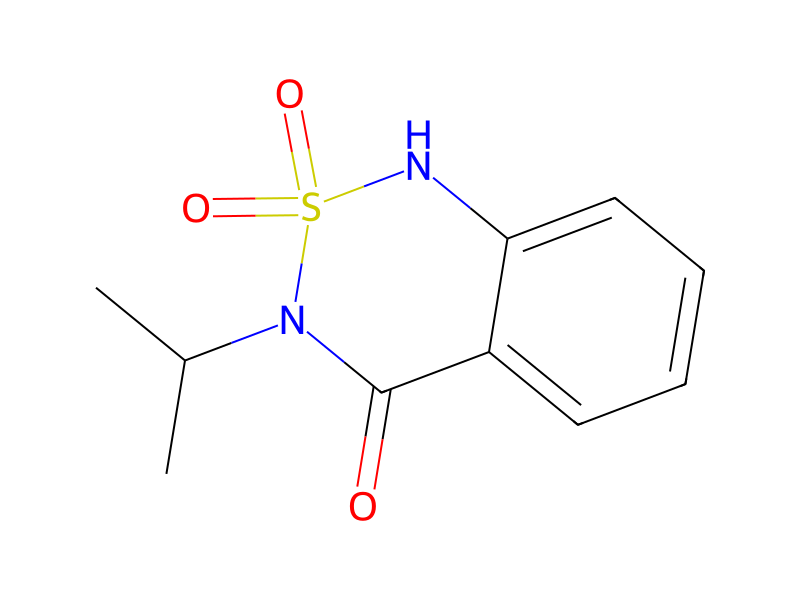
基本情報
- 標準SMILES
CC(C)N1C(=O)c2ccccc2NS1(=O)=O- InChIKey
ZOMSMJKLGFBRBS-UHFFFAOYSA-N- 分子式
- C10H12N2O3S
- 平均分子量
- 240.28 g/mol
- 単同位体質量
- 240.05686324
概要
Bentazone is a benzothiadiazine that is 1H-2,1,3-benzothiadiazin-4(3H)-one 2,2-dioxide substituted by an isopropyl group at position 3. It has a role as a herbicide, a xenobiotic and an environmental contaminant.
名称と識別子
- 優先名称
- Bentazon
- IUPAC
- 2,2-dioxo-3-propan-2-yl-1H-2λ6,1,3-benzothiadiazin-4-one
- 現地名
- 3-イソプロピル-1H-2,1,3-ベンゾチアジアジン-4(3H)-オン2,2-ジオキシド
- 英語名
- Bentazone
- 分子式
- C10H12N2O3S
- 分子量
- 240.28
名称と別名
Bentazonebentazon25057-89-0BasagranBendioxideLeaderBasagran 480PentazoneLaddokPledgeBasagran MBasagran KV
名称をさらに表示
ベンジオキシド3-イソプロピル-4-オキソ-1H,3H-2,1,3-ベンゾチアジアジン2,2-ジオキシド3-イソプロピル-1H-2,1,3-ベンゾチアジアジン-4(3H)-オン2,2-ジオキシド3,4-ジヒドロ-3-イソプロピル-4-オキソ-1H-2,1,3-ベンゾチアジアジン2,2-ジオキシドバサグランベンタゾンペンタゾン3-(1-メチルエチル)-1H-2,1,3-ベンゾチアジアジン-4(3H)-オン2,2-ジオキシドベンタゾン標準品ベンタゾン標準液ベンタゾンノナトリウムエン3イソプロピル1H2,1,3ベンゾチアジアジン4(3H)オン2,2ジオキシドベンタゾン標準物質ベンタゾン STANDARDベンタゾン Standard, 0.1 mg/mL in Acetonitrileベンタゾン Standard, 100 µg/mL in Acetoneベンタゾン Standard, 1000 µg/mL in Acetoneベンタゾン, 0.1 mg/mL in Acetonitrile4-オキソ-3-(プロパン-2-イル)-1,2,3,4-テトラヒドロ-2,1,3-ベンゾチアジアジン-2,2-ジイウム-2,2-ビス(オラート)3-イソプロピル-1H-2,1,3-ベンゾチアジアジン-4(3H)-オン2,2-ジオキシド標準品GALAXY3-isopropyl-1h-2,1,3-benzothiadiazin-4(3h)-one-2,2-dioxide3,4-Dihydro-3-isopropyl-1H-2,1,3-benzothiadiazin-4-one 2,2-DioxideAdagioThianon
BAS 351HDTXSID0023901BAS 3510HBAS 3512HBAS 3517HBAS 3510BAS 351-07HBAS 351-H
データベース識別子
- CAS
25057-89-0- PubChem CID
- 2328
- DTXSID
DTXSID0023901- ChEMBL
CHEMBL1567045- ChEBI
CHEBI:3018- UNII
- R4S7ZGZ9CT
- EC Number
- 246-585-8
物性
構造計算による物性
- XLogP
- 2.8
- 極性表面積
- 74.9 Ų
- 水素結合供与体数
- 1
- 水素結合受容体数
- 4
- 回転可能結合数
- 1
- 重原子数
- 16
- 形式電荷
- 0
- 複雑度
- 385
実験および物理化学的性質
SpringerMaterials PropertiesFusion temperature
Pesticides
Pesticide -> EPA IRIS
Agrochemicals -> Pesticide active substances
Active substance -> EU Pesticides database: Approved
Pesticides -> Herbicides, Other
Environmental transformation -> Pesticides (parent, predecessor)
Herbicides
LogP
log Kow = 2.34
-0.46
OdorOdorless
Density1.41 at 20 °C
Color/Form
Colorless crystals; tech. is an ochre-yellow solid [
White, crystalline powder
Solubility
Solubility: xylene < 1 g/100 g (at 20 °C). /Technical bentazon/
In water, 500 mg/L at 20 °C
In water 570 mg/L (pH 7, 20 °C)
In acetone 1507, ethanol 861, ethyl acetate 650, diethyl ether 616, chloroform 180, benzene 33, cyclohexane 0.2 (all in g/kg, 20 °C)
Solubility at 20 °C in xylene <1 g/100g; cyclohexanone approx 18 g/100g
Solubility in water: none
CorrosivityNot corrosive
Human DrugsPharmaceuticals
Decomposition
When heated to decomposition it emits very toxic fumes of /sulfur oxides and nitrogen oxides/.
200 °C
Melting Point
139.7 °C
Decomposition temp: 200 °C
137-139 °C
Vapor Pressure
0.00000345 [mmHg]
4.05X10⁻⁸ mm Hg at 20 °C
Vapor pressure, Pa at 20 °C:
物理化学的性質
- 融点
- 137 · 137-139°C
- 沸点
- 395.7 · 395.7±25.0 °C(Predicted)
- 比重(密度)
- 1.3387 · 1.3387 (rough estimate)
- 屈折率
- 1.565 · 1.5650 (estimate)
- 闪点
- 2 °C · 2 °C
- 貯蔵温度
- 4 °C · APPROX 4°C
- 溶解性
- クロロホルム(微量)、メタノール(微量)
- 外見
- 個体
- 酸解離定数(Pka)
- pKa (24°): 3.3
- 色
- 白い
- 水溶解度
- 0.5 g/L · 0.5g/L(20℃)
- Merck
- 13 · 13,1051
- BRN
- 530220 · 530220
- Henry's Law Constant
- 4.5 · 4.5×103 mol/(m3Pa) at 25℃, HSDB (2015)
- 主な用途
- 農業環境
- InChI
- 1S/C10H12N2O3S/c1-7(2)12-10(13)8-5-3-4-6-9(8)11-16(12,14)15/h3-7,11H,1-2H3
- InChIKey
- ZOMSMJKLGFBRBS-UHFFFAOYSA-N
- SMILES
- CC(C)N1C(=O)c2ccccc2NS1(=O)=O
- NISTの化学物質情報
- Bentazone(25057-89-0)
- EPAの化学物質情報
- Bentazon (25057-89-0)
化学的性質
化学的特性Bentazon is a colorless to white crystalline powder.
安全と法規制
GHS分類
GHS Classification
Warning
H302: Harmful if swallowed [Warning Acute toxicity, oral]
P203, P261, P264, P264+P265, P270, P272, P280, P301+P317, P302+P352, P305+P351+P338, P318, P321, P330, P333+P317, P337+P317, P362+P364, P405, and P501 (click each P-code to see the statement)
Warning
H302 (100%): Harmful if swallowed [Warning Acute toxicity, oral]
P203, P261, P264, P264+P265, P270, P272, P273, P280, P301+P317, P302+P352, P305+P351+P338, P318, P321, P330, P333+P317, P337+P317, P362+P364, P405, and P501 (click each P-code to see the statement)
危険有害性情報
Regulatory Information
Hazard Traits - Hepatotoxicity and Digestive System Toxicity
Regulation (EC) No 396/2005 (amended)
00/68/EC, 2010/77/EU, Reg. (EU) 2015/1885, Reg. (EU) 2016/549, Reg. (EU) 2017/841, Reg. (EU) 2018/660, Reg. (EU) 2020/1093, Reg. (EU) No 540/2011
Bentazone: Does not have an individual approval but may be used under an appropriate group standard
Fire HazardsLiquid formulations containing organic solvents may be flammable. Gives off irritating or toxic fumes (or gases) in a fire. Risk of fire and explosion if formulations contain flammable/explosive solvents.
Hazards SummaryAn eye irritant; [ICSC] A mucous membrane irritant; [HSDB] May cause skin sensitization; [eChemPortal: ESIS] An eye irritant; [MSDSonline] Not likely to be carcinogenic to humans (Group NL); [EPA]
EC ClassificationSymbol: Xn; R: 22-36; S: (2)-24-37-61
Special Reports
USEPA/Office of Prevention, Pesticides and Toxic Substances; Reregistration Eligibility Decision Document for Bentazon EPA 738-R-94-029 (September 1994). The RED summarizes the risk assessment conclusions and outlines any risk reduction measures necessary for the pesticide to continue to be registered in the USA.[Available from, as of October 26, 2017: http://www.epa.gov/pesticides/reregistration/status.htm]
WHO/IPCS; Pesticide Residues in Food - 1991. Part II - Toxicology (1992)
FIFRA Requirements
Tolerances are established for the combined residues of the herbicide bentazon (3-isopropyl-1H-2,1,3-benzothiadiazin-4(3H)-one-2,2-dioxide) and its 6- and 8-hydroxy metabolites in or on the following food commodities:[Table#4591]
Tolerances are established for the combined residues of the herbicide bentazon (3-isopropyl-1H-2,1,3-benzothiadiazin-4(3H)-one-2,2-dioxide) and its metabolite 2-amino-N-isopropyl benzamide (AIBA) in or on the following food commodities:[Table#4592]
Tolerances with regional registration as defined in section 180.1(m), are established for combined residues of the herbicide, bentazon (3-isopropyl-1H-2, 1,3-benzothiadiazin-4(3H)-one-2,2-dioxide) and its 6- and 8-hydroxy metabolites in or on the following food commodities:[Table#4593]
Based on the reviews of the generic data for the active ingredient bentazon, the Agency has sufficient information on the health effects of bentazon and on its potential for causing adverse effects in fish and wildlife and the environment. Therefore, the Agency concludes that products containing bentazon for all uses are eligible for reregistration. The Agency has determined that bentazon products, labeled and used as specified in this Reregistration Eligibility Decision, will not pose unreasonable risks or adverse effects to humans or the environment.
As the federal pesticide law FIFRA directs, EPA is conducting a comprehensive review of older pesticides to consider their health and environmental effects and make decisions about their continued use. Under this pesticide reregistration program, EPA examines newer health and safety data for pesticide active ingredients initially registered before November 1, 1984, and determines whether the use of the pesticide does not pose unreasonable risk in accordance to newer safety standards, such as those described in the Food Quality Protection Act of 1996. Bentazon is found on List A, which contains most pesticides that are used on foods and, hence, have a high potential for human exposure. List A consists of the 194 chemical cases (or 350 individual active ingredients) for which EPA issued registration standards prior to FIFRA '88. Case No: 0182; Pesticide type: Herbicide; Registration Standard Date: 09/28/85; Case Status: RED Approved 09/94; OPP has made a decision that some/all uses of the pesticide are eligible for reregistration, as reflected in a Reregistration Eligibility Decision (RED) document.; Active ingredient (AI): Sodium bentazon; Data Call-in (DCI) Date(s): 08/29/90; AI Status: OPP has completed a Reregistration Eligibility Decision (RED) document for the case/AI.
Chemical DangersDecomposes on heating and on burning. This produces toxic fumes including sulfur oxides and nitrogen oxides.
Packaging and LabellingDo not transport with food and feedstuffs.
Toxic Combustion ProductsSpecial hazards arising from the substance or mixture: Carbon oxides, nitrogen oxides (NOx), sulfur oxides.
Hazard Classes and Categories
Acute Tox. 4 (100%)
Acute toxicity - category 4
Repr. 2
State Drinking Water Standards(CA) CALIFORNIA 18 ug/L
State Drinking Water Guidelines(WI) WISCONSIN 300 ug/L
安全と保護具
Fire FightingUse water spray, powder, foam, carbon dioxide.
First Aid Measures
Fresh air, rest. Refer for medical attention.
Remove contaminated clothes. Rinse and then wash skin with water and soap.
First rinse with plenty of water for several minutes (remove contact lenses if easily possible), then refer for medical attention.
Give one or two glasses of water to drink. Refer for medical attention .
Safe StorageProvision to contain effluent from fire extinguishing. Separated from food and feedstuffs.
Fire Fighting Procedures
Suitable extinguishing media: Use water spray, alcohol-resistant foam, dry chemical or carbon dioxide.
Wear self contained breathing apparatus for fire fighting if necessary.
Storage ConditionsKeep container tightly closed in a dry and well-ventilated place.
Cleanup Methods
ACCIDENTAL RELEASE MEASURES: Personal precautions, protective equipment and emergency procedures: Use personal protective equipment. Avoid dust formation. Avoid breathing vapors, mist or gas. Ensure adequate ventilation. Evacuate personnel to safe areas. Avoid breathing dust. Environmental precautions: Prevent further leakage or spillage if safe to do so. Do not let product enter drains. Discharge into the environment must be avoided. Methods and materials for containment and cleaning up: Pick up and arrange disposal without creating dust. Sweep up and shovel. Keep in suitable, closed containers for disposal.
Disposal Methods
SRP: Recycle any unused portion of the material for its approved use or return it to the manufacturer or supplier. Ultimate disposal of the chemical must consider: the material's impact on air quality; potential migration in air, soil or water; effects on animal, aquatic and plant life; and conformance with environmental and public health regulations. If it is possible or reasonable use an alternative chemical product with less inherent propensity for occupational harm/injury/toxicity or environmental contamination.
Product: Offer surplus and non-recyclable solutions to a licensed disposal company. Contact a licensed professional waste disposal service to dispose of this material; Contaminated packaging: Dispose of as unused product.
Group I Containers: Combustible containers from organic or metallo-organic pesticides (except organic mercury, lead, cadmium, or arsenic compounds) should be disposed of in pesticide incinerators or in specified landfill sites. /Organic or metallo-organic pesticides/
Group II Containers: Non-combustible containers from organic or metallo-organic pesticides (except organic mercury, lead, cadmium, or arsenic compounds) must first be triple-rinsed. Containers that are in good condition may be returned to the manufacturer or formulator of the pesticide product, or to a drum reconditioner for reuse with the same type of pesticide product, if such reuse is legal under Department of Transportation regulations (eg 49 CFR 173.28). Containers that are not to be reused should be punctured ... and transported to a scrap metal facility for recycling, disposal or burial in a designated landfill. /Organic or metallo-organic pesticides/
Spillage Disposal
Do NOT wash away into sewer. Sweep spilled substance into covered containers. If appropriate, moisten first to prevent dusting. Carefully collect remainder. Then store and dispose of according to local regulations. Personal protection: chemical protection suit including self-contained breathing apparatus.
Preventive Measures
ACCIDENTAL RELEASE MEASURES: Personal precautions, protective equipment and emergency procedures: Use personal protective equipment. Avoid dust formation. Avoid breathing vapors, mist or gas. Ensure adequate ventilation. Evacuate personnel to safe areas. Avoid breathing dust. Environmental precautions: Prevent further leakage or spillage if safe to do so. Do not let product enter drains. Discharge into the environment must be avoided.
Precautions for safe handling: Avoid contact with skin and eyes. Avoid formation of dust and aerosols. Provide appropriate exhaust ventilation at places where dust is formed.
Appropriate engineering controls: Handle in accordance with good industrial hygiene and safety practice. Wash hands before breaks and at the end of workday.
Gloves must be inspected prior to use. Use proper glove removal technique (without touching glove's outer surface) to avoid skin contact with this product. Dispose of contaminated gloves after use in accordance with applicable laws and good laboratory practices. Wash and dry hands.
For more Preventive Measures (Complete) data for Bentazon (6 total), please visit the HSDB record page.
Eye PreventionWear safety goggles.
Inhalation RiskEvaporation at 20 °C is negligible; a harmful concentration of airborne particles can, however, be reached quickly on spraying or when dispersed, especially if powdered.
Skin PreventionProtective gloves.
毒性情報
Interactions
Maize black Mexican sweet cell suspension cultures were used to study the effects of various cytochrome p450 monooxygenase inhibitors on the uptake and metabolism of the herbicide bentazon. Maize cells rapidly absorbed bentazon and metabolized it via aryl hydroxylation and glycosylation to a glycosyl conjugate of 6-hydroxybentazon. Maize black Mexican sweet cells accumulated bentazon to levels approximately 20 fold greater than those in the external medium. When maize black Mexican sweet cells were incubated in an external medium containing 25 uM bentazon, the formation of the glycosyl conjugate (ca 2 nmol/min/g fresh wt) was rate limited by aryl hydroxylation. Tetcyclacis, a plant growth retardant, phenylhydrazine, a mechanism based cytochrome p450 inhibitor, and piperonyl butoxide, an insecticide synergist, inhibited bentazon metabolism with I50 values of approximately 0.1, 1.0, and 1.0 uM, respectively. Other mechanism based cytochrome p450 inhibitors, 3(2,4-dichlorophenoxy)-1-propyne and aminobenzotriazole, also inhibited bentazon metabolism but were less effective. The results obtained with selected inhibitors are consistent with the hypothesis that aryl hydroxylation of bentazon is catalyzed by a cytochrome p450 monooxygenase.
Target OrgansHematologic
Ecotoxicity Values
LC50; Species: Colinus virginianus (Northern Bobwhite Quail) juvenile; dietary >10000 ppm for 8 days /42% purity/
LC50; Species: Eisenia fetida (Earthworm) adult, sexually mature; dermal, filter paper 3.27 kg/ha for 48 hr (95% confidence interval: 2.50-4.28 kg/ha)
EC50; Species: Nostoc muscorum (Blue-Green Algae) Axenic clonal stock; Conditions: freshwater, static, 28 °C; Concentration: 1 mM for 72 hr; Effect: physiology, decreased photosynthesis
EC50; Species: Nostoc muscorum (Blue-Green Algae) Axenic clonal stock; Conditions: freshwater, static, 28 °C; Concentration: 6.8 mM for 72 hr; Effect: biochemistry, decreased phycobiliproteins
For more Ecotoxicity Values (Complete) data for Bentazon (23 total), please visit the HSDB record page.
Environmental Fate
TERRESTRIAL FATE: Based on a classification scheme(1), a Koc range of 0 to 46(2,3) indicates that bentazon is expected to have very high to high mobility in soil(SRC). The pKa of bentazon is 3.3(4), indicating that this compound will exist almost entirely in anion form in the environment and anions generally do not adsorb more strongly to soils containing organic carbon and clay than their neutral counterparts(5). Volatilization from moist soil is not expected because the compound exists as an anion and anions do not volatilize. Bentazon is not expected to volatilize from dry soil surfaces(SRC) based upon a vapor pressure of 4.05X10⁻⁸ mm Hg at 20 °C(2). In aerobic soils, reported degradation half-lives of 6.7 to 50 days(2,6) suggests that under certain conditions biodegradation may be an important environmental fate process in soil(SRC).
FIELD STUDY: Field dissipation studies were conducted in Texas on sandy soil (0.5% OM) planted with peanuts, Mississippi on a Commerce silt loam soil planted with soybeans and peanuts, Mississippi on a Sharkey silty clay loam soil planted with soybeans, North Carolina on acidic, sandy loam soil (2.8% OM) planted to peanuts, Minnesota on clay soil planted to soybeans, and Idaho on a sandy loam soil. Bentazon, applied as a wettable powder or soluble concentrate at cumulative rates of 1.0 to 10 lbs a.i./A, had field dissipation half-lives of 7 to 33 days. The degradate AIBA was detected (< 0.05 ppm) in the North Carolina, Mississippi, Alabama, and Idaho field dissipation studies. Bentazon and 2-amino-N-isopropylbenazamide were not detected in deep soil samples (> 12 inches of soil) in field studies.
AQUATIC FATE: Based on a classification scheme(1), a Koc range of 0 to 46(2,3) indicates that bentazon is not expected to adsorb to suspended solids and sediment(SRC). A pKa of 3.3(4) indicates bentazon will exist almost entirely in the anion form at pH values of 5 to 9 and, therefore, volatilization from water surfaces is not expected to be an important fate process(SRC). According to a classification scheme(5), a whole body BCF of 3.7 in bluegill sunfish(6), suggests the potential for bioconcentration in aquatic organisms is low(SRC). Complete photolysis of bentazon took place within 16 hours in distilled water at pH 6.8 when irradiated with UV light(7,8). Bentazon was not degraded in biodegradation experiments anaerobic aquifer conditions(9) but the available soil studies would suggest that biodegradation may an important environmental fate process in water.(SRC).
ATMOSPHERIC FATE: According to a model of gas/particle partitioning of semivolatile organic compounds in the atmosphere(1), bentazon, which has a vapor pressure of 4.05X10⁻⁸ mm Hg at 20 °C(2), is expected to exist solely in the particulate phase in the ambient atmosphere. Particulate-phase bentazon may be removed from the air by wet and dry deposition(SRC). Bentazon absorbs light at wavelengths between 330 and 335 nm(3) and, therefore, may be susceptible to direct photolysis by sunlight, since sunlight consists of wavelengths above 290 nm(SRC).
Food Survey ValuesBentazon was not included in the U.S Food and Drug Administration Total Diet Study Market Baskets 2004 through 2005(1).
Adverse EffectsSkin Sensitizer - An agent that can induce an allergic reaction in the skin.
Exposure RoutesThe substance can be absorbed into the body by inhalation and by ingestion.
Milk ConcentrationsIn 2010, bentazone was not detected in bovine raw milk (n=100) from a local farm, and full-fat milk (n=30), half-skimmed milk (n=20), and skimmed milk (n=20) from a local supermarket, near Shenyang Agricultural University, China(1).
Toxicity Summary
IDENTIFICATION AND USE: Bentazone is a white, crystalline solid. It was formerly used as an herbicide. HUMAN STUDIES: Bentazone is irritating to eyes and mucous membranes. A 50-year-old male who had sprayed corn with a solution of bentazone was admitted to the hospital with sweating, fever, nausea, vomiting of aqueous and hemorrhagic content, and bloody, watery stools. He was treated according to the symptoms including extracorporeal hemodialysis, but eventually suffered from multiorgan failure (acute respiratory failure, acute liver failure, coagulopathy, acute renal failure, metabolic acidosis, and gastrointestinal bleeding) and died 11.35 hr after admittance. In another case, intentional poisoning with 130 g of bentazone resulted in vomiting, fever, sweating, pipe-like muscle rigidity, sinus tachycardia, drowsiness, leukocytosis, rhabdomyolysis and hepatorenal damage. ANIMAL STUDIES: Bentazone is not a skin irritant but was a moderate eye irritant in rabbits. It is a skin sensitizer in guinea-pigs. In a chronic toxicity study, bentazone was administered to rats (50 of each sex per group) via a diet at doses 0, 5, 17 and 76 mg/kg bw per day for 2 years. Statistical analysis of tumor incidence did not reveal any significance among the groups tested. Bentazone was not teratogenic in rabbits or rats. In rat developmental studies, it increased post-implantation loss, skeletal variations (incomplete or absent ossification in the phalangeal nuclei of the extremities, sternebrae and cervical vertebrae) and reduced body weights of fetuses surviving to day 21 at 250 mg/kg bw per day. Dietary administration of bentazone to rats at dose levels of 0, 300, 1000 and 3500 ppm did not result in any indication of neurotoxicity. In vitro genotoxicity studies included bacterial reverse mutation assays on Salmonella typhimurium and Escherichia coli, DNA damage and repair studies on E. coli and Saccharomyces cerevisiae, and chromosomal aberration and forward mutation assays in CHO cells. In vivo studies included chromosome analyses in mice and rats, unscheduled DNA synthesis tests in mice, and mutation assays in germ cells for mice and rats. Bentazone gave negative results in all of these studies. ECOTOXICITY STUDIES: Bentazone affected zebrafish embryos and associated bacterial communities. It was nontoxic to bees.
Ecotoxicity Excerpts
/AQUATIC SPECIES/ This study aimed to assess the effects of Basagran on zebrafish (Danio rerio) embryos. The embryos were exposed to Basagran at concentrations ranging from 120.0 to 480.6 mg/L, and the effects on embryo development (up to 96 hr) and bacterial communities of 96 hr-larvae were assessed. The embryo development response was time-dependent and concentration-dependent (106.35 < EC50 < 421.58 mg/L). The sensitivity of embryo-related endpoints decreased as follows: blood clotting in the head and/or around the yolk sac > delay or anomaly in yolk sac absorption > change in swimming equilibrium > development of pericardial and/or yolk sac edema > scoliosis. A PCR-DGGE analysis was used to evaluate changes in the structure, richness, evenness and diversity of bacterial communities after herbicide exposure. A herbicide-induced structural adjustment of bacterial community was observed. In this study, it was successfully demonstrated that Basagran affected zebrafish embryos and associated bacterial communities, showing time-dependent and concentration-dependent embryos' developmental response and structural changes in bacterial community. Thus, this work provides for the first time a complementary approach, which is useful to derive robust toxicity thresholds considering the embryo-microbiota system as a whole. The aquatic hazard assessment will be strengthened by combining current ecotoxicological tests with molecular microbiology tools.
/OTHER TERRESTRIAL SPECIES/ /Nontoxic to bees./
/OTHER TOXICITY INFORMATION/ The toxicological effects of the active ingredients of the herbicides diuron and bentazon on the activity of acetylcholinesterase (AChE) of krait (Bungarus sindanus) venom and electric eel (Electrophorus electricus) were studied. The diuron and bentazon caused non-competitive inhibition of AChE from both species. For the venom AChE, the calculated IC50 for diuron and bentazon were found to be 3.25 and 0.14 uM, while for eel AChE, the respective IC50 values were 3.6 and 0.135 uM. In comparison, bentazon was a more potent inhibitor than diuron of AChE from both species. The insecticide lindane did not have any inhibitory effect on AChE activity in either species, even when tested at high concentrations (200-800 uM).
Signs and SymptomsRedness. Pain.
Ongoing Test Status
EPA has released the Interactive Chemical Safety for Sustainability (iCSS) Dashboard. The iCSS Dashboard provides an interactive tool to explore rapid, automated (or in vitro high-throughput) chemical screening data generated by the Toxicity Forecaster (ToxCast) project and the federal Toxicity Testing in the 21st century (Tox21) collaboration. /The title compound was tested by ToxCast and/or Tox21 assays/[USEPA; ICSS Dashboard Application; Available from, as of November 16, 2017: http://actor.epa.gov/dashboard/]
法規制情報
FIFRA Requirements
Tolerances are established for the combined residues of the herbicide bentazon (3-isopropyl-1H-2,1,3-benzothiadiazin-4(3H)-one-2,2-dioxide) and its 6- and 8-hydroxy metabolites in or on the following food commodities:[Table#4591]
Tolerances are established for the combined residues of the herbicide bentazon (3-isopropyl-1H-2,1,3-benzothiadiazin-4(3H)-one-2,2-dioxide) and its metabolite 2-amino-N-isopropyl benzamide (AIBA) in or on the following food commodities:[Table#4592]
Tolerances with regional registration as defined in section 180.1(m), are established for combined residues of the herbicide, bentazon (3-isopropyl-1H-2, 1,3-benzothiadiazin-4(3H)-one-2,2-dioxide) and its 6- and 8-hydroxy metabolites in or on the following food commodities:[Table#4593]
Based on the reviews of the generic data for the active ingredient bentazon, the Agency has sufficient information on the health effects of bentazon and on its potential for causing adverse effects in fish and wildlife and the environment. Therefore, the Agency concludes that products containing bentazon for all uses are eligible for reregistration. The Agency has determined that bentazon products, labeled and used as specified in this Reregistration Eligibility Decision, will not pose unreasonable risks or adverse effects to humans or the environment.
As the federal pesticide law FIFRA directs, EPA is conducting a comprehensive review of older pesticides to consider their health and environmental effects and make decisions about their continued use. Under this pesticide reregistration program, EPA examines newer health and safety data for pesticide active ingredients initially registered before November 1, 1984, and determines whether the use of the pesticide does not pose unreasonable risk in accordance to newer safety standards, such as those described in the Food Quality Protection Act of 1996. Bentazon is found on List A, which contains most pesticides that are used on foods and, hence, have a high potential for human exposure. List A consists of the 194 chemical cases (or 350 individual active ingredients) for which EPA issued registration standards prior to FIFRA '88. Case No: 0182; Pesticide type: Herbicide; Registration Standard Date: 09/28/85; Case Status: RED Approved 09/94; OPP has made a decision that some/all uses of the pesticide are eligible for reregistration, as reflected in a Reregistration Eligibility Decision (RED) document.; Active ingredient (AI): Sodium bentazon; Data Call-in (DCI) Date(s): 08/29/90; AI Status: OPP has completed a Reregistration Eligibility Decision (RED) document for the case/AI.
State Drinking Water Standards(CA) CALIFORNIA 18 ug/L
State Drinking Water Guidelines(WI) WISCONSIN 300 ug/L
Federal Drinking Water GuidelinesEPA 200 ug/L
安全データ
- wgk
- 2
- tsca
- TSCA listed
- rtecs
- DK9900000
- ridadr
- UN 1648 3/PG 2
- 毒性
- LD50 in male, female rats (mg/kg): 383.2, 433.6 orally (Ugazio)
- PRTR法
- 1-13
- hs_code
- 29349990
- risk_code
- 22-36-43-52/53-20/21/22-11
- 安衛法
- 57,57-2
- 消防法
- 危-4-1-S-II
- hazard_code
- Xn,F
- safety_code
- 2-24-37-61-36-26-16
- 毒劇物取締法
- II
- Hazard Classifications
- Acute Tox. 4 OralEye Irrit. 2Repr. 2Skin Sens. 1
- ストレージクラス
- 11 - Combustible Solids
- 有毒物質データの
- 25057-89-0(Hazardous Substances Data)
化学と産業
薬理情報
Mechanism of ActionInhibition of photosynthesis at photosystem II.
Metabolism/Metabolites
The metabolism of bentazone was investigated in a number of toxicokinetic studies following oral (rat and rabbit) or intravenous administration (mouse) ... . Bentazone was only poorly metabolized, with the parent compound being the predominant excretion product. Only small amounts of 6-hydroxybentazone and 8-hydroxybentazone could be detected. In rats, rabbits and mice, no conjugated products were found.
6-Hydroxybentazone and 8-hydroxybentazone are major plant metabolites of bentazone. Because crops of treated plants can be consumed by humans, farm animals or pets, an exposure to both of these compounds might be expected in principle. Although both metabolites have been demonstrated to be formed in mammals and therefore can be regarded as included in toxicological testing of the parent compound, specific toxicological studies were performed. It has been shown that the 8-hydroxy and 6-hydroxy metabolites of bentazone are of comparable toxicity by the oral route of administration and are both less toxic than the parent compound. Additionally, both metabolites were negative in the Ames assay for the potential to induce point mutations in bacteria. As it is unlikely that a hydroxy group shift in the bentazone ring system dramatically changes the toxicity, it was decided to perform further investigations on 8-hydroxybentazone as a reference substance. Therefore, 8-hydroxybentazone was investigated in a subchronic feeding study, in several mutagenicity studies and in a prenatal developmental study. These investigations revealed that the metabolites have no mutagenic or teratogenic potential and are less toxic than the parent substance.
In studies with soybeans [Glycine max (Leguminatae) Merr.] and navy beans (Phaseolus vulgaris Leguminatae), four unidentified conjugates were observed. After foliar or root absorption, bentazon was rapidly metabolized by soybeans with hydroxylation at the 6 and 8 position. These were conjugated. Analysis of soybean field samples showed hydroxylation of bentazon in early growth stages.
Although absorption and translocation of bentazon was not markedly different in resistant rice and susceptible C. serotinus, metabolism differed markedly. In rice, there was 80% metabolism of absorbed bentazon within 24 hr and 85% conversion to a major water soluble metabolite within 7 days. In C. serotinus, there was only 25-50% metabolism of bentazon in 7 days. Similar results were obtained with other resistant and susceptible plant species indicating that ability to metabolize this compound is the primary mechanism of selectivity. The primary metabolite in rice was identified by GC-MS, NMR and IR as 6-(bentazon)-O-beta-glucopyranoside. Other studies showed that the 6- and 8-hydroxybentazon were formed in about equal amounts in soybeans and that the 6-hydroxy analog predominates in wheat, rice, peanuts, Senecio sp., and Chenopodium sp.
For more Metabolism/Metabolites (Complete) data for Bentazon (8 total), please visit the HSDB record page.
MeSH Pharmacological ClassificationPesticides used to destroy unwanted vegetation, especially various types of weeds, grasses (POACEAE), and woody plants. Some plants develop HERBICIDE RESISTANCE.
Absorption, Distribution and Excretion
Toxicokinetic studies performed on mice, rats and rabbits indicate that bentazone is rapidly and almost completely absorbed via the oral route (> 99%), and maximum blood concentrations of radioactivity are achieved in approximately 15 minutes at low doses (4 mg/kg bw) and by 1 hour at high doses (200 mg/kg bw). Administration of bentazone either as the sodium salt or as the free acid did not result in any significant differences in absorption. There was no evidence of penetration into the central nervous system or spinal cord, and elimination from other tissues was rapid, with no indication of bioaccumulation. Elimination was almost exclusively via the urine (approximately 91% within 24 hours); 5 days after dosing, less than 2% was found in feces and less than 0.02% in expired air. Biliary excretion of radioactivity was minimal. No significant differences were found in absorption and elimination among the different species investigated (rat, rabbit, mouse).
The dermal penetration of [14C]bentazone sodium salt (batch no. 210-2201, radiochemical purity 97.3%) through human skin was assessed by a single topical application of about 4933, 49.3 or 8.22 ug/sq cm of active ingredient formulated in BAS 351 32 H to split thickness skin membranes mounted on Franz-type diffusion cells. The doses represent the formulation concentrate or two representative spray dilutions (1:100 and 1:600) for field use, respectively. The study was performed using five diffusion cells per dose. ... It can be concluded that in vitro dermal penetration of bentazone formulated as an aqueous soluble (liquid) concentrate formulation of bentazone sodium through human skin is appropriately calculated as per cent absorbed dose. Considering the amount of radiolabeled substance associated with the skin (remaining skin and tape strips 3-6) after washing as absorbable and combining this with the absorbed amount detected in the receptor, the extent of dermal penetration through human epidermis is about 0.06% for the concentrate, 1.31% for the 1:100 spray strength dilution and 1.23% for the 1:600 dilution. /Bentazone sodium salt/
A case of fatal suicidal bentazone poisoning was presented along with a description of the different analytical methods involved. A 56-year-old farmer was examined by the family doctor 1 hour after voluntarily ingesting 500 mL of FIGHTER (about 250 g bentazone). He presented a Glasgow score of 15, polypnea, diarrhea and vomiting. During transport by ambulance to the hospital, he tossed, sweated and suddenly presented breathing difficulty followed by heart failure. The patient died within 2 hours post-ingestion. Blood and urine samples were taken just before death. Bentazone plasma and urine levels were 1500 and 1000 mg/L, respectively.
A 59-year-old woman who intentionally ingested 100-200 mL Basagran (about 50-100 g bentazone) was taken to the hospital with cardiac arrest 2 days after she had consumed the herbicide. During this period, she suffered vomiting, urination and diarrhoea, and she was drowsy with a muddled speech. Biological samples obtained at the autopsy were analysed, and the presence of bentazone, alcohol and an active metabolite of citalopram was detected. Blood concentrations of bentazone, alcohol and desmethyl-citalopram were 625 mg/kg, 0.62 g/L and 0.03 mg/kg, respectively.
用途と製造
Uses
Used as a post-emergence herbicide with activity against a wide range of broadleaf weeds, as well as yellow nutsedge; [HSDB]
Farming (Pesticides) [Category: Industry]
For bentazon (USEPA/OPP Pesticide Code: 275200) ACTIVE products with label matches. /SRP: Registered for use in the USA but approved pesticide uses may change periodically and so federal, state and local authorities must be consulted for currently approved uses./
Herbicide
A selective herbicide to control many broadleaf weeds and yellow nutsedge. A postemergence contact spray, so thorough coverage is essential.
This is a man-made compound that is used as a pesticide.
U.S. ImportsIn the period 1970 to 1980, the US imported over 500 metric tons of bentazon.
Methods of Manufacturing
Bentazone can be made by reaction of methylanthralinate with isopropylsulfamoyl chloride.
... Made by the reaction of anthranilic acid with isopropylsulfamoyl chloride to give N-(isopropylsulfamoyl) anthranilic acid which is then cyclized with phosgene to give bentazon .
Preparation: A. Zeidler et al., South Africa patent 6705164; eidem, United States of America patent 3708277 (1968, 1973 both to BASF).
Formulations/Preparations
UPI Bentazon Technical (United Phosphorus, Inc.): Active ingredient: bentazon 98.6%.
Bentazon Technical (Sharda Cropchem Limited): Active ingredient: bentazon 98.6%.
Sharda Bentazon 5L (Sharda USA LLC): Active ingredient: bentazon 53.0%%.
Bentazon Technical (Redeagle International LLC): Active ingredient: bentazon 98.9%.
For more Formulations/Preparations (Complete) data for Bentazon (7 total), please visit the HSDB record page.
Use Classification
Herbicides
Environmental transformation -> Pesticides (parent, predecessor)
Pharmaceuticals
General Manufacturing Information
1H-2,1,3-Benzothiadiazin-4(3H)-one, 3-(1-methylethyl)-, 2,2-dioxide: ACTIVE
The WHO Recommended Classification of Pesticides by Hazard identifies bentazone (technical grade) as Class II: moderately hazardous; Main Use: herbicide.
応用分野
説明Bentazone is unique under these herbicides because it is the only compound that bears a sulfonyl group. A puzzle that is not solved yet is that bentazone is an excellent herbicide but has a very low pI50-value.
使用Herbicide.
上流・下流製品情報
上流原料
サプライヤー50 社
国药集团化学试剂有限公司86-21-63210123 · [email protected]
湖北永阔科技有限公司027-59223108 15972152991 · [email protected]
上海阿拉丁生化科技股份有限公司400-6206333 13167063860 · [email protected]
湖北威德利化学试剂有限公司181-6332-1995 18062128043 · [email protected]
盐城通铭生物科技有限公司15195160625 · [email protected]
湖北科麦迪化工有限公司18372743325
山东海舟生物工程有限公司130-0567-0367 13006570367 · [email protected]
武汉欣扬瑞和化学科技有限公司153-07155313 15307155313 · [email protected]
杭州品高化工有限公司0571-87658025 · [email protected]
湖北海克斯生化有限公司17362916295; 17362916295 · [email protected]
Hebei Yanxi Chemical Co., Ltd.+86-17531190177 · [email protected]
单县览铂生物科技有限公司15854067352 · [email protected]
湖北辰心化工有限公司18696113233 · [email protected]
安耐吉化学&3A(安徽泽升科技有限公司)021-58432009 400-005-6266 · [email protected]
梯希爱(上海)化工贸易有限公司021-61109150 · [email protected]
湖北长耀生物科技有限公司17683887209 17683887209 · [email protected]
湖北魏氏化学试剂股份有限公司027-59102966 18717199209 · [email protected]
凯试(上海)科技有限公司021-50135380 · [email protected]
河北茹麒科技有限公司176-03256889 17603256889 · [email protected]
上海毕楷科技有限公司18516304666
四川库利南科技有限公司400-1166-196 18981987031 · [email protected]
艾科试剂4008-755-333 18080918076 · [email protected]
TCI AMERICA800-4238616 · [email protected]
TOKYO CHEMICAL INDUSTRY CO., LTD.03-36680489 · [email protected]
TCI Europe320-37350700 · [email protected]
成都思天德生物科技有限公司028-83243028 19136088901 · [email protected]
深圳振强药物研发有限公司0755-66853366 13670046396 · [email protected]
武汉普洛夫生物科技有限公司17612776928 · [email protected]
南京生利德生物科技有限公司025-57798810 18652991625 · [email protected]
上海将来实业股份有限公司021-61552785 · [email protected]
天津阿尔塔科技有限公司022-65378550-8551 · [email protected]
天津普西唐生物医药科技有限公司010-60605840 · [email protected]
湖北宝凌化工科技有限公司13129969326 · [email protected]
湖北巨胜科技有限公司027-59599241 18871490274 · [email protected]
石家庄通洋进出口有限公司[email protected]
天津阿尔塔科技有限公司022-6537-8550 15522853686 · [email protected]
TargetMol中国(陶术生物)021-021-33632979 15002134094 · [email protected]
上海陶术生物科技股份有限公司+1-781-999-5354; +1-00000000000 · [email protected]
九鼎化学(上海)科技有限公司4009209199 · [email protected]
厦门志信化学有限公司+86-5922680277 +86-13806087780 · [email protected]
武汉欣扬瑞和化学科技有限公司13720181483 13720181483 · [email protected]
泰安嘉岳生物化工有限公司15318151873 · [email protected]
泰安市江舟生物科技有限公司1385-13854830759 13854830759 · [email protected]
湖北辰心化工有限公司17362916295
湖北万业众诚化学试剂有限责任公司18671296875 · [email protected]
南京择优新材料科技有限公司173-40521416 17340521416 · [email protected]
上海西陇生化科技有限公司021-52907766-8042
上海源叶生物科技有限公司13636370518 · [email protected]
上海西格生物科技有限公司021-57810052 18930344717 · [email protected]
湖北威德利化学试剂有限公司15871722230 · [email protected]
補足説明
定義ChEBI: Bentazone is a benzothiadiazine that is 1H-2,1,3-benzothiadiazin-4(3H)-one 2,2-dioxide substituted by an isopropyl group at position 3. It has a role as an environmental contaminant, a xenobiotic and a herbicide.
関連反応
22 件



関連ノート
読み込み中…