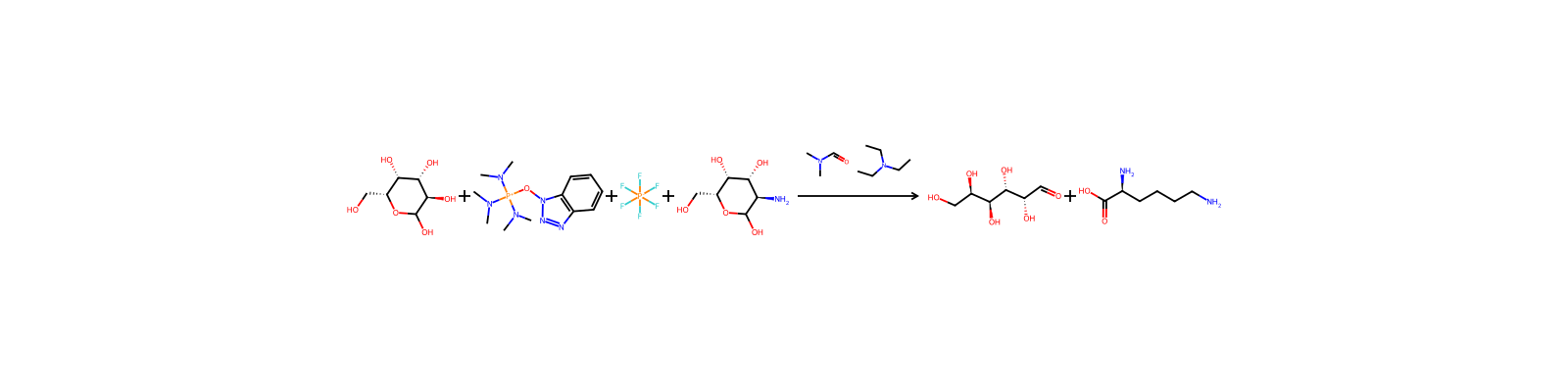
HRID 19437反応物として
D-Galactosamine

7535-00-4N[C@H]1C(O)O[C@H](CO)[C@H](O)[C@@H]1OMSWZFWKMSRAUBD-GASJEMHNSA-N2-amino-2-deoxy-D-galactopyranose is the pyranose form of D-galactosamine. It has a role as a toxin. It is a D-galactosamine and a primary amino compound. It is functionally related to a D-galactopyranose. It is a conjugate base of a 2-ammonio-2-deoxy-D-galactopyranose.
7535-00-4、90-76-6安全情報は参考情報です。供給元の安全データシート(SDS)、適用法令、専門家による評価に代わるものではありません。
解説D-ガラクトサミン.コンドロサミンともいう.ヘキソサミンの一種.D-グルコサミンについで広く天然に分布するアミノ糖で,一般に,N-アセチル誘導体として存在する.動物,植物,微生物の多糖類,とくにコンドロイチン硫酸をはじめ,多くのムコ多糖類,糖タンパク質,糖脂質の構成成分である.これらの酸加水分解のほか,合成によっても得られる.α形の塩酸塩は,分解点185 ℃.[α]D+121→+95°(水).β形の塩酸塩は分解点187 ℃.[α]D+44.5→+95°(水).還元糖,アミノ糖としての一般的性質を示す.フェニルヒドラジンによってアミノ基を失い,ガラクトサゾンを与える.エルソン-モルガン法によって検出,定量される.
説明Galactosamine is a model hepatotoxicant, induces hepatitis characterized by neutrophilic infiltration, and kills the animal by fulminant hepatic failure. Galactosamine, an amino derivative of sugar galactose, has been used as a model hepatotoxicant since the first reports of hepatotoxicity in late 1970s by Keppler and associates. Galactosamine-induced hepatitis has been a model of choice to study various aspects of liver disease, including mechanisms of toxicant-induced apoptosis and necrosis, liver tissue repair, neutrophil infiltration and transmigration, and the role of endotoxin or lipopolysaccharide (LPS) in initiating liver injury. Humans and animals synthesize galactosamine in the body. Galactosamine (a type of hexosamine) is formed when an amino group replaces one of the hydroxy groups of a sixcarbon sugar, or hexose. The human body utilizes uridine diphosphate (UDP)-N-acetyl-D-glucosamine or glucosamine as a precursor to synthesize this compound, and is most often found in the form N-acetyl-D-galactosamine (often referred to as N-acetylgalactosamine). Most importantly, galactosamine is a constituent of hyaluronic acid, a powerful water-binding agent. Many different types of tissues in human body contain hyaluronic acid, which acts as a lubricating agent in the synovial fluid of joints and in connective tissues. Hyaluronic acid also acts as a lubricating agent in the vitreous humor of the eyeball. Hyaluronic acid has considerable medicinal value; it is often used in wound healing, burn dressings, osteoarthritis treatment, cataract or corneal transplantation surgery, and various types of plastic surgeries.
定義ChEBI: The pyranose form of D-galactosamine.



DTXSID7043871CHEMBL3304228CHEBI:60312