
2-メトキシピリミジン-5-ボロン酸
2-Methoxypyrimidine-5-boronic acid
データを補完しています。しばらくしてからページを更新すると最新の内容を表示できます

基本情報
- CAS
628692-15-9- 標準SMILES
COc1ncc(B(O)O)cn1- InChIKey
YPWAJLGHACDYQS-UHFFFAOYSA-N- 分子式
- C5H7BN2O3
- 平均分子量
- 153.93 g/mol
- 単同位体質量
- 154.05497248
名称と識別子
- 優先名称
- 2-Methoxypyrimidine-5-boronic acid
- IUPAC
- (2-methoxypyrimidin-5-yl)boronic acid
- 現地名
- 2-メトキシピリミジン-5-ボロン酸
- 英語名
- 2-Methoxypyrimidine-5-boronic acid
- 分子式
- C5H7BN2O3
- 分子量
- 153.93
名称と別名
2-Methoxypyrimidine-5-boronic acid628692-15-9DTXSID70371597RefChem:262814DTXCID80322631670-240-4(2-methoxypyrimidin-5-yl)boronic Acid2-Methoxy-5-pyrimidineboronic acid2-methoxypyrimidin-5-ylboronic acidMFCD03094664Boronic acid, (2-methoxy-5-pyrimidinyl)-2-Methoxy-5-pyrimidylboronic Acid
名称をさらに表示
2-メトキシピリミジン-5-ボロン酸2-メトキシ-5-ピリミジルボロン酸2-メトキシ-5-ピリミジニルボロン酸2‐メトキシピリミジン‐5‐ボロン酸2-メトキシ-5-ピリミジンボロン酸2-METHOXYL-5-PYRIMIDYLBORIC ACID2-Methoxypyrimidine-5-boronicaci2-Methoxy PyriMidine boronic acid2-METHOXYL-5-PYRIMIDINEBORIC ACID2-MethoxypyriMidine-4-boronic acid
2-Methoxy-5-pyrimidinylboronic Acid(2-methoxypyrimidin-5-yl)boronicAcidHY-W0046982-METHOXYPYRIMIDIN-5-YL-5-BORONIC ACID2-Methoxy-pyrimidine-5-boronic acidMethoxypyrimidine-5-boronic acidA8682SCHEMBL9497
データベース識別子
- CAS
628692-15-9- PubChem CID
- 2736778
- DTXSID
DTXSID70371597- EC Number
- 670-240-4
- Nikkaji
- J2.035.654E
物性
構造計算による物性補完中
- 極性表面積
- 75.5 Ų
- 水素結合供与体数
- 2
- 水素結合受容体数
- 5
- 回転可能結合数
- 2
- 重原子数
- 11
- 形式電荷
- 0
- 複雑度
- 116
物理化学的性質
- 融点
- 161 °C · 161°C(lit.)
- 沸点
- 378.3 · 378.3±52.0 °C(Predicted)
- 比重(密度)
- 1.33 · 1.33±0.1 g/cm3(Predicted)
- 貯蔵温度
- Keep in dark place,Sealed in dry,Room Temperature
- 溶解性
- soluble in Methanol
- 外見
- powder to crystal
- 酸解離定数(Pka)
- 5.59 · 5.59±0.11(Predicted)
- 色
- White to Light yellow
- InChI
- InChI=1S/C5H7BN2O3/c1-11-5-7-2-4(3-8-5)6(9)10/h2-3,9-10H,1H3
- InChIKey
- YPWAJLGHACDYQS-UHFFFAOYSA-N
- SMILES
- B(C1=CN=C(OC)N=C1)(O)O
- CAS データベース
- 628692 · 628692-15-9(CAS DataBase Reference)
化学的性質
化学的特性Off-white to light yellow solid
安全と法規制
安全情報は参考情報です。供給元の安全データシート(SDS)、適用法令、専門家による評価に代わるものではありません。
GHS分類
GHS Classification
Warning
H302 (89.1%): Harmful if swallowed [Warning Acute toxicity, oral]
P261, P264, P264+P265, P270, P271, P280, P301+P317, P302+P352, P304+P340, P305+P351+P338, P319, P321, P330, P332+P317, P337+P317, P362+P364, P403+P233, P405, and P501 (click each P-code to see the statement)
Aggregated GHS information provided per 46 reports by companies from 7 notifications to the ECHA C&L Inventory. Each notification may be associated with multiple companies.
危険有害性情報
Hazard Classes and CategoriesAcute Tox. 4 (89.1%)
安全データ
- wgk
- WGK 3
- PRTR法
- 第一種指定化学物質
- hs_code
- 29349990
- risk_code
- 36-41-36/37/38
- hazard_code
- Xi
- safety_code
- 26-39-36/37/39
- hazard_class
- IRRITANT
- Hazard Classifications
- Acute Tox. 4 OralEye Irrit. 2
- ストレージクラス
- 11 - Combustible Solids
化学と産業
応用分野
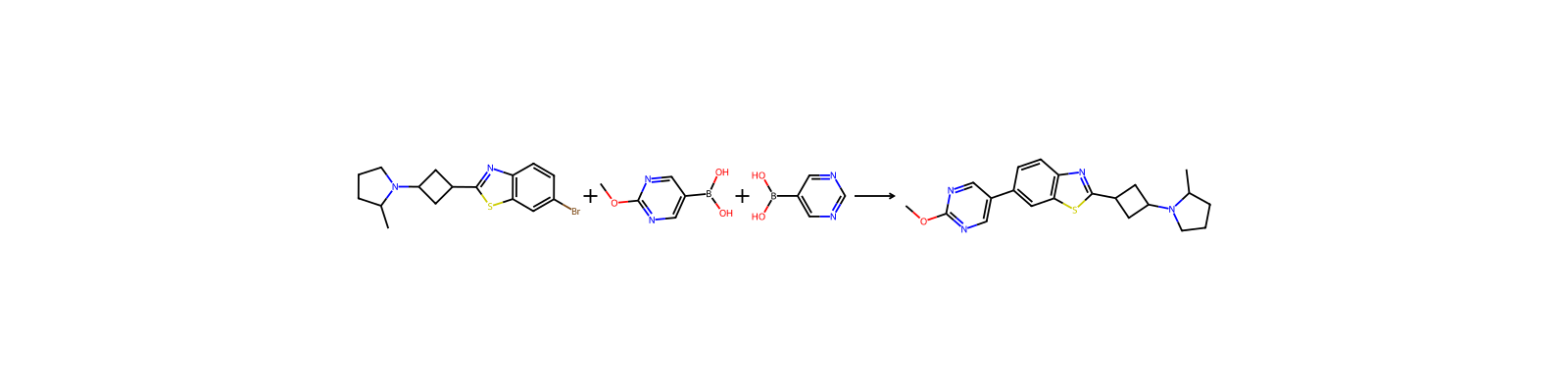
使用2-Methoxypyrimidine-5-boronic acid serves as a coupling partner in Suzuki–Miyaura reactions to synthesize diverse heterocyclic scaffolds. It reacts with intermediates such as compound 26 or 6-bromo-3-(4-hydroxyphenyl)-coumarin using potassium carbonate and palladium catalysts (e.g., Pd(OAc)₂ or 1,1′-bis(di-tert-butylphosphino)ferrocene palladium dichloride) in solvents including DMF or deep eutectic systems at 85 °C. The reagent also couples with 2-(4-((4-chloro-6-morpholino-1,3,5-triazin-2-yl)amino)phenyl)ethan-1-ol in DME/aqueous sodium carbonate under microwave heating[1][2][3]. The compound participates in Liebeskind–Srögl couplings with thioester or amide intermediates (such as series 18a–18c or 20a–20f) using tetrakis(triphenylphosphine)palladium(0) and copper(I) thiophene-2-carboxylate in THF at 100 °C, yielding target products in ranges of 22–55% or 29–50%[1].
調製方法
5-Bromo-2-methoxypyrimidine could synthesize 2-Methoxypyrimidine-5-boronic acid as the start material.
上流・下流製品情報
上流原料
関連反応
135 件




化合物ノート
読み込み中…