
ホームMCPワークベンチSkills
ホームワークベンチ通知マイページ
llms.txt · MCPガイドプライバシーポリシー · 利用規約 · サポートv1.8.0
  1. ホーム
  2. /化合物

デシプラミン

Desipramine

HCID 2995
ノートを作成反応を作成見積依頼を出す
印刷プレビュー

データを補完しています。しばらくしてからページを更新すると最新の内容を表示できます
基本情報概要名称と識別子物性安全と法規制化学と産業関連反応化合物ノート
部分構造検索類似構造を探す

基本情報

CAS
50-47-5
標準SMILES
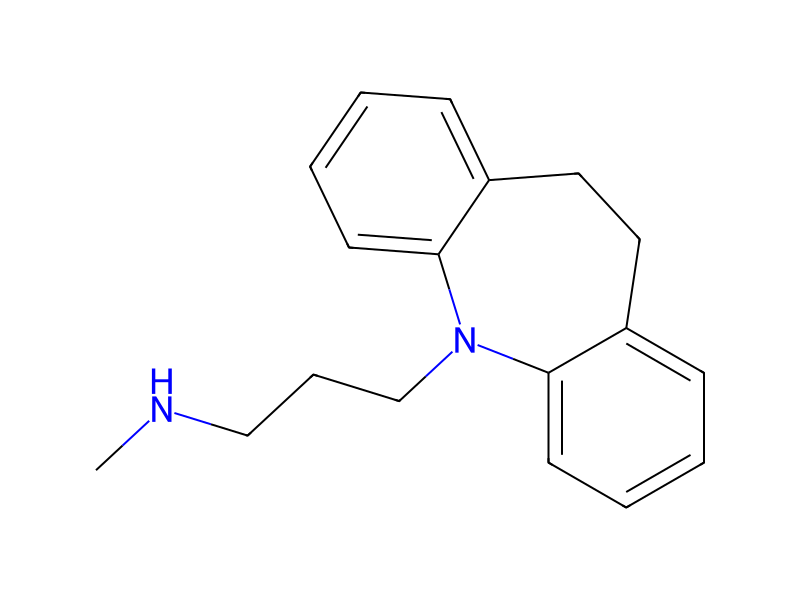
CNCCCN1c2ccccc2CCc2ccccc21
InChIKey
HCYAFALTSJYZDH-UHFFFAOYSA-N
分子式
C18H22N2
平均分子量
266.4 g/mol
単同位体質量
266.1782987

概要

Desipramine is a dibenzoazepine consisting of 10,11-dihydro-5H-dibenzo[b,f]azepine substituted on nitrogen with a 3-(methylamino)propyl group. It has a role as an antidepressant, an adrenergic uptake inhibitor, an alpha-adrenergic antagonist, a H1-receptor antagonist, a cholinergic antagonist, a serotonin uptake inhibitor, an EC 3.4.21.26 (prolyl oligopeptidase) inhibitor, an EC 3.1.4.12 (sphingomyelin phosphodiesterase) inhibitor and a drug allergen. It is a dibenzoazepine and a secondary amino compound.

名称と識別子

優先名称
Desipramine
IUPAC
3-(5,6-dihydrobenzo[b][1]benzazepin-11-yl)-N-methylpropan-1-amine
現地名
デシプラミン
英語名
DESIPRAMINE
分子式
C18H22N2
分子量
266.38

名称と別名

desipramineNorimipramine50-47-5DesmethylimipramineMonodemethylimipramineDesipraminDemethylimipramineDesimipramineDimethylimipramineDezipramineDesipraminaMethylaminopropyliminodibenzyl
名称をさらに表示
デシプラミンノルポラーク10,11-ジヒドロ-N-メチル-5H-ジベンゾ[b,f]アゼピン-5-プロパン-1-アミンノルチミル10,11-ジヒドロ-N-メチル-5H-ジベンゾ[b,f]アゼピン-5-(プロパン-1-アミン)デスイミプラミンデスメチルイミプラミン10,11-ジヒドロ-5-[3-(メチルアミノ)プロピル]-5H-ジベンゾ[b,f]アゼピンセルトフレン(3-{2-アザトリシクロ[9.4.0.03,8]ペンタデカ-1(15),3,5,7,11,13-ヘキサエン-2-イル}プロピル)(メチル)アミン5-[3-(メチルアミノ)プロピル]-10,11-ジヒドロ-5H-ジベンゾ[b,f]アゼピンネブリルペルチリル10,11-ジヒドロ-N-メチル-5H-ジベンゾ[b,f]アゼピン-5-(1-プロパンアミン)ノルイミプラミン10,11-ジヒドロ-5-(3-メチルアミノプロピル)-5H-ジベンゾ[b,f]アゼピンPentofranSertofranPertrofaneesipramine
Imipramine, demethyl-desipraminumDesimpramine3-(10,11-DIHYDRO-5H-DIBENZO[B,F]AZEPIN-5-YL)-N-METHYLPROPAN-1-AMINEN-(3-Methylaminopropyl)iminobibenzylDesipramine (D4)5-(gamma-Methylaminopropyl)iminodibenzylDMI 50475

物性

構造計算による物性補完中

XLogP
4.9
極性表面積
15.3 Ų
水素結合供与体数
1
水素結合受容体数
2
回転可能結合数
4
重原子数
20
形式電荷
0
複雑度
267

実験および物理化学的性質

Drugs · 3 件

DEA NFLIS-Drug Category -> Antidepressants

Pharmaceuticals

Pharmaceuticals -> Listed in ZINC15

LogP · 3 件

log Kow = 4.90

3.7

4.0

Solubility · 3 件

WHITE CRYSTALLINE POWDER; ODORLESS; BITTER TASTE; MELTS WITHIN 5 DEG RANGE BETWEEN 208-218 °C; 1 G IN CA 4 ML CHLOROFORM, 20 ML WATER, 20 ML ALC; FREELY SOL IN METHANOL; INSOL IN ETHER /HCL/

In water, 58.6 mg/l @ 24 °C.

3.96e-02 g/L

Human Drugs · 3 件

Antidepressants -> Tricyclic antidepressants (TCA)

Breast Feeding; Lactation; Milk, Human; Antidepressive Agents; Antidepressive Agents, Tricyclic

Pharmaceuticals

Boiling Point172-174 °C @ 0.02 MM HG
DecompositionWhen heated to decomposition it emits toxic fumes of nitroxides.
Melting Point · 2 件

214-218 °C

214 - 218 °C

Physical DescriptionSolid
Stability/Shelf Life

安全と法規制

安全情報は参考情報です。供給元の安全データシート(SDS)、適用法令、専門家による評価に代わるものではありません。

GHS分類

GHS Classification · 4 件

Danger

H302 (66.7%): Harmful if swallowed [Warning Acute toxicity, oral]

P260, P261, P264, P270, P271, P273, P301+P317, P304+P340, P308+P316, P319, P321, P330, P391, P403+P233, P405, and P501 (click each P-code to see the statement)

Aggregated GHS information provided per 3 reports by companies from 2 notifications to the ECHA C&L Inventory. Each notification may be associated with multiple companies.

危険有害性情報

Regulatory Information · 2 件

Status: Active Update: 08-02-2018 https://echa.europa.eu/registration-dossier/-/registered-dossier/22353

5H-Dibenzb,fazepine-5-propanamine, 10,11-dihydro-N-methyl-: Does not have an individual approval but may be used under an appropriate group standard

Other Safety InformationIMAP assessments - 5H-Dibenz[b,f]azepine-5-propanamine, 10,11-dihydro-N-methyl-: Environment tier I assessment
FDA Requirements · 1 件

Manufacturers, packers, and distributors of drug and drug products for human use are responsible for complying with the labeling, certification, and usage requirements as prescribed by the Federal Food, Drug, and Cosmetic Act, as amended (secs 201-902, 52 Stat. 1040 et seq., as amended; 21 U.S.C. 321-392).

Hazard Classes and CategoriesAcute Tox. 4 (66.7%)

安全と保護具

Storage ConditionsDesipramine hydrochloride capsules and tablets should be stored in tight containers at a temperature less than 40 °C, preferably at 15-30 °C. /Desipramine hydrochloride/
Disposal Methods

化学と産業

薬理情報

ATC Code · 2 件

N - Nervous system

QN - Nervous system

Protein Binding73-92% bound to plasma proteins
Pharmacodynamics · 1 件

Desipramine, a secondary amine tricyclic antidepressant, is structurally related to both the skeletal muscle relaxant cyclobenzaprine and the thioxanthene antipsychotics such as thiothixene. It is the active metabolite of imipramine, a tertiary amine TCA. The acute effects of desipramine include inhibition of noradrenaline re-uptake at noradrenergic nerve endings and inhibition of serotonin (5-hydroxy tryptamine, 5HT) re-uptake at the serotoninergic nerve endings in the central nervous system. Desipramine exhibits greater noradrenergic re-uptake inhibition compared to the tertiary amine TCA imipramine. In addition to inhibiting neurotransmitter re-uptake, desipramine down-regulates beta-adrenergic receptors in the cerebral cortex and sensitizes serotonergic receptors with chronic use. The overall effect is increased serotonergic transmission. Antidepressant effects are typically observed 2 - 4 weeks following the onset of therapy though some patients may require up to 8 weeks of therapy prior to symptom improvement. Patients experiencing more severe depressive episodes may respond quicker than those with mild depressive symptoms.

Mechanism of Action · 4 件

Desipramine is a tricyclic antidepressant (TCA) that selectively blocks reuptake of norepinephrine (noradrenaline) from the neuronal synapse. It also inhibits serotonin reuptake, but to a lesser extent compared to tertiary amine TCAs such as imipramine. Inhibition of neurotransmitter reuptake increases stimulation of the post-synaptic neuron. Chronic use of desipramine also leads to down-regulation of beta-adrenergic receptors in the cerebral cortex and sensitization of serotonergic receptors. An overall increase in serotonergic transmission likely confers desipramine its antidepressant effects. Desipramine also possesses minor anticholinergic activity, through its affinity for muscarinic receptors. TCAs are believed to act by restoring normal levels of neurotransmitters via synaptic reuptake inhibition and by increasing serotonergic neurotransmission via serotonergic receptor sensitization in the central nervous system.

MANNER IN WHICH IMIPRAMINE RELIEVES...DEPRESSION...IS NOT CLEAR. .../EFFECT/ DESCRIBED AS DULLING OF DEPRESSIVE IDEATION RATHER THAN AS EUPHORIC STIMULATION PRODUCED BY MAO INHIBITORS...DEFINITIVELY DISCRIMINATIVE EXPT... YET TO BE PERFORMED. ...DOES HAVE STIMULANT ACTION UNDER CERTAIN CIRCUMSTANCES. /IMIPRAMINE/

関連反応

22 件
反応記録を作成
HRID 28851 の反応式
HRID 28851生成物としてuspto-grants-2008_09
HRID 175966 の反応式
HRID 175966反応物としてTraining data from https://doi.org/10.1039/C8SC04228D (6/10)
HRID 687216 の反応式
HRID 687216反応物としてTraining data from https://doi.org/10.1039/C8SC04228D (3/10)
HRID 749691 の反応式
HRID 749691生成物としてuspto-grants-2008_07
HRID 840509 の反応式
HRID 840509反応物としてuspto-grants-2002_04
HRID 840510 の反応式
HRID 840510生成物としてuspto-grants-2002_04
HRID 840511 の反応式
HRID 840511反応物としてuspto-grants-2002_04
HRID 902287 の反応式
HRID 902287生成物としてuspto-grants-2008_04
1 / 3 ページ

化合物ノート

読み込み中…

このページの内容基本情報概要名称と識別子物性安全と法規制化学と産業関連反応化合物ノート
その他の操作
ノートを作成反応を作成見積依頼を出す

データベース識別子

CAS
50-47-5
PubChem CID
2995
DTXSID
DTXSID6022896
ChEMBL
CHEMBL72
ChEBI
CHEBI:47781
UNII
TG537D343B
EC Number
200-040-0
Nikkaji
J8.596K
UNSTABLE AFTER LONG EXPOSURE TO LIGHT, HEAT, & AIR /HYDROGEN CHLORIDE/
Dissociation Constants · 5 件

10.16

10.23

10.2

10.2

10.4

Collision Cross Section · 3 件

163.5 Ų [M+H]+ [CCS Type: DT; Buffer gas: N2; Ionization: ESI+; Dataset: Antidepressants]

160.93 Ų [M+H]+ [CCS Type: TW; Method: calibrated with polyalanine and drug standards]

163.3 Ų [M+H]+ [CCS Type: TW; Method: Major Mix IMS/Tof Calibration Kit (Waters)]

物理化学的性質

融点
212 °C · 212°C
沸点
0.02 · bp0.02 172-174°
比重(密度)
0.9934 · 0.9934 (rough estimate)
屈折率
1.52 · 1.5200 (estimate)
酸解離定数(Pka)
10.21 · pKa 10.21(-)(H2O t=20) (Uncertain)
外見
粉
色
白い
EPAの化学物質情報
Desipramine (50-47-5)
· 1 件

SRP: At the time of review, criteria for land treatment or burial (sanitary landfill) disposal practices are subject to significant revision. Prior to implementing land disposal of waste residue (including waste sludge), consult with environmental regulatory agencies for guidance on acceptable disposal practices.

毒性情報

Treatment · 1 件

Obtain an ECG and immediately initiate cardiac monitoring. Protect the patient's airway, establish an intravenous line, and initiate gastric decontamination. A minimum of 6 hours of observation with cardiac monitoring and observation for signs of CNS or respiratory depression, hypotension, cardiac dysrhythmias and/or conduction blocks, and seizures is necessary. If signs of toxicity occur at any time during this period, extended monitoring is required. Follow ECG, renal function, CPK, and arterial blood gasses as clinically indicated. (L1712)

Interactions · 5 件

ADMIN OF TRICYCLIC ANTIDEPRESSANTS...WITH OR SHORTLY AFTER...MAO INHIBITORS HAS RESULTED IN SEVERE REACTIONS. ... OTHER INTERACTIONS INCL POTENTIATION OF CENTRAL DEPRESSANT DRUGS, BLOCKADE OF ANTIHYPERTENSIVE EFFECTS OF GUANETHIDINE, & AUGMENTATION OF PRESSOR EFFECTS OF SYMPATHOMIMETIC AMINES. /TRICYCLIC ANTIDEPRESSANTS/

Concurrent use /of thyroid hormones/ with tricyclic antidepressants may increase the therapeutic and toxic effects of both medications, possibly due to increased receptor sensitivity to catecholamines; toxic effects include cardiac arrhythmias and CNS stimulation. /Tricyclic antidepressants/

Concurrent use /of sympathomimetics/ with tricyclic antidepressants may potentiate cardiovascular effects possibly resulting in arrhythmias, tachycardia, or severe hypertension or hyperpyrexia; phentolamine can control the adverse reaction. Significant systemic absorption of ophthalmic epinephrine may also potentiate cardiovascular effects; also, local anesthetics with vasoconstrictors should be avoided or a minimal amount of the vasoconstrictor should be used with the local anesthetic. Concurrent use with tricyclic antidepressants may decrease the pressor effect of ephedrine and mephentermine. /Tricyclic antidepressants/

If significant systemic absorption occurs, concurrent use /of ophthalmic naphazoline, nasal or ophthalmic oxymetazoline, nasal or ophthalmic phenylephrine, or nasal xylometazoline/ with tricyclic antidepressants may potentiate pressor effects of these medications. /Tricyclic antidepressants/

For more Interactions (Complete) data for DESIPRAMINE (20 total), please visit the HSDB record page.

Hepatotoxicity · 1 件

Liver test abnormalities have been reported to occur in up to 16% of patients being treated with tricyclic antidepressants, but elevations are uncommonly above 3 times the upper limit of normal. The aminotransferase abnormalities are usually mild, asymptomatic and transient, reversing even with continuation of medication and without dose adjustment. Rare instances of clinically apparent acute liver injury have been reported due to desipramine, but far fewer than have been reported with amitriptyline or imipramine. The onset of jaundice is usually within 1 to 8 weeks of starting the antidepressant, and the pattern of serum enzyme elevations can be either hepatocellular or cholestatic. Features suggestive of hypersensitivity (fever, rash, eosinophilia) are common, but rarely severe. Autoantibody formation is unusual. These features are typical of tricyclic antidepressant hepatotoxicity.

Adverse Effects · 1 件

Desipramine has a broad toxic profile, including an increased risk of suicide, orthostatic hypotension, cardiac abnormalities, seizures, ocular crisis, and fractures. A short-term study demonstrated a significantly increased risk of suicide in children, adolescents, and young adults aged 24 and younger; this represents one of the most significant adverse effects to consider when prescribing desipramine. Orthostatic hypotension, likely due to alpha-1 receptor blockade, is a common reason for drug discontinuation. Reports describe cardiovascular adverse effects, including heart block, arrhythmias, and sudden death associated with desipramine. Clinicians should screen for conduction abnormalities, with particular attention to the QT interval and family history of cardiac disease, before prescribing desipramine.

Exposure RoutesDesipramine hydrochloride is rapidly and almost completely absorbed from the gastrointestinal tract. It undergoes extensive first-pass metabolism. Peak plasma concentrations are attained 4 - 6 hours following oral administration.
Toxicity Summary · 2 件

Signs and Symptoms of Overdose

Desipramine is a tricyclic antidepressant (TCA) that selectively blocks reuptake of norepinephrine (noradrenaline) from the neuronal synapse. It also inhibits serotonin reuptake, but to a lesser extent compared to tertiary amine TCAs such as imipramine. Inhibition of neurotransmitter reuptake increases stimulation of the post-synaptic neuron. Chronic use of desipramine also leads to down-regulation of beta-adrenergic receptors in the cerebral cortex and sensitization of serotonergic receptors. An overall increase in serotonergic transmission likely confers desipramine its antidepressant effects. Desipramine also possesses minor anticholinergic activity, through its affinity for muscarinic receptors. TCAs are believed to act by restoring normal levels of neurotransmitters via synaptic reuptake inhibition and by increasing serotonergic neurotransmission via serotonergic receptor sensitization in the central nervous system.

Human Toxicity Excerpts · 2 件

MILD PARKINSONIAN SYNDROME...MAY BE SEEN IN SOME PT, PARTICULARLY OLDER PERSONS TAKING LARGE DOSES. ...HIGH DOSES...MAY PRODUCE GRAND MAL SEIZURES EVEN IN PT WITHOUT HISTORY OF CONVULSIONS. .../IT/ MAY PRODUCE ALLERGIC TYPE OF OBSTRUCTIVE JAUNDICE.../WHICH/ CLEARS WHEN DRUG IS DISCONTINUED. /IMIPRAMINE/

Effects of overdosage include agitation, hallucinations, hyperreflexia, hyperpyrexia, and convulsions. Both hypotension and hypertension also occur.

Carcinogen ClassificationNo indication of carcinogenicity to humans (not listed by IARC).
Drug Induced Liver Injury · 6 件

Benchmark Dataset for the Liver Toxicity Knowledge Base (LTKB)

desipramine

Norpramin®

Antidepressants

3

less-DILI-concern drugs

Non-Human Toxicity Excerpts · 3 件

IN CATS UNDER ANESTHESIA IV INJECTION OF 4 TO 25 MG OF DESIPRAMINE HAS BEEN FOUND TO REDUCE SPONTANEOUS ACTIVITY OF RETINAL NEURONES. DOSES OF 5 TO 20 MG/KG INCR C-WAVE IN ELECTRORETINOGRAM, & DOSES OF 20 TO 35 MG/KG REDUCED B-WAVE...

DESPITE ITS CLINICAL ANTIDEPRESSANT EFFECTS, IMIPRAMINE PRODUCES DEPRESSION OF SPONTANEOUS MOTOR ACTIVITY IN LAB ANIMALS. ...IT ALSO...DECR BODY TEMP, & CAUSES ATAXIA. IT IMPAIRS BOTH ACQUISITION & PERFORMANCE OF CONDITIONED AVOIDANCE RESPONSES. /IMIPRAMINE/

IMIPRAMINE LOWERS BLOOD PRESSURE IN ANESTHETIZED DOGS & OBTUNDS VARIOUS CARDIOVASCULAR REFLEXES, INCL CAROTID OCCLUSION REFLEX, BEZOLD-JARISCH REFLEX, & POSTURAL RESPONSES. /IMIPRAMINE/

Effects During Pregnancy and Lactation · 2 件

◉ Summary of Use during Lactation

◈ What is desipramine?

Toxicity DataLD50: 290 mg/kg (Mouse) (A308) LD50: 320 mg/kg (Rat) (A308)

法規制情報

FDA Requirements · 1 件

Manufacturers, packers, and distributors of drug and drug products for human use are responsible for complying with the labeling, certification, and usage requirements as prescribed by the Federal Food, Drug, and Cosmetic Act, as amended (secs 201-902, 52 Stat. 1040 et seq., as amended; 21 U.S.C. 321-392).

安全データ

wgk
3
risk_code
20/21/22
hazard_code
Xn
safety_code
36
有毒物質データの
50-47-5(Hazardous Substances Data)

ACTION OF TRICYCLIC ANTIDEPRESSANTS ON METABOLISM OF CATECHOLAMINES & INDOLEAMINES IN BRAIN HAS CONTRIBUTED SIGNIFICANTLY TO "BIOGENIC AMINE HYPOTHESIS" OF DEPRESSION. ... ALL TRICYCLIC ANTIDEPRESSANTS BLOCK RE-UPTAKE OF NOREPINEPHRINE BY ADRENERGIC NERVE TERMINALS. /TRICYCLIC ANTIDEPRESSANTS/

IMIPRAMINE SLOWS TURNOVER RATE OF 5-HT, EFFECT NOT SHARED BY DESIPRAMINE, WHILE TURNOVER RATE OF NOREPINEPHRINE IS INCR BY DEMETHYLATED DRUGS NORTRIPTYLINE & DESIPRAMINE. EXACT RELATIONSHIP OF THESE EFFECTS TO ACTIONS OF TRICYCLIC ANTIDEPRESSANTS IN HUMAN DEPRESSION IS NOT KNOWN.

Biological Half-Life · 2 件

7-60+ hours; 70% eliminated renally

...DESIPRAMINE /WAS GIVEN/ IN DOSE OF 25 MG EVERY 8 HR TO 15 PT. ...BIOLOGICAL HALF-LIFE...FROM A FEW HR TO MORE THAN 2 DAYS...

Metabolism/Metabolites · 5 件

Desipramine is extensively metabolized in the liver by CYP2D6 (major) and CYP1A2 (minor) to 2-hydroxydesipramine, an active metabolite. 2-hydroxydesipramine is thought to retain some amine reuptake inhibition and may possess cardiac depressant activity. The 2-hydroxylation metabolic pathway of desipramine is under genetic control.

DEMETHYLIMIPRAMINE YIELDS BISDEMETHYLIMIPRAMINE, DEMETHYL-2-HYDROXYIMIPRAMINE, DEMETHYL-10-HYDROXYIMIPRAMINE, & IMINODIBENZYL IN MAN. /FROM TABLE/

DEMETHYLIMIPRAMINE YIELDS IMIPRAMINE IN RABBITS AND IN RATS. /FROM TABLE/

Desipramine has known human metabolites that include Desipramine N-glucuronide and 2-hydroxy-desipramine.

Desipramine is extensively metabolized in the liver by CYP2D6 (major) and CYP1A2 (minor) to 2-hydroxydesipramine, an active metabolite. 2-hydroxydesipramine is thought to retain some amine reuptake inhibition and may possess cardiac depressant activity. The 2-hydroxylation metabolic pathway of desipramine is under genetic control. Route of Elimination: Desipramine is metabolized in the liver, and approximately 70% is excreted in the urine. Half Life: 7-60+ hours; 70% eliminated renally

FDA Pharmacological Classification · 6 件

TG537D343B

DESIPRAMINE

Established Pharmacologic Class [EPC] - Tricyclic Antidepressant

Desipramine is a Tricyclic Antidepressant.

DESIPRAMINE

Tricyclic Antidepressant [EPC]

MeSH Pharmacological Classification · 3 件

Substances that contain a fused three-ring moiety and are used in the treatment of depression. These drugs block the uptake of norepinephrine and serotonin into axon terminals and may block some subtypes of serotonin, adrenergic, and histamine receptors. However, the mechanism of their antidepressant effects is not clear because the therapeutic effects usually take weeks to develop and may reflect compensatory changes in the central nervous system.

Compounds or agents that combine with an enzyme in such a manner as to prevent the normal substrate-enzyme combination and the catalytic reaction.

Drugs that block the transport of adrenergic transmitters into axon terminals or into storage vesicles within terminals. The tricyclic antidepressants (ANTIDEPRESSIVE AGENTS, TRICYCLIC) and amphetamines are among the therapeutically important drugs that may act via inhibition of adrenergic transport. Many of these drugs also block transport of serotonin.

Absorption, Distribution and Excretion · 6 件

Desipramine hydrochloride is rapidly and almost completely absorbed from the gastrointestinal tract. It undergoes extensive first-pass metabolism. Peak plasma concentrations are attained 4 - 6 hours following oral administration.

Desipramine is metabolized in the liver, and approximately 70% is excreted in the urine.

...DESIPRAMINE /WAS GIVEN/ IN DOSE OF 25 MG EVERY 8 HR TO 15 PT. .../IT/ ACCUM IN BODY FOR PERIODS VARYING FROM 1 TO 16 DAYS, PEAK PLASMA LEVELS RANGING FROM 10 TO 275 UG/L...

IN ANIMALS, TRANSPLACENTAL PASSAGE HAS BEEN DEMONSTRATED RECENTLY OF...DESIPRAMINE...

AFTER IV ADMIN OF SINGLE DOSE OF DESMETHYLIMIPRAMINE...TO DOGS, RATE OF RENAL EXCRETION OF UNCHANGED DRUG DECR DRAMATICALLY IN INCREASING URINARY PH, WITH LITTLE CHANGE IN CREATININE CLEARANCE. ... URINARY EXCRETION...IN MAN WAS ALSO SHOWN TO BE PH-DEPENDENT...

THERE IS WIDE INTERPATIENT VARIATION IN STEADY-STATE PLASMA CONCN OF TRICYCLIC ANTIDEPRESSANTS. ...VARIATION SEEMS TO BE GENETICALLY DETERMINED... /TRICYCLIC ANTIDEPRESSANTS/

Cellular LocationsCytoplasm
Metabolite PathwaysDesipramine Action Pathway

用途と製造

Uses · 2 件

Antidepressant

For relief of symptoms in various depressive syndromes, especially endogenous depression. It has also been used to manage chronic peripheral neuropathic pain, as a second line agent for the management of anxiety disorders (e.g. panic disorder, generalized anxiety disorder), and as a second or third line agent in the ADHD management.

Methods of ManufacturingFREE BASE & HYDROCHLORIDE: BRITISH PATENT 908,788 (1962 TO GEIGY)
Formulations/PreparationsDESIPRAMINE HYDROCHLORIDE, NF: NORPRAMIN, CAPSULES: 25, 50 MG; PERTOFRANE, TABLETS: 25, 50 MG /HYDROGEN CHLORIDE, FROM TABLE/
Use ClassificationPharmaceuticals
General Manufacturing InformationPREPN OF HYDROCHLORIDE: BELGIAN PATENT 614,616, CA 58 11338C (1963), (1962 TO GEIGY)

応用分野

使用Desipramine is used for depression of various etiology and in particular for endogenous depression.

上流・下流製品情報

上流原料

水素2-ニトロトルエン

補足説明

定義ChEBI: A dibenzoazepine consisting of 10,11-dihydro-5H-dibenzo[b,f]azepine substituted on nitrogen with a 3-(methylamino)propyl group.