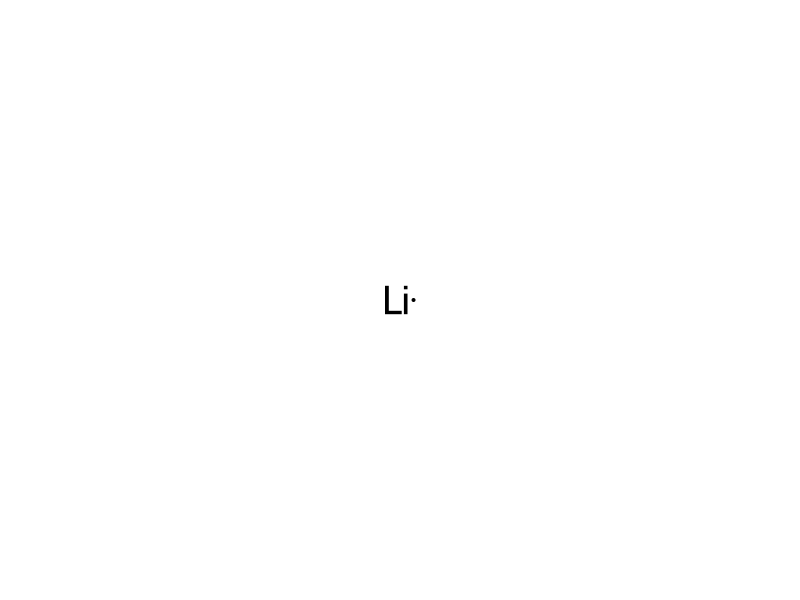
7439-93-2[Li]WHXSMMKQMYFTQS-UHFFFAOYSA-NLithium appears as a soft silvery metal that is normally grayish white. Reacts violently with water to form flammable hydrogen gas and strong caustic solution. Ignition usually occurs. Strong (corrosive) alkali fumes are formed in fire. (USCG, 1999)
7439-93-2DTXSID5036761Metals -> Elements, Metallic
Flammable agents - 2nd degree
Trace element
0.53 at 68 °F (USCG, 1999) - Less dense than water; will float
0.534 g/cu cm at 25 °C
0.5 g/cm³
0.534 @25 °C
Soft silvery-white metal
Silvery-white metal; body centered cubic structure; becomes yellowish on exposure to moist air
Reacts with water
Soluble in liquid ammonia forming a blue solution
Solubility in water: violent reaction
LIQUID METAL IS CORROSIVE, ATTACKING GLASS OR PORCELAIN AT A TEMPERATURE OF ABOUT 200 °C
Emits corrosive fumes when burned
1336 °C (2437 °F)
1342 °C
1336 °C
1342 °C @760 [mm Hg]
Danger
H260: In contact with water releases flammable gases which may ignite spontaneously [Danger Substances and mixtures which in contact with water, emit flammable gases]
P223, P231+P232, P260, P264, P280, P301+P330+P331, P302+P335+P334, P302+P361+P354, P304+P340, P305+P354+P338, P316, P321, P363, P370+P378, P402+P404, P405, and P501 (click each P-code to see the statement)
Danger
H260 (100%): In contact with water releases flammable gases which may ignite spontaneously [Danger Substances and mixtures which in contact with water, emit flammable gases]
P223, P231+P232, P260, P264, P264+P265, P280, P301+P330+P331, P302+P335+P334, P302+P361+P354, P304+P340, P305+P354+P338, P316, P317, P321, P363, P370+P378, P402+P404, P405, and P501 (click each P-code to see the statement)
Chemical: Lithium
Lithium is listed on the EPA's Chemical Data Reporting (CDR) system. Manufacturers and importers of Lithium are required to report information about their production and use of this chemical to the EPA under the Toxic Substances Control Act (TSCA). (40 eCFR Part 711)
Status: Active Update: 03-08-2021 https://echa.europa.eu/registration-dossier/-/registered-dossier/14178
Lithium: HSNO Approval: HSR001278 Approved with controls
The New Jersey Worker and Community Right to Know Act requires public and private employers to provide information about hazardous substances at their workplaces. (N.J.S.A. 34:5A-1 et. seq.)
Special Hazards of Combustion Products: Strong alkali fumes are formed in fire.
· Produce flammable gases on contact with water.
Flammable. Many reactions may cause fire or explosion. Gives off irritating or toxic fumes (or gases) in a fire. Risk of fire and explosion on contact with combustible substances or water.
N - Nervous system
QN - Nervous system
LITHIUM
Mood Stabilizer [EPC]
LITHIUM METALLICUM
Mood Stabilizer [EPC]
Used to manufacture alloys, greases, ceramics, batteries, aircraft fuel, and organic chemicals; Used as a fuel and heat-transfer fluid in the nuclear power industry and as a scavenger for oxygen and sulfur; Dietary intake estimated at 2mg/day; Lithium salts are used as drugs in the treatment of bipolar depression. [CHEMINFO]
Metal Preparation and Pouring [Category: Foundry]
Ceramics making [Category: Hobbies]
As "getter" in vacuum tubes; manufacture of catalysts for polyolefin plastics; in fuels for aircraft, missiles.
In metallurgy, as degasifier, deoxidizer, desulfurizer; as grain refiner in non-ferrous metals.
Chem intermediate for butyllithium polymerization catalyst; in alloys with aluminum or magnesium for aerospace uses
The purity of the meatal is 99.8% or better with the metallic impurities less than 0.1%
Purity of metal is 99.8%
(1975) 2.72X10+7 GRAMS
(1985) 2.36X10+9 g
読み込み中…
CHEMBL1201333CHEBI:30145180.5 °C (357 °F)
180.54 °C
Enthalpy of fusion at the melting point: 432 J/g; specific heat capacity at constant pressure at 25 °C: 3.57 24.8 J/mol K
When heated above melting point it burns with an intense white light; liquid metal dissolves metals such as copper, zinc, tin and their alloys.
180.5 °C
180.5 °C
7.90X10⁻¹¹ Pa (5.92X10⁻¹³ mm Hg) at 400 K (127 °C); 0.000489 Pa (3.67X10⁻⁶ mm Hg) at 600 K (327 °C); 1.08 Pa (0.00810 mm Hg) at 800 K (524 °C); 109 Pa (0.818 mm Hg) at 1000 K (727 °C)
Vapor pressure, Pa at 723 °C: 133
化学的特性Lithium is a silvery to grayish-white metal that turns yellow on exposure to air and/or moisture.
... Flammable solid.
Molten Li is... difficult to extinguish.
Reacts violently /with water/ to form hydrogen gas and strong caustic solution. Ignition usually occurs.
If lithium metal is heated to its melting point, spontaneous ignition is likely.
Lithium is spontaneously flammable in air if heated to 180 °C, if the surface of the metal is clean ...
Finely divided metal may ignite in air at ambient temperature and /a large mass of/ metal above the melting point, 180 °C, especially if oxide or nitride is present.
Contact with eyes causes caustic irritation or burn. Incontact with skin lithium reacts with body moisture to cause chemical burns: foil, ribbon, and wire react relatively slowly. (USCG, 1999)
· Inhalation or contact with vapors, substance or decomposition products may cause severe injury or death.
Reacts with air; Reacts with water to form explosive hydrogen gas and corrosive lithium hydroxide; [CHEMINFO] Lithium poisoning is most common in patients in long-term treatment with renal impairment. The usual daily dose is 300 to 2400 mg. The therapeutic serum level is 0.6-1.2 mEq/L. Lithium intoxication may occur in lithium-treated patients who develop acute gastroenteritis, take thiazide diuretics, or use NSAIDs or ACE inhibitors. Common symptoms of lithium intoxication are lethargy, weakness, slurred speech, ataxia, tremor, and myoclonic jerks which may progress to delirium, seizures, hyperthermia, and coma. Diagnosis is supported by an elevated lithium level, but the degree of elevation does not predict the degree of toxicity. [Olson, p. 293-5] There is evidence from pharmacologic use that lithium is nephrotoxic. [Rosenstock, p. 572] Not being protein bound, Li is rapidly eliminated by the kidneys, with almost no tissue accumulation. Side effects in patients treated with lithium include reduced urinary concentration capacity, hypothyroidism, and neurotoxicity. [Nordberg, p. 969] MAK TWA is for Lithium compounds, inorganic, as Li, except of Li and highly irritating lithium compounds (as lithium amide, hydride, hydroxide, nitride, oxide, tetrahydroalumininate, tetrahydroborate); [MAK]
Excerpt from ERG Guide 138 [Substances - Water-Reactive (Emitting Flammable Gases)]:
Use special powder. NO water. NO other agents. In case of fire: keep drums, etc., cool by spraying with water. NO direct contact with water.
Fresh air, rest. Half-upright position. Refer for medical attention.
Remove contaminated clothes. Rinse skin with plenty of water or shower. Refer for medical attention .
First rinse with plenty of water for several minutes (remove contact lenses if easily possible), then refer for medical attention.
Refer for medical attention .
· CALL 911. Then call emergency response telephone number on shipping paper. If shipping paper not available or no answer, refer to appropriate telephone number listed on the inside back cover.
· ELIMINATE all ignition sources (no smoking, flares, sparks or flames) from immediate area.
EYES or SKIN: flush with water and treat with boric acid. (USCG, 1999)
General First Aid:
Corrosive ... Water reactive ... Evolves hydrogen and ignites on contact with water.
Sodium carbonate and sodium chloride are unsuitable to use as extinguishers for lithium fires, since burning lithium will liberate the more reactive sodium in contact with them.
Liquid lithium is readily ignited and reacts with most extinguishing agents, including water, carbon tetrachloride and carbon dioxide.
Since lithium will burn in oxygen, nitrogen or carbon dioxide, and when alight it will remove the combined oxygen in sand, sodium carbonate, etc., it is difficult to extinguish once alight ... Use of normal fire extinguishers (containing water, form, carbon dioxide, halocarbons, dry powders) will either accelerate combustion or cause explosion.
· Wear positive pressure self-contained breathing apparatus (SCBA).
0.2 [mg/m3], inhalable fraction, as Li (except Li and highly irritating lithium compounds, lithium amide, hydride, hydroxide, nitride, oxide, tetrahydroaluminate, and tetrahydroborate)[German Research Foundation (DFG)]
Extinguish lithium fires only with chemicals designed for this purpose.
Use approved Class D extinguishers or smother with dry sand, dry clay, or dry ground limestone. DO NOT use carbon dioxide or halogenated extinguishing agents. DO NOT use water. Violent reaction may result.
If material on fire or involved in fire: Do not use water. Do not use carbon dioxide. Use graphite, soda ash, powdered sodium chloride, or suitable dry powder.
Powdered graphite, lithium chloride, potassium chloride or zirconium silicate are suitable extinguishants.
Store in a cool, dry, well-ventilated location. Separate from water.
Keep under mineral oil or other liquid free from oxygen or water.
Eliminate all ignition sources. Keep water away from release. Shovel into suitable dry container.
Spillage Disposal: Wear eye protection, laboratory coat and nitrile rubber gloves. Cover spill with a 1:1:1 mixture by weight of sodium carbonate or calcium carbonate, clay cat litter (bentonite) and sand. Scoop the mixture into a pail and transport to the fume hood. Slowly and with stirring add to a large quantity of 95% ethanol. Mix and let stand for 24 hours. The solid residue may be treated as normal refuse.
Waste Disposal: Package Lots. Place in a separate labeled container for recycling or disposal by burning. Burn in an open furnace. Use caution and limit to 100 g packages. Small Quantities. Wear eye protection, laboratory coat and nitrile rubber gloves. Work in the fume hood. Equip a 3-necked round-bottom flask with a stirrer, dropping funnel, condenser and heating mantle. Flush the flask with nitrogen and place the lithium (cut in small pieces) in it. Add 30 mL of 95% ethanol per gram of lithium at a rate that causes rapid refluxing. Stirring is started as soon as enough ethanol has been added to make it feasible. The mixture is stirred and heated under reflux until the lithium is dissolved. The heat is turned off, and an equal volume of water is added at a rate that causes no more than mild refluxing. The solution is then cooled, neutralized with 6 M hydrochloric acid (cautiously add a volume of concentrated acid to an equal volume of cold water) and washed down the drain with at least 50 times its volume of water.
SRP: The most favorable course of action is to use an alternative chemical product with less inherent propensity for occupational exposure or environmental contamination. Recycle any unused portion of the material for its approved use or return it to the manufacturer or supplier. Ultimate disposal of the chemical must consider: the material's impact on air quality; potential migration in soil or water; effects on animal, aquatic, and plant life; and conformance with environmental and public health regulations.
Liver test abnormalities have been reported to occur in a small proportion of patients on long term therapy with lithium. These abnormalities are usually asymptomatic and transient, reversing even with continuation of medication. Instances of more marked elevations in serum aminotransferases have been reported in patients taking overdoses of lithium, but the other metabolic and systemic effects of lithium overdose generally overshadow hepatic adverse effects. Lithium has not been associated with instances of clinically apparent acute liver injury with jaundice.
Neurotoxin - Other CNS neurotoxin
Lithium can cause various adverse effects, often correlated with the dosage. The notable adverse effects of lithium include:
IDENTIFICATION AND USE: Elemental lithium is a silver white metal; body centered cubic structure it becomes yellowish on exposure to moist air and it reacts with water. It is soluble in liquid ammonia forming a blue solution. It is used in the manufacture of catalysts for polyolefin plastics; in fuels for aircraft and missiles.It is used in metallurgy, as a degasifier, deoxidizer, desulfurizer; as a grain refiner in non-ferrous metals. Chemical intermediate for butyllithium polymerization catalyst; in alloys with aluminum or magnesium for aerospace uses. It is used in the production of tritium, reducing and hydrogenating agents, alloy hardeners, pharmaceuticals and Grignard reagents. Scavenger and degassifier for stainless and mild steels in molten state, modular iron, soaps and greases, deoxidizer in copper and copper alloys, heat-transfer liquid, storage batteries (with sulfur, selenium, tellurium, and chlorine). Rocket propellants, vitamin A synthesis, silver solders, underwater bouyancy devices, nuclear reactor coolent. HUMAN EXPOSURE AND TOXICITY: Elemental lithium causes severe eye and skin burns. Industrial exposures to lithium may occur during extraction of lithium from its ores, preparation of various lithium compounds, welding, brazing, enameling, and from the use of lithium hydrides. ANIMAL STUDIES: No animal studies could be located.
Due to its narrow therapeutic index, serum levels of lithium exceeding 2 mEq/L are considered toxic, which falls within its therapeutic range. Lithium toxicity can result in interstitial nephritis, arrhythmia, sick sinus syndrome, hypotension, T-wave abnormalities, and bradycardia. In rare instances, toxicity can lead to pseudotumor cerebri and seizures. Notably, there exists no antidote for lithium toxicity. The primary approach to treating lithium toxicity involves hydration and discontinuation of the drug. Administering hydration through normal saline concurrently facilitates lithium excretion. Close monitoring is essential to prevent hypernatremia in patients receiving normal saline. Diuretic use should be avoided for patients on lithium treatment. For mitigating tremors, administering 20 to 30 mg of propranolol twice or thrice daily is recommended.
Burning sensation. Cough. Laboured breathing. Shortness of breath. Sore throat. Symptoms may be delayed.
Redness. Skin burns. Pain. Blisters.
Redness. Pain. Severe deep burns.
Abdominal cramps. Abdominal pain. Burning sensation. Nausea. Shock or collapse. Vomiting. Weakness.
Lithium is widely distributed in nature; trace amounts are found in many minerals, in most rocks and soils, and in many natural waters(1). Lithium is a member of the alkali metals and does not occur as the free metal in nature(2). The typical oxidation state of the alkali metals is +1; no other cations are known or expected for the alkali metals(4). Lithium concentrations in the earth's crust are estimated to be 20 to 70 ppm by weight(1); it is the 27th most abundant element(3). Lithium is found in small amounts in nearly all igneous rocks and in the waters of many mineral springs(2). Lepidolite, spodumene, petalite, and amblygonite are the most important lithium containing minerals(2).
NIOSH (NOES Survey 1981-1983) has statistically estimated that 3,455 workers (1,084 of these are female) are potentially exposed to lithium in the US(1).
Industrial exposures to lithium may occur during extraction of lithium from its ores, preparation of various lithium compounds, welding, brazing, enameling, and from the use of lithium hydrides. /Lithium/
Lithium is widely distributed in nature; trace amounts are found in many minerals, in most rocks and soils, and in many natural waters. Lithium is a member of the alkali metals and does not occur as the free metal in nature. Lithium concentrations in the earth's crust are estimated to be 20 to 70 ppm by weight; it is the 27th most abundant element. Lithium is found in small amounts in nearly all igneous rocks and in the waters of many mineral springs. Lepidolite, spodumene, petalite, and amblygonite are the most important lithium containing minerals. The production and use of lithium compounds in ceramics, glass and primary aluminum production, the manufacture of lubricants and greases, primary and secondary (rechargeable) batteries, the production of synthetic rubber, the manufacture of polyester fiber, the production of antioxidants and antihistamines, as catalysts, and in the treatment of mood disorders may result in the release of lithium compounds to the environment through various waste streams. If release to air lithium compounds should exist in the particulate phase in the ambient atmosphere since the ionic nature of lithium compounds makes them essentially non-volatile. Particulate-phase lithium may be physically removed from the air by wet and dry deposition. The adsorption of lithium was measured on aquifer material; Freundlich coefficients ranged from 4.5 to 5.5. Lithium has been found to sorb slightly to humic soils with a Kp of 4.6 at pH 5. These data indicate that lithium compounds are not expected to adsorb strongly to soils and sediments. Lithium ion would not be expected to undergo oxidation-reduction reactions under environmental conditions, and would exist in its +1 oxidation state either in compounds or as dissolved ions. The ionic nature of lithium compounds makes them essentially non-volatile; lithium compounds would not volatilized from dry soil surfaces. Due to the ionic nature of lithium compounds, volatilization from moist surfaces will not occur. In water, adsorption to suspended solids and sediments is not expected to be important fate processes for lithium compounds. Lithium ions may undergo precipitation, sorption, or ligand exchange reactions in the environment. Due to the ionic nature of most lithium compounds, volatilization from water surfaces will not occur. Bioconcentration is not expected to be an important fate process due to the ionic nature of lithium compounds. Occupational exposure to lithium compounds may occur through inhalation and dermal contact at workplaces where lithium compounds are produced or used. Since lithium is found various environmental media, the general public would be exposed to small amounts of lithium via inhalation of ambient air, ingestion of food and drinking water. (SRC)
Basic treatment: Establish a patent airway (oropharyngeal or nasopharyngeal airway, if needed). Suction if necessary. Watch for signs of respiratory insufficiency and assist ventilations if necessary. Administer oxygen by nonrebreather mask at 10 to 15 L/min. Monitor for pulmonary edema and treat if necessary ... . Monitor for shock and treat if necessary ... . Anticipate seizures and treat if necessary ... . For eye contamination, flush eyes immediately with water. Irrigate each eye continuously with 0.9% saline (NS) during treatment ... . Do not use emetics. For ingestion, rinse mouth and administer 5 ml/kg up to 200 ml of water for dilution if the patient can swallow, has a strong gag reflex, and does not drool ... . Cover skin burns with dry sterile dressings after decontamination ... . /Lithium and related compounds/
Advanced treatment: Consider orotracheal or nasotracheal intubation for airway control in the patient who is unconscious, has severe pulmonary edema, or is in severe respiratory distress. Positive-pressure ventilation techniques with a bag-valve-mask device may be beneficial. Consider drug therapy for pulmonary edema ... . Monitor cardiac rhythm and treat arrhythmias if necessary ... . Start IV administration of D5W /SRP: "To keep open", minimal flow rate/. Use 0.9% saline (NS) or lactated Ringer's (LR) if signs of hypovolemia are present. For hypotension with signs of hypovolemia, administer fluid cautiously. Consider vasopressors if patient is hypotensive with a normal fluid volume. Watch for signs of fluid overload ... . Treat seizures with diazepam or lorazepam ... . Use proparacaine hydrochloride to assist eye irrigation ... . /Lithium and related compounds/
Ingestion of lithium metal ... is caustic. Dilution with water or other water-containing materials may produce a reaction that exacerbates the corrosive activity. Consideration may be given to gastric lavage with a large diameter tube for removal of material and then dilution with large amounts of water. Esophagoscopy may be of assistance in this procedure and to assess extent of damage. Treatment is otherwise symptomatic and supportive. Administration of activated charcoal is not useful because it does not bind to lithium ions and obscures endoscopic findings
0.002
PPRTV Current
0.002
PPRTV Current
2023: 2,500,000 - <4,000,000 lb
(1972) LESS THAN 5.6X10+8 GRAMS (USE)
(1975) 4.03X10+9 G (DELIVERIES)
Recovery of the ore, spodumene, followed by concentration by froth flotation, conversion to lithium chloride, and electrolysis from an anhydrous lithium chloride-potassium chloride mixture.
...High-temperature extraction from spodumene by sodium carbonate; solar evaporation of lake brines.
Recovered from natural brines; electrochemical processes; reduction of the oxide with magnesium or aluminum; Hanson, U.S. patent 2,028,390 (1936)
Lithium metal is produced only by the electrolysis of molten lithium chloride.
Dry Lithium chloride is the feed material for manufacture of Li metal by electrolysis. The cell bath is actually a molten mixture of Li chloride and potassium chloride. The cell is operated at 400 to 420 °C with a voltage across the cell of 8 to 9 volts. Current consumption in electrolysis is about 18 kw/hr/lb of Li produced.
All Other Basic Inorganic Chemical Manufacturing
Lithium: ACTIVE
Available as ingots, rods, wire, ribbon, & pellets.
解説Li.原子番号3の元素.電子配置1s22s1の周期表1族元素.原子量6.94.安定同位体 6Li,7Li,ほかに3種類の放射性同位体がある.1817年J. Berzelius(ベルセリウス)の弟子J.A. Arfwedsonがペタル石(petalite,LiAlSi4O10)中に発見し,Berzeliusがギリシア語の岩石λιθοζ"(lithos)から命名した.宇田川榕菴は天保8年(1837年)出版の「舎密開宗」で,利知烏母(リチウム)と記載している.1855年R.W.E. Bunsen(ブンゼン)とA. Mathiessenが塩化物の融解電解によりはじめて金属を遊離した.天然には,リチア雲母,ペダル石,リチア石などの鉱石や岩石中に広く分布する.地殻中の存在度13 ppm.最大資源国はボリビアで推定埋蔵量540万t.次いでチリ300万t.おもに炭酸リチウムとして輸入され,2006年度の輸入量は14000 t で,約1万t がチリから.塩化リチウムの融解電解で得られる.真空蒸留により精製する.銀白色の軟らかい金属.体心立方格子構造.格子定数a = 0.350 nm(20 ℃).融点180.5 ℃,沸点1350 ℃.密度0.534 g cm-3(20 ℃).第一イオン化エネルギー5.390 eV.炎色反応は深紅色.常温,乾いた空気中では酸化されない.高温では酸素,窒素,水素,ハロゲン,硫黄,炭素,ケイ素などと直接化合する.常温の水や酸と反応して水素を発生し,水酸化物や塩を生じる.化合物においてはつねに酸化数1をとる.リチウムやリチウム化合物の化学的性質は,マグネシウムに似ている点が多い.これは Li+ が Mg2+ とほぼ同じ大きさをもつためである.重合触媒(アルミニウム-リチウム合金),合金添加物,リチウムイオン電池用電極材,半導体材料,脱酸剤として用いられる.リチウムイオン電池用が最大·最重要用途である.森北出版「化学辞典(第2版)
用途金属還元剤·合金添加·リチウム電池
説明Lithium is an alkali metal with physiologic actions similar to potassium and sodium. Lithium was discovered as a salt in 1817 by Johan August Arfwedson. It does not occur in nature as a free metal but is found in minerals such as spodumene, petalite, and eucryptite. It is the 27th most abundant element in Earth’s crust. Lithium was used to treat gout, as a salt substitute, and as a major constituent of the soft drink 7-Up before 1950.
天然物の起源Lithium ranks 33rd among the most abundant elements found on Earth. It does not existin pure metallic form in nature because it reacts with water and air. It is always combinedwith other elements in compound forms. These lithium mineral ores make up only about0.0007%, or about 65 ppm, of the Earth’s crust.Lithium is contained in minute amounts in the mineral ores of spodumene, lepidolite, andamblygonite, which are found in the United States and several countries in Europe, Africa, andSouth America. High temperatures are required to extract lithium from its compounds and byelectrolysis of lithium chloride. It is also concentrated by solar evaporation of salt brine in lakes.Metallic lithium is produced on a commercial scale by electrolysis of molten lithium chloride (LiCl) that is heated as a mixture with potassium chloride (KCl). Both have a rather highmelting point, but when mixed, the temperature required to melt them (400°C) is severalhundred degrees lower than their individual melting points. This liquid mixture of LiCl andKCl becomes the electrolyte. The anode is graphite (carbon) and the cathode is steel. Themolten liquid positive lithium cations collect at the cathode while negative chlorine anionscollect at the anode, and the potassium chloride remains in the electrolyte. Each positive ion oflithium that collects at the cathode gains an electron, thus producing neutral atoms of moltenlithium metal, which is then further purified.
使用In production of organometallic alkyl and aryl lithium compounds; in production of high-strength, low-density aluminum alloys for the aircraft industry; extremely tough, low-density alloys with aluminum and magnesium used for armour plate and aerospace components. In polymerization catalysts for the polyolefin plastics industry; manufacture of high-strength glass and glass-ceramics. As anode in electrochemical cells and batteries; as chemical intermediate in organic syntheses. Lithium stearate as thickener and gelling agent to transform oils into lubricating greases.
一般的な説明A soft silvery metal that is normally grayish white due to oxide formation. Spontaneous ignition is likely if heated to melting point.
用途軽くて大容量の電池として活躍金属中最も軽く、イオン化傾向が大きいというエネルギー密度を活 かし、リチウムイオン電池(以下 LIB)は自動車のバッテリーやノートパ ソコンなどのモバイル用電源として欠かせない存在であり、電気自動 車(EV)の販売増を背景に需要が拡大している。大気中で容易に酸化 されるため、主に軽量合金として利用されてきたが、リチウム金属及び その化合物の用途は、電池以外でも耐熱ガラスなどのガラス用添加 剤、冷凍機の吸収剤などでも需要が増大し、また、アルミ・リチウム合 金は航空機の構造材としても使用されている。
純化方法After washing with pet ether to remove storage oil, lithium is fused at 400o and then forced through a 10-micron stainless-steel filter with argon pressure. It is again melted in a dry-box, skimmed, and poured into an iron distillation pot. After heating under a vacuum to 500o, cooling and returning it to the dry-box for a further cleaning of its surface, the lithium is distilled at 600o using an all-iron distillation apparatus [Gunn & Green J Am Chem Soc 80 4782 1958].