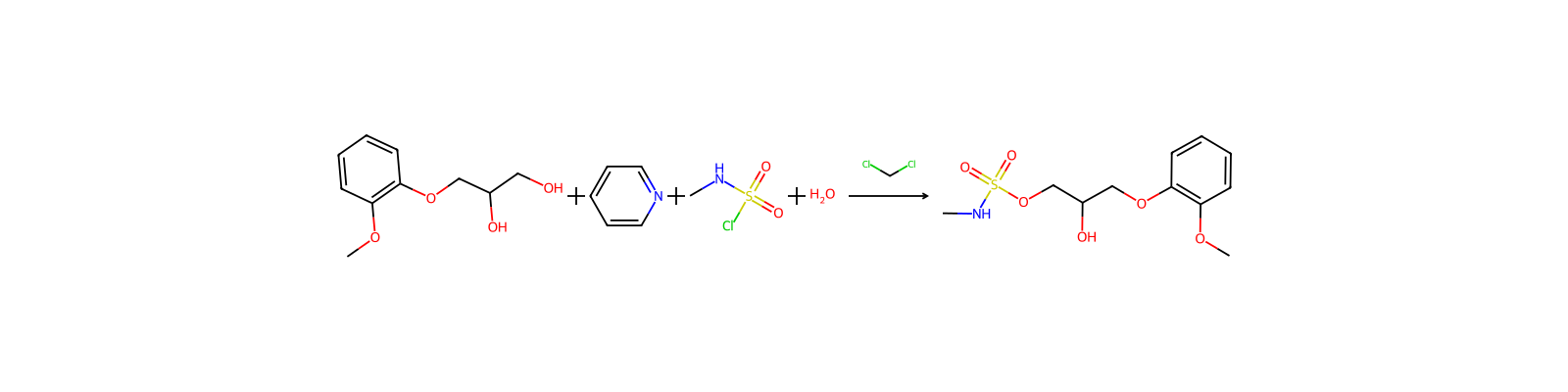
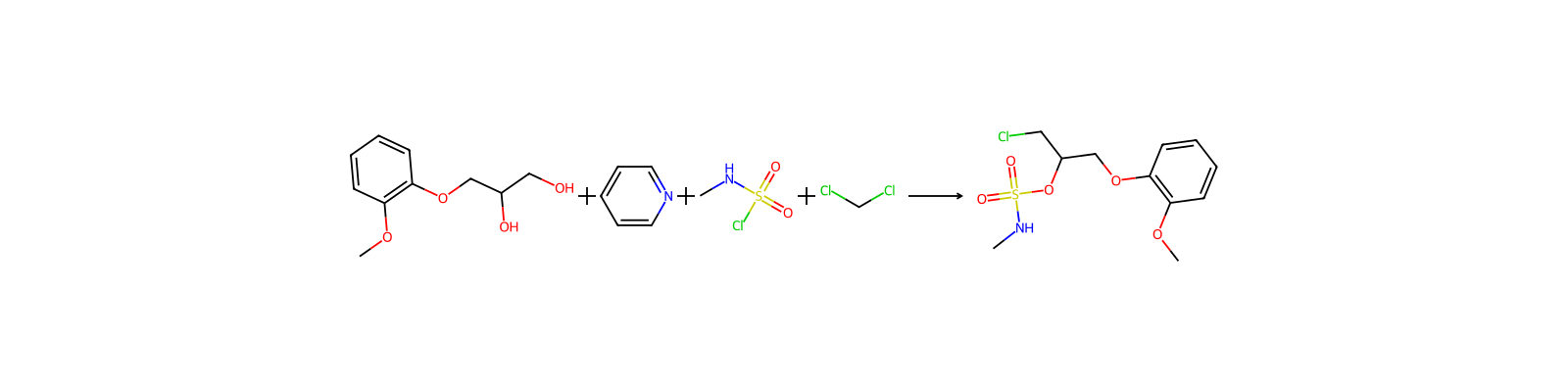
HRID 249097反応物として
Guaifenesin

93-14-1COc1ccccc1OCC(O)COHSRJKNPTNIJEKV-UHFFFAOYSA-NGuaifenesin is a member of methoxybenzenes.
93-14-1DTXSID5023114CHEMBL980CHEBI:5551Pharmaceuticals -> Used in Switzerland
Pharmaceuticals
Pharmaceuticals -> Metabolite of Ranolazine
log Kow = 1.39
1.39
0.24
Minute rhombic prisms from ether
WHITE TO SLIGHTLY GRAY, CRYSTALLINE POWDER
Freely sol in ethanol; sol in chloroform, glycerol, propylene glycol, n,n-dimethylformamide; moderately sol in benzene; practically insol in petroleum ether
In water, 5.00X10+4 mg/L at 25 °C ... much more in hot water
Breast Feeding; Lactation; Milk, Human; Expectorants
FDA approved drugs -> Active ingredient
FDA approved drugs -> Active ingredient
FDA approved animal drugs -> Active ingredient
Pharmaceuticals -> Animal Drugs -> Approved in Taiwan
78.5-79
78.5-79 °C
78.5 °C
化学的特性This substance is a white crystalline powder with a melting point of 78.5-79°C and a boiling point of 215°C (2.53kPa). It is soluble in 20ml of water and ethanol, chloroform, glycerin, and dimethylformamide. It is easily soluble in benzene but insoluble in petroleum ether. It has a slightly bitter taste and a slightly particular odor.
安全情報は参考情報です。供給元の安全データシート(SDS)、適用法令、専門家による評価に代わるものではありません。
This chemical does not meet GHS hazard criteria for 6% (44 of 731) of reports.
Warning
H302 (94%): Harmful if swallowed [Warning Acute toxicity, oral]
P264, P270, P301+P317, P330, and P501 (click each P-code to see the statement)
Aggregated GHS information provided per 731 reports by companies from 11 notifications to the ECHA C&L Inventory.
The Approved Drug Products with Therapeutic Equivalence Evaluations List identifies currently marketed over-the-counter drug products, incl guaifenesin, approved on the basis of safety and effectiveness by FDA under sections 505 of the Federal Food, Drug, and Cosmetic Act.
Cold, cough, allergy, bronchodilator, and antiasthmatic drug products for over-the-counter human use. Expectorant active ingredient. The active ingredient of the product is guaifenesin when used within the dosage limits established in §341.78(d).
Implantation or injectable dosage form new animal drugs. Guaifenesin sterile powder. ... It is indicated for intravenous use as a muscle relaxant in horses. ... Not to be used in horses intended for food. ... Federal law restricts this drug to use by or on the order of a licensed veterinarian.
Implantation or injectable dosage form new animal drugs. Guaifenesin injection. ... The drug is used intravenously in horses as a skeletal muscle relaxant. ... Not to be used in horses intended for food. ... Federal law restricts this drug to use by or on the order of a licensed veterinarian.
Guaifenesin powder tends to become lumpy on storage. Guaifenesin preparations should be stored in tight containers.
Store at controlled room temperature, between 15 °C and 30 °C (59 °F and 86 °F).
SRP: At the time of review, criteria for land treatment or burial (sanitary landfill) disposal practices are subject to significant revision. Prior to implementing land disposal of waste residue (including waste sludge), consult with environmental regulatory agencies for guidance on acceptable disposal practices.
TERRESTRIAL FATE: Based on a classification scheme(1), an estimated Koc value of 140(SRC), determined from a log Kow of 1.39(2) and a regression-derived equation(3), indicates that guaifenesin is expected to have high mobility in soil(SRC). Volatilization of guaifenesin from moist soil surfaces is not expected to be an important fate process(SRC) given an estimated Henry's Law constant of 4.4X10⁻¹¹ atm-cu m/mole(SRC), using a fragment constant estimation method(4). Guaifenesin is not expected to volatilize from dry soil surfaces(SRC) based upon an estimated vapor pressure of 1.52X10⁻⁶ mm Hg(SRC), determined from a fragment constant method(5). Biodegradation data were not available(SRC, 2007).
AQUATIC FATE: Based on a classification scheme(1), an estimated Koc value of 140(SRC), determined from a log Kow of 1.39(2) and a regression-derived equation(3), indicates that guaifenesin is not expected to adsorb to suspended solids and sediment(SRC). Volatilization from water surfaces is not expected(3) based upon an estimated Henry's Law constant of 4.4X10⁻¹¹ atm-cu m/mole(SRC), developed using a fragment constant estimation method(4). According to a classification scheme(5), an estimated BCF of 7.0(SRC), from its log Kow(2) and a regression-derived equation(6), suggests the potential for bioconcentration in aquatic organisms is low(SRC). Biodegradation data were not available(SRC, 2007).
ATMOSPHERIC FATE: According to a model of gas/particle partitioning of semivolatile organic compounds in the atmosphere(1), guaifenesin, which has an estimated vapor pressure of 1.5X10⁻⁶ mm Hg at 25 °C(SRC), determined from a fragment constant method(2), will exist in both the vapor and particulate phases in the ambient atmosphere. Vapor-phase guaifenesin is degraded in the atmosphere by reaction with photochemically-produced hydroxyl radicals(SRC); the half-life for this reaction in air is estimated to be 9.4 hours(SRC), calculated from its rate constant of 4.1X10⁻¹¹ cu cm/molecule-sec at 25 °C(SRC) that was derived using a structure estimation method(3). Particulate-phase guaifenesin may be removed from the air by wet or dry deposition(SRC). Guaifenesin does not contain chromophores that absorb at wavelengths >290 nm(4) and therefore is not expected to be susceptible to direct photolysis by sunlight(SRC).
Guaifenesin may act as an irritant to gastric vagal receptors, and recruit efferent parasympathetic reflexes that cause glandular exocytosis of a less viscous mucus mixture. Cough may be provoked. This combination may flush tenacious, congealed mucopurulent material from obstructed small airways and lead to a temporary improvement in dyspnea or the work of breathing.
Guaifenesin was detected at a concentration range of 21-52 ng/L in the waters of the Las Vegas Bay of Lake Mead, Nevada, sampled from 1997 through 1998. This study detected several pharmacteuticals and personal care products which were entering the Bay through the discharge of the Las Vegas Wash(1).
The Koc of guaifenesin is estimated as 140(SRC), using a log Kow of 1.39(1) and a regression-derived equation(2). According to a classification scheme(3), this estimated Koc value suggests that guaifenesin is expected to have high mobility in soil.
/HUMAN EXPOSURE STUDIES/ ... 197 mother-child pairs exposed to guaifenesin during the first trimester /were monitored/. An increased occurrence of inguinal hernias was found in the neonates. However, congenital defects were not strongly associated with guaifenesin use during pregnancy in 2 large groups of mother-child pairs.
/SIGNS AND SYMPTOMS/ Nausea and drowsiness may occur rarely. ...May produce false positive test for urinary 5-hydroxyindoleacetic acid (5-HIAA).
/CASE REPORTS/ Guaifenesin is a commonly used expectorant whose use may lead to the occasional formation of guaifenesin urinary stones. /Investigators/ herein describe a patient who was taking 2400 mg Guaifenesin per day as part of his treatment for asthma. He had a past history of a guaifenesin stone removed ureteroscopically. His current presentation was with a 9 mm by 6 mm stone in the upper left ureter, seen on CT scan, and treated initially with a ureteral stent and hydration. After 3 weeks, the stone had disappeared, as confirmed by repeat CT scan.
/CASE REPORTS/ ...This paper reviews the reported cases of ephedrine- and guaifenesin-induced nephrolithiasis, as well as the diagnostic techniques and treatments that have been successfully used for these stones. A systematic review of the literature pertaining to nephrolithiasis and the compounds ephedrine and guaifenesin was conducted. Ephedrine and guaifenesin use results in over 35% of urinary stones that are related to pharmaceutical metabolites, and collectively are present in 0.1% of all urinary stones. These calculi are radiolucent, requiring the use of computerized tomography (CT scan) for diagnosis. Alkalinization therapy offers an alternative to surgical intervention and may have a role in prevention of recurrence. ...
For more Human Toxicity Excerpts (Complete) data for GUAIFENESIN (6 total), please visit the HSDB record page.
Guaifenesin's production and use as a veterinary and human expectorant(1) for the treatment of respiratory tract infections(2) and as a centrally acting muscle relaxant in animals(3) may result in its release to the environment through various waste streams(SRC).
Drug Induced Liver Injury Rank (DILIrank 2.0)
Guaifenesin
vNo-DILI-concern
0
No match
DOI:10.1016/j.drudis.2016.02.015
An estimated BCF of 7.0 was calculated for guaifenesin(SRC), using a log Kow of 1.39(1) and a regression-derived equation(2). According to a classification scheme(3), this BCF suggests the potential for bioconcentration in aquatic organisms is low(SRC).
The Henry's Law constant for guaifenesin is estimated as 4.4X10⁻¹¹ atm-cu m/mole(SRC) using a fragment constant estimation method(1). This Henry's Law constant indicates that guaifenesin is expected to be essentially nonvolatile from water surfaces(2). Guaifenesin is not expected to volatilize from dry soil surfaces(SRC) based upon an estimated vapor pressure of 1.5X10⁻⁶ mm Hg(SRC), determined from a fragment constant method(3).
The Approved Drug Products with Therapeutic Equivalence Evaluations List identifies currently marketed over-the-counter drug products, incl guaifenesin, approved on the basis of safety and effectiveness by FDA under sections 505 of the Federal Food, Drug, and Cosmetic Act.
Cold, cough, allergy, bronchodilator, and antiasthmatic drug products for over-the-counter human use. Expectorant active ingredient. The active ingredient of the product is guaifenesin when used within the dosage limits established in §341.78(d).
Implantation or injectable dosage form new animal drugs. Guaifenesin sterile powder. ... It is indicated for intravenous use as a muscle relaxant in horses. ... Not to be used in horses intended for food. ... Federal law restricts this drug to use by or on the order of a licensed veterinarian.
Implantation or injectable dosage form new animal drugs. Guaifenesin injection. ... The drug is used intravenously in horses as a skeletal muscle relaxant. ... Not to be used in horses intended for food. ... Federal law restricts this drug to use by or on the order of a licensed veterinarian.
R05CA03
R - Respiratory system
QR - Respiratory system
QM - Musculo-skeletal system
Guaifenesin is categorized as an expectorant that acts by enhancing the output of phlegm (sputum) and bronchial secretions via decreasing the adhesiveness and surface tension of such material. Furthermore, guaifenesin elicits an increased flow of less viscous gastric secretions that subsequently promote ciliary action - all actions that ultimately change dry, unproductive coughing to coughs that are more productive and less frequent. Essentially, by decreasing the viscosity and adhesiveness of such secretions, guaifenesin enhances the efficacy of mucociliary activity in removing accumulated secretions from the upper and lower airway.
Although the exact mechanism of action of guaifenesin may not yet be formally or totally elucidated, it is believed that expectorants like guaifenesin function by increasing mucus secretion. Moreover, it is also further proposed that such expectorants may also act as an irritant to gastric vagal receptors, and recruit efferent parasympathetic reflexes that can elicit glandular exocytosis that is comprised of a less viscous mucus mixture. Subsequently, these actions may provoke coughing that can ultimately flush difficult to access, congealed mucopurulent material from obstructed small airways to facilitate a temporary improvement for the individual. Consequently, while it is generally proposed that guaifenesin functions as an expectorant by helping to loosen phlegm (mucus) and thin bronchial secretions to rid the bronchial passageways of bothersome mucus and make coughs more productive, there has also been research to suggest that guaifenesin possesses and is capable of demonstrating anticonvulsant and muscle relaxant effects to some degree possibly by acting as an NMDA receptor antagonist.
Guaifenesin is thought to act as an expectorant by increasing the volume and reducing the viscosity of secretions in the trachea and bronchi. Thus it may increase the efficiency of the cough reflex and facilitate removal of the secretions; however, objective evidence for this is limited and conflicting.
By increasing respiratory tract fluid, guaifenesin reduces the viscosity of tenacious secretions and acts as an expectorant.
Guaifenesin, a commonly used agent for the treatment of cough, is termed an expectorant since it is believed to alleviate cough discomfort by increasing sputum volume and decreasing its viscosity, thereby promoting effective cough. Despite its common usage, relatively few studies, yielding contrasting results, have been performed to investigate the action and efficacy of guaifenesin. To evaluate the effect of guaifenesin on cough reflex sensitivity. Randomized, double-blind, placebo-controlled trial. Fourteen subjects with acute viral upper respiratory tract infection (URI) and 14 healthy volunteers. On 2 separate days, subjects underwent capsaicin cough challenge 1 to 2 hr after receiving a single, 400-mg dose (capsules) of guaifenesin or matched placebo. Measurements and results: The concentration of capsaicin inducing five or more coughs (C(5)) was determined. Among subjects with URI, mean (+/- SEM) log C(5) after guaifenesin and placebo were 0.92 +/- 0.17 and 0.66 +/- 0.14, respectively (p = 0.028). No effect on cough sensitivity was observed in healthy volunteers. /The/ results demonstrate that guaifenesin inhibits cough reflex sensitivity in subjects with URI, whose cough receptors are transiently hypersensitive, but not in healthy volunteers. Possible mechanisms include a central antitussive effect, or a peripheral effect by increased sputum volume serving as a barrier shielding cough receptors within the respiratory epithelium from the tussive stimulus.
The half-life in plasma observed for guaifenesin is approximately one hour.
Guaifenesin has a plasma half-life of one hour.
Centrally acting muscle relaxant glyceryl guaiacolate ether was found to have t/2 of 56.5 min in male rats and 88.5 min in female rats following ip administration.
After the oral administration of 400 mg guaifenesin, the agent experiences rapid hydrolysis (more than 60% of the dose hydrolyzed over a range of seven hours) with β-(2-methoxyphenoxy)-lactic acid found as the major urinary metabolite but no parent drug detectable in the urine. Moreover, it has been observed that guaifenesin also experiences both oxidation and demethylation. In particular, the medication is quickly metabolized hepatically by way of oxidation to β-(2-methoxyphenoxy)-lactic acid. Furthermore, guaifenesin is also demethylated by O-demethylase in liver microsomes to the point where about 40% of an administered dose is excreted as this metabolite in the urine within 3 hours. In fact, O-demethylase appears to be the primary enzyme for the metabolism of guaifenesin and the primary metabolites of the substance are β-(2-methoxyphenoxy)-lactic acid and the demethylated hydroxyguaifenesin, both of which are themselves inactive moieties.
The major urinary metabolite is beta-(2-methoxyphenoxy) lactic acid.
It is excreted in urine principally as glucuronates & sulfates.
Oxidative o-demethylation of glyceryl guaiacolate ether occurred much more rapidly in ip injected male rats than in females. This sex difference in metabolism was paralleled by corresponding difference in o-demethylase activity between male & female animals.
Rapidly hydrolyzed (60% within seven hours) and then excreted in the urine, with beta-(2-methoxyphenoxy)-lactic acid as its major urinary metabolite. Half Life: 1 hour
495W7451VQ
GUAIFENESIN
Established Pharmacologic Class [EPC] - Expectorant
Physiologic Effects [PE] - Decreased Respiratory Secretion Viscosity
Physiologic Effects [PE] - Increased Respiratory Secretions
Guaifenesin is an Expectorant. The physiologic effect of guaifenesin is by means of Decreased Respiratory Secretion Viscosity and Increased Respiratory Secretions.
Studies have shown that guaifenesin is well absorbed from and along the gastrointestinal tract after oral administration.
After administration, guaifenesin is metabolized and then largely excreted in the urine.
The geometric mean apparent volume of distribution of guaifenesin determined in healthy adult subjects is 116L (CV=45.7%).
The mean clearance recorded for guaifenesin is about 94.8 L/hr (CV=51.4%).
Readily absorbed from the gastrointestinal tract.
It is not known whether guaifenesin is distributed into breast milk.
MEDICATION
THERAP CAT: Expectorant
THERAP CAT (VET): Expectorant; muscle relaxant
Use (kg; approx.) in Germany (2009): >1000
Used to assist the expectoration of phlegm from the airways in acute respiratory tract infections.
(1972) No Data
(1975) No Data
(1972) 9.0X10+6 GRAMS (PRINCPL CUSTMS DISTS)
(1975) 4.14X10+7 GRAMS
(1972) 6.0X10+8 G (GUAIACOL & DERIVS)
(1975) GREATER THAN 9.08X10+5 GRAMS
Production volumes for non-confidential chemicals reported under the Inventory Update Rule. [Table#4417]
Reaction of guaiacol and 3-chloro-1,2-propanediol by warming a mixture of the reactants with a base
Prepn: Marle, J. Chem Soc 101, 305(1912); Yale et al, J Am Chem Soc, 72, 3710 (1950); Roviralta, Astoul, ES 212920 (1954), CA 49, 8332b (1955). Prepn from 2-methoxyphenol and glycidol; W Merck et al, DE 3106995; eidem US 4390732 (1982, 1983 to Degussa AG).
Production: guaiacol and chlorohydrin (epoxidation)
... Made by the reaction of guaiacol with oxiranylmethanol or with 3-chloro-1,2-propanediol in the presence of sodium hydroxide.
Guaifenesin may be prepared by the coupling of sodium guaiacolate and glyceryl monochlorohydrin.
Oral /formulations/: Capsules 200 mg Hytuss-2X,(Hyrex); Capsules, extended-release 300 mg Humibid Pediatric, (Celltech); Solution 100 mg/5 mL Phanasin Diabetic Choice ( with parabens and propylene glycol), (Pharmakon); 200 mg/5 mL Naldecon Senior EX, (Bristol-Myers Squibb); Tablets 100 mg Hytuss (scored), (Hyrex); 200 mg guaifenesin Tablets, (United Research); Tablets, extended-release 600, 1200 mg Mucinex, (Adams).
Capsules: 100 & 200 mg; syrup NF: 100 mg/5 mL; tablets: 100 & 200 mg.
説明Guaifenesin is an oral expectorant drug. The expectorant action of guaifenesin is mediated by stimulation of the gastrointestinal tract. It is a common ingredient in prescription and over-the-counter medications used to treat cough due to colds and minor upper respiratory infections. Additionally, Guaifenesin is also a centrally-acting muscle relaxant and is used routinely in combination with analgesics and sedatives in large-animal veterinary surgery.
使用Guaifenesin is a muscle relaxant with expectorant properties often used as an expectorant to facilitate the removal of phlegm from the airways in acute respiratory tract infections. Guaifenesin comes in tablet and capsule form, as syrup, as dissolving granules, and recently as an extended-release (longacting) tablet. The tablets, capsules, dissolving granules, and syrup are usually taken with or without food every 4 h as needed. The extended-release tablet is usually taken with or without food every 12 h.
一般的な説明Guaifenesin is an expectorant, widely used in the treatment of cough. Its mode of action involves the alleviating of cough discomfort by increasing sputum volume and decreasing its viscosity, thus resulting in effective cough.Pharmaceutical secondary standards for application in quality control, provide pharma laboratories and manufacturers with a convenient and cost-effective alternative to the preparation of in-house working standards.