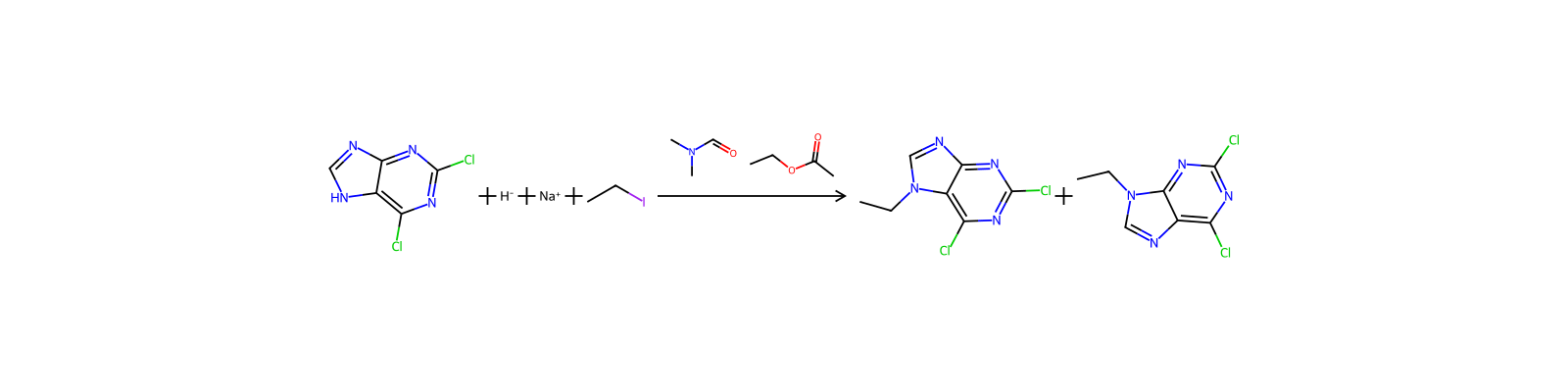
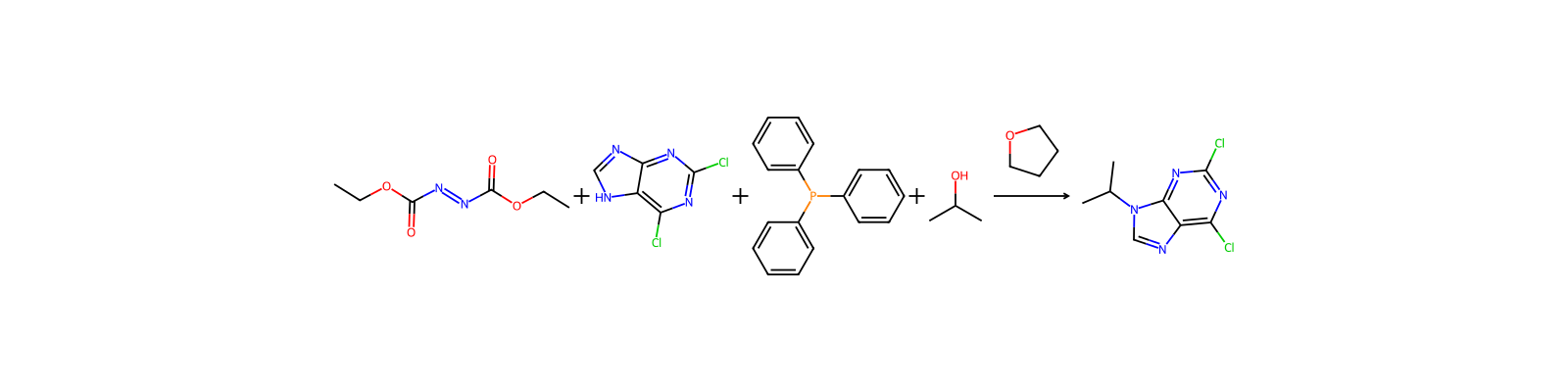
HRID 9895反応物として
2,6-Dichloropurine

5451-40-1Clc1nc(Cl)c2[nH]cnc2n1RMFWVOLULURGJI-UHFFFAOYSA-N5451-40-1DTXSID60202922CHEMBL1256006化学的特性white to light yellow crystal powder
安全情報は参考情報です。供給元の安全データシート(SDS)、適用法令、専門家による評価に代わるものではありません。
This chemical does not meet GHS hazard criteria for 0.7% (1 of 146) of reports.
Danger
H301 (71.2%): Toxic if swallowed [Danger Acute toxicity, oral]
P261, P264, P264+P265, P270, P272, P280, P301+P316, P302+P352, P305+P351+P338, P321, P330, P332+P317, P333+P317, P337+P317, P362+P364, P405, and P501 (click each P-code to see the statement)
Aggregated GHS information provided per 146 reports by companies from 9 notifications to the ECHA C&L Inventory. Each notification may be associated with multiple companies.
用途有機合成原料。
説明2,6-Dichloropurine is an important pharmaceutical intermediate. It is widely used in the preparation of purine nucleosides and purine nucleotides[1].
使用2,6-Dichloropurine is used in the synthesis of 2,6-diamino-substituted purine derivatives as potential cardiomyogenesis inducing agents.
純化方法It can be recrystallised from 150 parts of boiling H2O and dried at 100o to constant weight. It is soluble in EtOAc. The HgCl2 salt separates from EtOH solution. UV: max 275nm ( 8.9K) at pH 1; and 280nm ( 8.5K) at pH 11 [Elion & Hitchings J Am Chem Soc 78 3508 1956, Schaeffer & Thomas J Am Chem Soc 80 3738 1958, Beaman & Robins J Appl Chem (London) 12 432 1962, Montgomery J Am Chem Soc 78 1928 1956]. [Beilstein 26 III/IV 1747.]