
HRID 47594反応物として
(6E)-7-(3-(4-fluorophenyl)-1-(propan-2-yl)-1H-indol-2-yl)-3,5-dihydroxyhept-6-enoic acid
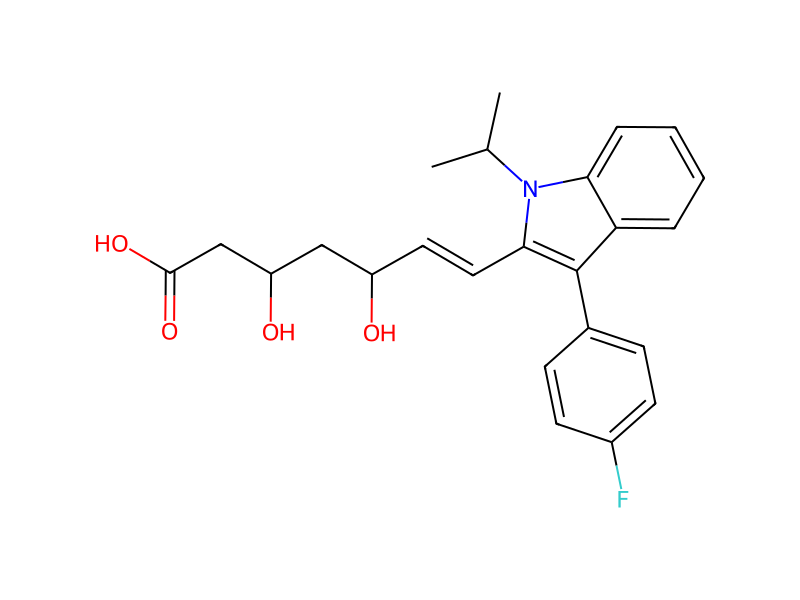
93957-54-1CC(C)n1c(/C=C/C(O)CC(O)CC(=O)O)c(-c2ccc(F)cc2)c2ccccc21FJLGEFLZQAZZCD-VAWYXSNFSA-N7-[3-(4-fluorophenyl)-1-propan-2-yl-2-indolyl]-3,5-dihydroxy-6-heptenoic acid is a member of pyrroles.
安全情報は参考情報です。供給元の安全データシート(SDS)、適用法令、専門家による評価に代わるものではありません。
Fluvastatin, the first synthetically-derived HMG-CoA reductase inhibitor, is a hydrophilic, acidic, antilipemic agent used to lower cholesterol and triglyceride levels associated with primary hypercholesterolemia and mixed dyslipidemia (Fredrickson types IIa and IIb), to slow the progression of coronary atherosclerosis in patients with CHD and as secondary prevention therapy in patients with CHD to reduce the risk of requiring coronary revascularization procedures. Although similar to lovastatin, simvastatin, and pravastatin, fluvastatin has a shorter half-life, no active metabolites, extensive protein binding, and minimal CSF penetration. Fluvastatin acts primarily in the liver. It is prepared as a racemate of two erythro enantiomers of which the 3R,5S enantiomer exerts the pharmacologic effect.
Fluvastatin selectively and competitively inhibits the hepatic enzyme hydroxymethylglutaryl-coenzyme A (HMG-CoA) reductase. HMG-CoA reductase is responsible for converting HMG-CoA to mevalonate, the rate-limiting step in cholesterol biosynthesis. Inhibition results in a decrease in hepatic cholesterol levels which stimulates the synthesis of LDL receptors and increases hepatic uptake of LDL cholesterol. The end result is decreased levels of plasma total and LDL cholesterol.
Undergoes hepatic metabolism primarily via hydroxylation of the indole ring at the 5- and 6-positions to 5-hydroxy fluvastatin and 6-hydroxy fluvastatin, respectively. N-dealkylation to N-desisopropyl fluvastatin and beta-oxidation of the side chain also occurs. Metabolized primarily by the CYP2C9 isozyme system (75%), and to a lesser extent by CYP3A4 (~20%) and CYP2C8 (~5%). Hydroxylated metabolites retain some pharmcological activity, but are present as conjugates (glucuronides and sulfates) in the blood and are rapidly eliminated via bile into feces. Both enantiomers of fluvastatin are metabolized in a similar manner. Fluvastatin also undergoes glucuronidation via UGT enzymes.



93957-54-1CHEMBL2220442CHEBI:95159Rapidly and almost completely absorbed (> 90%), but undergoes extensive first pass metabolism. Bioavailability is 24% (range 9-50%) when a 10 mg dose is given. The mean relative bioavailability of the extended-release tablet is 29% (range: 9% to 66%) compared to an immediate-release capsule administered under fasting conditions. When given orally, fluvastatin reaches peak concentrations (Tmax) in less than one hour. Taking the extended release tablet with a high-fat meal will delay absorption (Tmax = 6 hours) and increase bioavailability by approximately 50%. However, the maximum concentration of fluvastatin sodium extended-release tablets seen after a high fat meal is less than the peak concentration following a single dose or twice daily dose of the 40 mg fluvastatin capsule.
When orally administered, fluvastatin is primarily excreted in the faces ( ~90%) as metabolites, with less than 2% present as unchanged drug. Approximately 5% was recovered in the urine.
0.35 L/kg
0.8 L/h/kg
使用A synthetic HMG-CoA reductase inhibitor
一般的な説明Fluvastatin, [R*,S*-(E)]-(±)-7-[3-(4-fluorophenyl)-1-(1-methylethyl)-1H-indol-2-yl]-3,5-dihydroxy-6-heptenoic acid monosodium salt (Lescol), is very similarto pravastatin. It possesses a heptanoic acid side chain thatis superimposable over the lactone ring found in lovastatinand simvastatin. This side chain is recognized by HMGCoAreductase. Also, much like pravastatin, the CNS sideeffects of this lipid-lowering agent are much lower thanthose of the agents that possess a lactone ring as part of theirarchitectural design.