
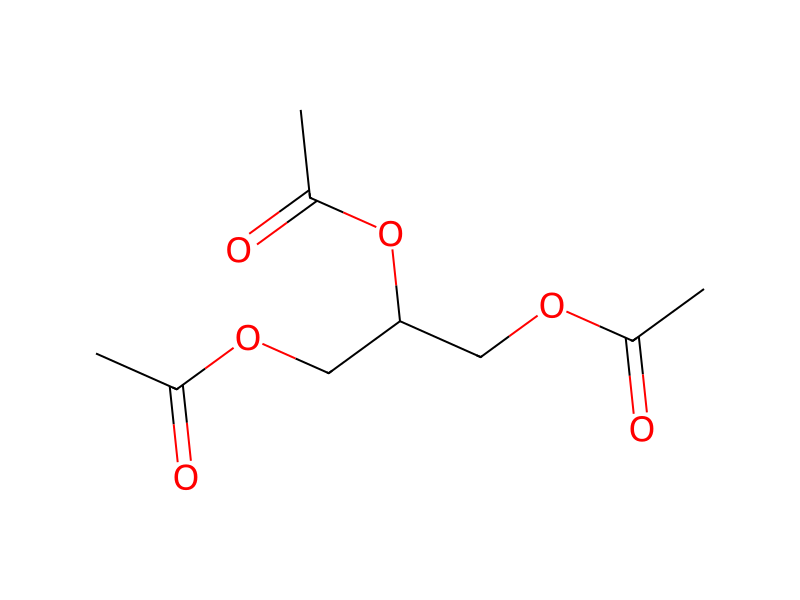
基本情報
- 標準SMILES
CC(=O)OCC(COC(C)=O)OC(C)=O- InChIKey
URAYPUMNDPQOKB-UHFFFAOYSA-N- 分子式
- C9H14O6
- 平均分子量
- 218.2 g/mol
- 単同位体質量
- 218.07903817
概要
Triacetin is a triglyceride obtained by acetylation of the three hydroxy groups of glycerol. It has fungistatic properties (based on release of acetic acid) and has been used in the topical treatment of minor dermatophyte infections. It has a role as a solvent, an adjuvant, a fuel additive, a food emulsifier, a plant metabolite, a food humectant, a food additive carrier and an antifungal drug. It is functionally related to an acetic acid.
名称と識別子
- 優先名称
- Triacetin
- IUPAC
- 2,3-diacetyloxypropyl acetate
- 現地名
- トリアセチン
- 英語名
- Triacetin
- 分子式
- C9H14O6
- 分子量
- 218.2
名称と別名
triacetin102-76-1Glyceryl triacetateGlycerol triacetateEnzactinTriacetineTriacetylglycerolGlycerin triacetateFungacetinGlypedVanayKesscoflex TRA
名称をさらに表示
トリアセチントリス酢酸1,2,3-プロパントリイルトリアセチルグリセロールケスコフレックスTRAグリセロールトリアセタート1,2,3-プロパントリオールトリアセタートバナイ1-O,2-O,3-O-トリアセチルグリセロールグリペッド1,2,3-トリアセトキシプロパングリセロールトリスアセタートL-グリセロールトリアセタートグリペドグリセリントリアセタート三酢酸1,2,3-プロパントリイルコダフレックストリアセチンフンガセチン三酢酸グリセリルエンザクチングリセリン1-O,2-O,3-O-トリアセタートtriacetateFEMA 2007Glyceryl Triacetate (Triacetin)
Kodaflex triacetinTriacetyl glycerineTriacetina1,2,3-Propanetriol, triacetateTriacetinum1,2,3-Propanetriol triacetate1,2,3-triacetoxypropaneUjostabil
データベース識別子
- CAS
102-76-1- PubChem CID
- 5541
- DTXSID
DTXSID3026691- ChEMBL
CHEMBL1489254- ChEBI
CHEBI:9661- UNII
- XHX3C3X673
- EC Number
- 203-051-9、686-191-7
- Nikkaji
- J5.010E
物性
構造計算による物性
- XLogP
- 0.2
- 極性表面積
- 78.9 Ų
- 水素結合供与体数
- 0
- 水素結合受容体数
- 6
- 回転可能結合数
- 8
- 重原子数
- 15
- 形式電荷
- 0
- 複雑度
- 229
実験および物理化学的性質
Chemical ClassesOther Classes -> Esters, Other
LipidsLipids -> Glycerolipids [GL] -> Triradylglycerols [GL03] -> Triacylglycerols [GL0301]
Polymers
Plastics -> PVC (soft)
Plastics -> Plasticisers
Cosmetics
Cosmetic ingredients (Triacetin) -> CIR (Cosmetic Ingredient Review)
Antimicrobial; Solvent; Film forming; Plasticiser; Hair dyeing
SpringerMaterials PropertiesBoiling point
FragrancesFragrance Ingredient ((tri-)Acetin) -> IFRA transparency List
LogP
log Kow = 0.25
0.25
0.21
0.25
Odor
Slightly fatty odor
Slightly fruity or fatty odor
Plasticizers
Plasticizer
Plasticizer
Taste
MILD, SWEET TASTE, BITTER ABOVE 0.05%
Bitter taste
Slightly fatty taste
Food AdditivesFLAVORING AGENT OR ADJUVANT, FORMULATION AID, HUMECTANT, MASTICATORY SUBSTANCE, PROCESSING AID, SOLVENT OR VEHICLE, SURFACE-FINISHING AGENT -> FDA Substance added to food
Density
1.1583 g/cu cm at 20 °C
Bulk density: 9.7 lb/gal
Relative density (water = 1): 1.16
1.154-1.159
1.1562 @25 °C
物理化学的性質
- 融点
- 3 °C · 3 °C(lit.)
- 沸点
- 258 · 258-260 °C(lit.)
- 比重(密度)
- 1.16 g/mL · 1.16 g/mL at 25 °C(lit.)
- 蒸気密度
- 7.52 · 7.52 (vs air)
- 蒸気圧
- 0.00248 mm · 0.00248 mm Hg @ 250C
- 屈折率
- 25 · n25/D 1.429-1.431(lit.)
- FEMA
- 2007 · 2007 | (TRI-)ACETIN
- 闪点
- 300 °F · 300 °F
- 貯蔵温度
- Sealed in dry,Room Temperature
- 溶解性
- 水に溶け、エタノール (96%) およびトルエンと混和します。
- 外見
- 液体
- 色
- 無色透明
- PH
- 5 · 5.0-6.0 (20°C, 50g/L in H2O)
- 臭い (Odor)
- 特有の臭い
- 爆発限界(explosive limit)
- 1.05 %, · 1.05%, 189°F
- 由来生物
- synthetic
- においのタイプ
- フルーティーな
- 水溶解度
- 64 g/L · 64.0g/L(20℃)
- 比熱容量
- 1.76 J/ · Cp(liquid): 1.76 J/(g·K), at 25℃
- JECFA Number
- 920 · 920
- Merck
- 14 · 14,9589
- BRN
- 1792353 · 1792353
- Henry's Law Constant
- 8 · 8.0×102 mol/(m3Pa) at 25℃, Duchowicz et al. (2020)
- Dielectric constant
- 7.2 · 7.2(20℃)
- 安定性
- 安定。強力な酸化剤とは相容れない。可燃性。
- 主な用途
- フレーバーそして香料
- 化粧品成分の機能
- 可塑剤溶媒フィルム形成香料抗菌剤
- InChI
- 1S/C9H14O6/c1-6(10)13-4-9(15-8(3)12)5-14-7(2)11/h9H,4-5H2,1-3H3
- InChIKey
- URAYPUMNDPQOKB-UHFFFAOYSA-N
- SMILES
- CC(=O)OCC(COC(C)=O)OC(C)=O
- LogP
- 0.25 · 0.25
- CAS データベース
- 102 · 102-76-1(CAS DataBase Reference)
- NISTの化学物質情報
- 1 · 1,2,3-Propanetriol, triacetate(102-76-1)
- EPAの化学物質情報
- Glyceryl triacetate (102-76-1)
化学的性質
化学的特性Triacetin is a colorless, viscous liquid with a slightly fatty odor.
安全と法規制
GHS分類
GHS Classification
This chemical does not meet GHS hazard criteria for 99.8% (1973 of 1977) of all reports.
Not Classified
Aggregated GHS information provided per 1977 reports by companies from 5 notifications to the ECHA C&L Inventory.
Not Classified
危険有害性情報
Regulatory Information
Chemical: 1,2,3-Propanetriol, triacetate
1,2,3-Propanetriol, 1,2,3-triacetate is listed on the EPA's Chemical Data Reporting (CDR) system. Manufacturers and importers of 1,2,3-Propanetriol, 1,2,3-triacetate are required to report information about their production and use of this chemical to the EPA under the Toxic Substances Control Act (TSCA). (40 eCFR Part 711)
Status: Active Update: 08-05-2023 https://echa.europa.eu/registration-dossier/-/registered-dossier/15139
Glyceryl triacetate: Non hazardous
Other Safety InformationIMAP assessments - 1,2,3-Propanetriol, triacetate: Human health tier I assessment
Fire HazardsCombustible.
Fire PotentialCombustible when exposed to heat, flame, or powerful oxidizers.
Hazards Summary
A mild skin irritant; [ICSC] An eye irritant; [HSDB] Causes somnolence, spastic paralysis, and convulsions in lethal dose animal experiments; [RTECS] Tends to hydrolyze into acetic acid and glycerol both in the environment and in the body; [ToxPlanet: CPS&Q: IUCLID] May cause eye irritation; [MSDSonline] Documented occupational contact dermatitis in a cigarette manufacturing worker; [Kanerva, p. 1851]
FDA Requirements
An ingredient whose use in food or food packaging is subject to a prior sanction or approval within the meaning of section 201(s)(4) of the Act is exempt from classification as a food additive. ... Substances classified as plasticizers, when migrating from food-packaging material shall include ... triacetin.
Substance added directly to human food affirmed as generally recognized as safe (GRAS).
Drug products containing certain active ingredients offered over-the-counter (OTC) for certain uses. A number of active ingredients have been present in OTC drug products for various uses, as described below. However, based on evidence currently available, there are inadequate data to establish general recognition of the safety and effectiveness of these ingredients for the specified uses: triacetin is included in topical antifungal drug products.
Triacetin used as a general purpose food additive is generally recognized as safe when used in accordance with good manufacturing or feeding practice.
Special ReportsOpdyke DL J; Monographs Fragrance Raw Materials. Triacetin; Food Cosmet Toxicol (16) 879 (1978). A review with 51 references is published on triacetin incl toxicity, irritation, sensitization, metab & pharmacology.
EPA Safer ChemicalChemical: Glycerol triacetate
FIFRA Requirements
Residues of triacetin are exempted from the requirement of a tolerance when used in accordance with good agricultural practice as inert (or occasionally active) ingredients in pesticide formulations applied to animals. Use: solvent, cosolvent.
Chemical DangersReacts with strong oxidants.
Flammable LimitsLower flammable limit: 1.0% by volume at 373 °F (189 °C)
NFPA Hazard Classification
0 - Materials that, under emergency conditions, would offer no hazard beyond that of ordinary combustible materials.
1 - Materials that must be preheated before ignition can occur. Materials require considerable preheating, under all ambient temperature conditions, before ignition and combustion can occur.
0 - Materials that in themselves are normally stable, even under fire conditions.
安全と保護具
Fire FightingUse water spray, powder, alcohol-resistant foam, carbon dioxide. In case of fire: keep drums, etc., cool by spraying with water.
First Aid Measures
Fresh air, rest.
Rinse skin with plenty of water or shower.
Rinse with plenty of water for several minutes (remove contact lenses if easily possible).
Rinse mouth.
Safe StorageSeparated from strong oxidants.
Fire Fighting Procedures
Suitable extinguishing media: Use water spray, alcohol-resistant foam, dry chemical or carbon dioxide.
Advice for firefighters: Wear self contained breathing apparatus for fire fighting if necessary.
To fight fire, use alcohol foam, water, carbon dioxide, dry chemical.
In case of fire: keep drums, etc., cool by spraying with water.
Storage ConditionsKeep container tightly closed in a dry and well-ventilated place.
Cleanup Methods
Accidental release measures: Personal precautions, protective equipment and emergency procedures: Use personal protective equipment. Avoid breathing vapors, mist or gas.; Environmental precautions: Do not let product enter drains.; Methods and materials for containment and cleaning up: Soak up with inert absorbent material and dispose of as hazardous waste. Keep in suitable, closed containers for disposal.
AEROBIC: Triacetin, present at 100 mg/L, reached 91-94% of its theoretical BOD in 4 weeks using an activated sludge inoculum at 30 mg/L and the Japanese MITI test(1). Using a rapid infiltration system for treating primary and secondary effluents, triacetin, present in a feed solution at a concentration of 0.094 ug/L, was not detected in the column effluent(2). The specific loss process was not identified(2).
Collect leaking liquid in sealable containers. Absorb remaining liquid in sand or inert absorbent and remove to safe place. Do NOT wash away into sewer.
Disposal Methods
SRP: Recycle any unused portion of the material for its approved use or return it to the manufacturer or supplier. Ultimate disposal of the chemical must consider: the material's impact on air quality; potential migration in air, soil or water; effects on animal, aquatic and plant life; and conformance with environmental and public health regulations. If it is possible or reasonable use an alternative chemical product with less inherent propensity for occupational harm/injury/toxicity or environmental contamination.
Product: Offer surplus and non-recyclable solutions to a licensed disposal company. Contaminated packaging: Dispose of as unused product.
Spillage DisposalCollect leaking liquid in sealable containers. Absorb remaining liquid in sand or inert absorbent. Then store and dispose of according to local regulations.
Preventive Measures
Appropriate engineering controls: Handle in accordance with good industrial hygiene and safety practice. Wash hands before breaks and at the end of workday.
Gloves must be inspected prior to use. Use proper glove removal technique (without touching glove's outer surface) to avoid skin contact with this product. Dispose of contaminated gloves after use in accordance with applicable laws and good laboratory practices. Wash and dry hands.
SRP: The scientific literature for the use of contact lenses by industrial workers is inconsistent. The benefits or detrimental effects of wearing contact lenses depend not only upon the substance, but also on factors including the form of the substance, characteristics and duration of the exposure, the uses of other eye protection equipment, and the hygiene of the lenses. However, there may be individual substances whose irritating or corrosive properties are such that the wearing of contact lenses would be harmful to the eye. In those specific cases, contact lenses should not be worn. In any event, the usual eye protection equipment should be worn even when contact lenses are in place.
Eye PreventionWear safety spectacles.
Fire PreventionNO open flames.
Inhalation RiskA harmful contamination of the air will not or will only very slowly be reached on evaporation of this substance at 20 °C.
毒性情報
Interactions
The present studies investigated the effects of intravenous administration of the short-chain triglyceride triacetin on leucine metabolism in dogs. Animals received infusions of triacetin at 1.0 x estimated resting energy expenditure (REE), hyperenergetic triacetin at 1.5 x REE, glycerol, or saline during infusion of [(1-14)C]leucine. During both triacetin infusions, plasma alpha-ketoisocaproate concentrations increased (p < 0.05). During triacetin infusion at 1.5 REE, the plasma leucine concentration decreased (p < 0.05) and leucine rate of appearance decreased by approximately 19% (p < 0.05); this was significantly greater than the changes that occurred during triacetin at 1.0 x REE and glycerol (p < 0.05). There was no difference in leucine oxidation between the dogs given triacetin at 1.0 x REE and control groups, whereas leucine oxidation decreased by 53% during triacetin infusion at 1.5 x REE (p < 0.05). Nonoxidative leucine disappearance, an indicator of protein synthesis, did not change in any of the studies.
Ecotoxicity Values
LC50; Species: Cyprinus carpio (Carp); Conditions: static; Concentration: 174 mg/L for 48 hr
LC50; Species: Leuciscus idus (Ide); Conditions: static; Concentration: 170 mg/L for 48 hr
Environmental Fate
TERRESTRIAL FATE: Based on a classification scheme(1), an estimated Koc value of 40(SRC), determined from a structure estimation method(2), indicates that triacetin is expected to have very high mobility in soil(SRC). Volatilization of triacetin from moist soil surfaces is not expected to be an important fate process(SRC) given an estimated Henry's Law constant of 1.2X10⁻⁸ atm-cu m/mole(3) based upon its vapor pressure, 2.48X10⁻³ mm Hg(4), and water solubility, 5.8X10+4 mg/L(5). Triacetin is not expected to volatilize from dry soil surfaces(SRC) based upon its vapor pressure(4). Utilizing the Japanese MITI test, 93% of the Theoretical BOD of a mixture containing triacetin was reached in 4 weeks(6) indicating that biodegradation is an important environmental fate process in soil(SRC).
AQUATIC FATE: Based on a classification scheme(1), an estimated Koc value of 40(SRC), determined from a structure estimation method(2), indicates that triacetin is not expected to adsorb to suspended solids and sediment(SRC). Volatilization from water surfaces is not expected(3) based upon an estimated Henry's Law constant of 1.2X10⁻⁸ atm-cu m/mole(4) derived from its vapor pressure, 2.48X10⁻³ mm Hg(5), and water solubility, 5.8X10+4 mg/L(6). According to a classification scheme(7), an estimated BCF of 30(SRC), from its log Kow of 0.25(8) and a regression-derived equation(2), suggests the potential for bioconcentration in aquatic organisms is low(SRC). Utilizing the Japanese MITI test, 93% of the Theoretical BOD of a mixture containing triacetin was reached in 4 weeks(9) indicating that biodegradation is an important environmental fate process in water(SRC).
ATMOSPHERIC FATE: According to a model of gas/particle partitioning of semivolatile organic compounds in the atmosphere(1), triacetin, which has a vapor pressure of 2.48X10⁻³ mm Hg at 25 °C(5), is expected to exist solely as a vapor in the ambient atmosphere. Vapor-phase triacetin is degraded in the atmosphere by reaction with photochemically-produced hydroxyl radicals(SRC); the half-life for this reaction in air is estimated to be 4 days(SRC), calculated from its rate constant of 8.5X10⁻¹² cu cm/molecule-sec at 25 °C(SRC) that was derived using a structure estimation method(3). Triacetin does not contain chromophores that absorb at wavelengths >290 nm(4) and, therefore, is not expected to be susceptible to direct photolysis by sunlight(SRC).
Adverse EffectsNeurotoxin - Other CNS neurotoxin
Toxicity Summary
Safe in the present practices of use and concentration. Ingredient, concentration, and use information are available in documents discoverable at https://cir-reports.cir-safety.org
IDENTIFICATION AND USE: Triacetin, also known as glyceryl triacetate (GTA), is a colorless liquid. It is reported to function as a cosmetic biocide, plasticizer, and solvent in cosmetic formulations. Triacetin is also used as a cellulose plasticizer in the manufacture of cigarette filters, as a carrier in fungicidal compositions, and to remove carbon dioxide from natural gas. Triacetin was affirmed as a GRAS (generally recognized as safe) human food ingredient by FDA. Triacetin has been used experimentally for the treatment of Canavan disease, a fatal dysmyelinating genetic disorder associated with aspartoacylase deficiency, resulting in decreased brain acetate levels and reduced myelin lipid synthesis in the developing brain. HUMAN EXPOSURE AND TOXICITY: In humans, commercial Triacetin has caused ocular irritation but no injury. Triacetin was not an irritant or a sensitizer in a clinical maximization study, and only very mild reactions were seen in a Duhring-chamber test using a 50% dilution. In sensitive individuals, it may cause slight irritation. ANIMAL STUDIES: Triacetin is moderately toxic by intraperitoneal, subcutaneous, and intravenous routes. The symptoms of toxicity with triacetin are primarily weakness and ataxia. Animals near death exhibit severe dyspnea, muscular tremors, and occasional convulsions, usually 2-22 min after the injection. Also various degrees of hemorrhage in the lung have been observed. It does not appear to affect the liver, spleen, heart, or kidneys. In short-term feeding studies, triacetin affected weight gain. Rats that were fed diets containing 30% triacetin as a starch substitute for 3 to 4 or 12 to 13 weeks, showed relatively poor growth. Liver enlargement was observed in all animals. Triacetin was not toxic in short-term studies when administered via inhalation or parenterally or in subchronic studies when administered via feed or inhalation. Triacetin was, at most, slightly irritating to guinea pig skin. However, in one study, it caused erythema, slight edema, alopecia, and desquamation. Triacetin was not sensitizing in guinea pigs. Triacetin caused some irritation in rabbit eyes. In a study performed on dogs, it was found that intra-gastric infusion of 1.0%-2.0% triacetin delays gastric emptying by increasing proximal stomach receptive volume, temporarily inhibiting gastric antral contractions and facilitating duodenal contractions. In a study using triacetin as a method of delivering metabolizable acetate to the brain of rats suffering traumatic brain injury, it was found that triacetin administration significantly increased the levels of both NAA (N-acetylaspartate) and ATP in the injured hemisphere 4 and 6 days after injury, and also resulted in significantly improved motor performance in rats 3 days after injury. Triacetin, with and without metabolic activation, was not mutagenic in the Ames assay using Salmonella typhimurium strains TA98, TA100, TA1535, TA153 with or without activation. It was also not mutagenic in an in vivo assay using Drosophila.
Plant Concentrations
Triacetin occurs naturally in small quantities in the seed of Euonymus europaeus (European spindletree)(1).
Triacetin detections in plants(1).[Table#1685]
Signs and SymptomsRedness.
Ongoing Test Status
EPA has released the first beta version (version 0.5) of the Interactive Chemical Safety for Sustainability (iCSS) Dashboard. The beta version of the iCSS Dashboard provides an interactive tool to explore rapid, automated (or in vitro high-throughput) chemical screening data generated by the Toxicity Forecaster (ToxCast) project and the federal Toxicity Testing in the 21st century (Tox21) collaboration. /The title compound was tested by ToxCast and/or Tox21 assays; Click on the "Chemical Explorer" button on the tool bar to see the data./[USEPA; ICSS Dashboard Application; Available from, as of April 22, 2015: http://actor.epa.gov/dashboard/]
Effluent ConcentrationsTriacetin was detected at concentrations of 0.024 and 0.51 ug/L in secondary effluent samples from a rapid infiltration site in Fort Polk, LA sampled November 4-5, 1980(1).
Soil Adsorption/Mobility
Using a structure estimation method based on molecular connectivity indices(1), the Koc of triacetin can be estimated to be 40(SRC). According to a classification scheme(2), this estimated Koc value suggests that triacetin is expected to have very high mobility in soil.
Natural Pollution SourcesTriacetin occurs naturally in small quantities in the seed of European spindletree(1) and papaya(2).
Human Toxicity Excerpts
/HUMAN EXPOSURE STUDIES/ ... Triacetin (test concentrations not provided) was not an irritant or a sensitizer in a clinical maximization study, and only very mild reactions were seen in a Duhring-chamber test using a 50% dilution. In humans, commercial Triacetin has caused ocular irritation but no injury.
/HUMAN EXPOSURE STUDIES/ A Duhring-chamber test was conducted on 20 healthy volunteers. The test substance was applied as 50% dilution for 24 hours. Result: only very mild skin reactions were observed. The substance has a good skin compatibility.
/HUMAN EXPOSURE STUDIES/ A maximization test for undiluted triacetin was completed using 33 subjects. Triacetin was applied under an occlusive patch to the volar aspect of the forearm for 48 hr on 5 alternate days. Because a pretest indicated the triacetin was not an irritant, the test site was pretreated for 24 hr with 2% sodium lauryl sulfate (SLS) under an occlusive patch prior to application of the initial test patch. After a 10 to 14-day nontreatment period, challenge patches were applied to a previously unexposed site on the right side of the back. Prior to challenge, 2% SLS was applied for 30 min under an occlusive patch to the left side of the back. Additional SLS control patches and petrolatum patches were placed on the left and right sides, respectively, and used as controls. Undiluted triacetin did not produce an irritant or sensitization reaction.
/SIGNS AND SYMPTOMS/ ... Commercial triacetin may contain diacetin, as well as monoacetin, and when applied to ... human eyes causes severe burning pain and much redness of the conjunctiva, but no injury. Diacetin causes considerably more discomfort than pure triacetin.
For more Human Toxicity Excerpts (Complete) data for TRIACETIN (6 total), please visit the HSDB record page.
法規制情報
FDA Requirements
An ingredient whose use in food or food packaging is subject to a prior sanction or approval within the meaning of section 201(s)(4) of the Act is exempt from classification as a food additive. ... Substances classified as plasticizers, when migrating from food-packaging material shall include ... triacetin.
Substance added directly to human food affirmed as generally recognized as safe (GRAS).
Drug products containing certain active ingredients offered over-the-counter (OTC) for certain uses. A number of active ingredients have been present in OTC drug products for various uses, as described below. However, based on evidence currently available, there are inadequate data to establish general recognition of the safety and effectiveness of these ingredients for the specified uses: triacetin is included in topical antifungal drug products.
Triacetin used as a general purpose food additive is generally recognized as safe when used in accordance with good manufacturing or feeding practice.
FIFRA Requirements
Residues of triacetin are exempted from the requirement of a tolerance when used in accordance with good agricultural practice as inert (or occasionally active) ingredients in pesticide formulations applied to animals. Use: solvent, cosolvent.
安全データ
- wgk
- 1
- tsca
- TSCA listed
- rtecs
- AK3675000
- 毒性
- LD50 i.v. in mice: 1600 ±81 mg/kg (Wretlind)
- hs_code
- 29153930
- 化審法
- (2)-666, (2)-753
- 消防法
- 危-4-3-III
- safety_code
- 23-24/25
- 自然発火温度
- 809 °F
- ストレージクラス
- 10 - Combustible liquids
- 有毒物質データの
- 102-76-1(Hazardous Substances Data)
化学と産業
薬理情報
Metabolism/Metabolites
Triacetin has been administered iv to mongrel dogs. The majority of infused triacetin underwent intravascular hydrolysis, and the majority of the resulting acetate is oxidized. Triacetin was found to be hydrolyzed by human intestinal lipase.
...Triacetin is rapidly hydrolysed in vitro by all tissues of the organism including the gastrointestinal tract.
Groups of female mongrel dogs to study the metabolic effects of isocaloric and hypercaloric infusions of 5% v/v aqueous triacetin. A primed, continuous infusion of 5 umol/kg (0.3 uCi/kg/min) [(13)C]-acetoacetate and 1.0 uCi/kg (0.01 uCi/kg/min) [(3)H]-glucose was continued for 6 hr. Three hours after the start of the isotope infusion, dosing with triacetin was started. Six animals were infused at a rate of 47 umol/kg/min and seven were infused at a rate of 70 umol/kg/min triacetin for 3 hr. Blood and breath samples were taken at 15 to 30-min intervals. A group of four animals was infused with 70 umol/kg/min glycerol and used as the control for the hypercaloric infusion. During isocaloric infusion of triacetin, plasma acetate and free fatty acid concentrations were significantly increased at 30 and 60 min, respectively, and remained elevated. During hypercaloric infusion, plasma acetate concentration increased progressively throughout the study, whereas the plasma free fatty acid concentration did not change. Plasma pyruvate and lactate concentrations were significantly decreased after 30 and 90 min, respectively, and throughout the study with both isocaloric and hypercaloric infusion. The plasma insulin concentrations were modestly increased during both infusions. Plasma glucose concentration was significantly decreased during isocaloric triacetin infusion; a slight but significant increase was observed with hypercaloric infusion. Glucose clearance decreased significantly in both groups during the last hour of triacetin infusion. Plasma ketone body concentrations increased significantly by 60 min, and they remained elevated with isocaloric infusion and increased progressively with hypercaloric infusion of triacetin; the increased concentrations were due to increased ketone body production. During the last hour of infusion, resting energy expenditure was significantly increased with isocaloric triacetin.
Esterases in fungi or in serum act at pH >4 to slowly release acetic acid in situ. Extent of hydrolysis is automatically limited by increased acidity and lowering of pH.
... The fungistatic activity of triacetin (glyceryl triacetate) results from its hydrolysis by fungalesterases to acetic acid.
MeSH Pharmacological Classification
Substances that destroy fungi by suppressing their ability to grow or reproduce. They differ from FUNGICIDES, INDUSTRIAL because they defend against fungi present in human or animal tissues.
Liquids that dissolve other substances (solutes), generally solids, without any change in chemical composition, as, water containing sugar. (Grant & Hackh's Chemical Dictionary, 5th ed)
Absorption, Distribution and Excretion
...Triacetin is more rapidly absorbed from the gastrointestinal tract in 3 hours than the other fats tested. Triacetin has been shown to be a source of liver glycogen and when fed in amounts equal in caloric value to 15% glucose it was utilized as efficiently as was glucose.
Mongrel dogs /were used/ to determine the systemic, hindlimb, gut, hepatic, and renal uptake of acetate during infusion of a 5% v/v aqueous solution of triacetin. A primed, continuous infusion of [1-(14)C]-acetate was continued for 7 hr with 10 animals. Three hours after the start of the tracer infusion, the animals were infused with triacetin at a rate of 47 umol/kg/min for 4 hr. Blood and breath samples were taken at 15-min intervals for the last 30 min. Steady-state conditions were achieved in plasma acetate concentrations and specific activity and in expired [(14)-C02]. Plasma acetate concentrations were 1180, 935, 817, 752, and 473 umol/L /(all values approximate)/ in the aorta, renal vein, portal vein, femoral vein, and hepatic vein, respectively. The acetate turnover rate during triacetin infusion was 2214 umol/min; systemic acetate turnover accounted for 68% of triacetin-derived acetate.
Cellular LocationsCytoplasm
用途と製造
Uses
CIR ingredient: Triacetin
Used as cellulose plasticizer for cigarette filters; in binders for solid rocket fuels; as fixative in perfumes; to make cosmetics and pharmaceuticals; as solvent for celluloid and photographic films; to remove carbon dioxide from natural gas; and as topical antifungal medication; Technical triacetin (mixture of mono-, di-, and small quantities of triacetin) used as a solvent for basic dyes (especially indulines) and tannin in dyeing; [HSDB] Used in cigarette filters; Skin sensitization reported in a worker at a cigarette manufacturing plant; [Kanerva, p. 1841]
Photographic Processing [Category: Other]
... Primary use is as a cellulose plasticizer in the manufacture of cigarette filters, and its second largest use is as a component in binders for solid rocket fuels. Smaller amounts are used as a fixative in perfume, as a plasticizer for cellulose nitrate, in the manufacture of cosmetics, and as a carrier in fungicidal compositions.
Constituents of solid propellants: functions as inert plasticizer.
Fixative in perfumery; solvent in manufacturing celluloid, photographic films. Technical triacetin (a mixture of mono-, di-, and small quantities of triacetin) as a solvent for basic dyes, particularly indulines, and tannin in dyeing.
Impurities
Triacetin contains trace moisture and acetic acid
... Commercial triacetin may contain diacetin, as well as monoacetin ...
U.S. Production
2023: 10,000,000 - <25,000,000 lb
(1972) PROBABLY GREATER THAN 4.5X10+5 GRAMS
(1975) PROBABLY GREATER THAN 4.54X10+5 GRAMS
1,2,3-Propanetriol, triacetate is listed as a High Production Volume (HPV) chemical (65FR81686). Chemicals listed as HPV were produced in or imported into the U.S. in >1 million pounds in 1990 and/or 1994. The HPV list is based on the 1990 Inventory Update Rule. (IUR) (40 CFR part 710 subpart B; 51FR21438).
Production volume for non-confidential chemicals reported under the 2006 Inventory Update Rule. Chemical: 1,2,3-Propanetriol, 1,2,3-triacetate. Aggregated National Production Volume: 10 to < 50 million pounds.
Non-confidential 2012 Chemical Data Reporting (CDR) information on the production and use of chemicals manufactured or imported into the United States. Chemical: 1,2,3-Propanetriol, 1,2,3-triacetate. National Production Volume: 24,955,946 lb/yr.
Consumer UsesBinder
Industry UsesOther
Methods of Manufacturing
... By acetylation of glycerol; ... by reaction of oxygen with a liquid phase mixture of allyl acetate and acetic acid using a bromide as catalyst.
By direct reaction of glycerol with acetic acid in presence of Twitchell's reagent; or in benzene solution of glycerol and boiling acetic acid in presence of cationic resin (Zeo-Karb H) pretreated with dilute H2SO4 (sulfuric acid).
Action of acetic acid on glycerol. Method of purification: vacuum distillation.
... Prepared by heating glycerin with acetic anhydride alone or in the presence of finely divided potassium hydrogen sulfate.
Formulations/Preparations
Technical; chemically pure; ND; Food Chemical Codex
Food-grade Triacetin must be at least 98.5% C9H14O6, and it must not contain >5 mg/kg heavy metals (as Pb) or>0.2% water.
USP-grade Triacetin must contain not less than 97.0% and not greater than 100.5% C9H14O6, calculated on the anhydrous basis
Trade names: Enzaactin; Estoll 1581; Fungacetin; Glyped; Kessocoflex TRA; Kadoflex triacetin; Only-Clear Nail; Priacetin 1581; Ujostabil; and Vanay.
For more Formulations/Preparations (Complete) data for TRIACETIN (6 total), please visit the HSDB record page.
Household ProductsInformation on 15 consumer products that contain Triacetin in the following categories is provided:
Use Classification
EPA Safer Chemical Functional Use Classes -> Solvents
Safer Chemical Classes -> Green circle - The chemical has been verified to be of low concern
Food additives
Fragrance Ingredients
Flavouring Agent -> FLAVOURING_AGENTFood Additives -> CARRIER_SOLVENT; HUMECTANT -> JECFA Functional Classes
Flavoring Agents -> JECFA Flavorings Index
General Manufacturing Information
Soap, Cleaning Compound, and Toilet Preparation Manufacturing
1,2,3-Propanetriol, 1,2,3-triacetate: ACTIVE
応用分野
解説酢酸のグリセリンエステル,C3H5(OCOCH3)3.グリセリンのアセチル化で得られる無色の液体.脂肪臭,苦味を呈す.抗かび作用があり,写真フィルム,塩基性染料の溶剤,香料の固定剤として利用される.
用途防腐剤クロロアゾジンの溶剤、可塑剤、化粧品工業における香料の固定剤。セルロイド、写真フィルム工業における溶剤。
用途可塑剤、有機合成
説明§ 184.1901(a) Triacetin (C8H14O6), also known as 1,2,3-propanetriol triacetate or glyceryl triacetate, is the triester of glycerin and acetic acid. Triacetin can be prepared by heating glycerin with acetic anhydride alone or in the presence of finely divided potassium hydrogen sulfate. It can also be prepared by the reaction of oxygen with a liquid-phase mixture of allyl acetate and acetic acid using a bromide salt as a catalyst.
天然物の起源Reported found in papaya.
使用As fixative in perfumery; solvent in manufacture of celluloid, photographic films. Technical triacetin (a mixture of mono-, di-, and small quantities of triacetin) as a solvent for basic dyes, particularly indulines, and tannin in dyeing.
一般的な説明Triacetin is a triester of glycerin and acetic acid that occurs naturally in papaya. It is mainly used as a synthetic flavoring agent in ice-creams, nonalcoholic beverages and baked goods.
調製方法
Triacetin is prepared by the esterification of glycerin with acetic anhydride.
製造方法By direct reaction of glycerol with acetic acid in the presence of Twitchell’s reagent, or in benzene solution of glycerol and boiling acetic acid in the presence of a cationic resin (Zeo-Karb H) pretreated with dilute H2SO4.
上流・下流製品情報
上流原料
下流製品
サプライヤー50 社
国药集团化学试剂有限公司86-21-63210123 · [email protected]
北京华美互利生物化工010-56205725 · [email protected]
梯希爱(上海)化成工业发展有限公司021-67121386 · [email protected]
衢州润东化工有限公司0570-8789886 18892685668 · [email protected]
上海阿拉丁生化科技股份有限公司400-6206333 13167063860 · [email protected]
北京安司莫森技术有限公司010-82954736 13391601435 · [email protected]
上海迈瑞尔生化科技有限公司4006356688 18621169109 · [email protected]
阿法埃莎(中国)化学有限公司400-6106006 · [email protected]
安耐吉化学&3A(安徽泽升科技股份有限公司)400-0056266 · [email protected]
北京绿百草科技发展有限公司010-61136123 · [email protected]
上海瀚鸿科技股份有限公司021-54306202 13764082696 · [email protected]
吉良化学21-62165282 · [email protected]
上海景颜化工科技有限公司13817811078 · [email protected]
武汉赛沃尔化工有限公司027-85613400 18707177243 · [email protected]
合肥天健化工有限公司551-65418679 15856988503;15837135945 · [email protected]
上海忆嵘生物科技有限公司18049974220 · [email protected]
山东西亚化学有限公司13355009207 13355009207 · [email protected]
玛雅试剂+86 (573) 82222445 (0)18006601000 452520369 · [email protected]
四川库利南科技有限公司400-1166-196 18981987031 · [email protected]
斯百全化学(上海)有限公司021-021-021-67601398-809-809-809 15221380277 · [email protected]
上海源叶生物科技有限公司13636370518 · [email protected]
艾科试剂4008-755-333 18080918076 · [email protected]
上海思域化工科技有限公司86-21-34053660 · [email protected]
赛默飞世尔科技(中国)有限公司800-810-5118 · [email protected]
北京伊诺凯科技有限公司400-810-7969 010-59572699 · [email protected]
南京诺利斯医药科技有限公司13901585132 · [email protected]
TCI AMERICA800-4238616 · [email protected]
TOKYO CHEMICAL INDUSTRY CO., LTD.03-36680489 · [email protected]
TCI Europe320-37350700 · [email protected]
深圳振强药物研发有限公司0755-66853366 13670046396 · [email protected]
南京生利德生物科技有限公司025-57798810 18652991625 · [email protected]
山东博洛达生物科技有限公司0531-68659041 · [email protected]
北京环宇世纪化学科技有限公司hysj_bj.com
上海将来实业股份有限公司400-0066400 13621662912 · [email protected]
天津阿尔塔科技有限公司022-65378550-8551 · [email protected]
HBCChem, Inc.+1-510-219-6317 · [email protected]
成都零六生物科技有限公司400-1166-196 13458535857 · [email protected]
上海麦克林生化科技股份有限公司15221275939 15221275939 · [email protected]
湖北巨胜科技有限公司027-59599241 18871490274 · [email protected]
池州凯隆进出口贸易有限公司[email protected]
Sigma-Aldrich西格玛奥德里奇(上海)贸易有限公司021-61415566 800-8193336 · [email protected]
桦特昇生物科技(武汉)有限公司027-59207879 1972026995 18140587686 · [email protected]
天津阿尔塔科技有限公司022-6537-8550 15522853686 · [email protected]
TargetMol中国(陶术生物)021-021-33632979 15002134094 · [email protected]
Alfa Chemistry1-516-6625404 · [email protected]
九鼎化学(上海)科技有限公司4009209199 · [email protected]
上海谱振生物科技有限公司4001650900 13817534909 · [email protected]
杭州鼎燕化工有限公司0571-87157530-8003 18267553885 · [email protected]
苏州秋柏化学有限公司0512-62927368; 18136961057 · [email protected]
上海岚克医药科技发展有限公司0086-21-58956006
補足説明
定義本品は、酢酸(*)とグリセリン(*)のトリエステルであり、次の化学式で表される。参照表示名称:酢酸, グリセリン
定義ChEBI: A triglyceride obtained by acetylation of the three hydroxy groups of glycerol. It has fungistatic properties (based on release of acetic acid) and has been used in the topical treatment of minor dermatophyte infections.
関連反応
28 件


関連ノート
読み込み中…