
HRID 128899反応物として
Troglitazone
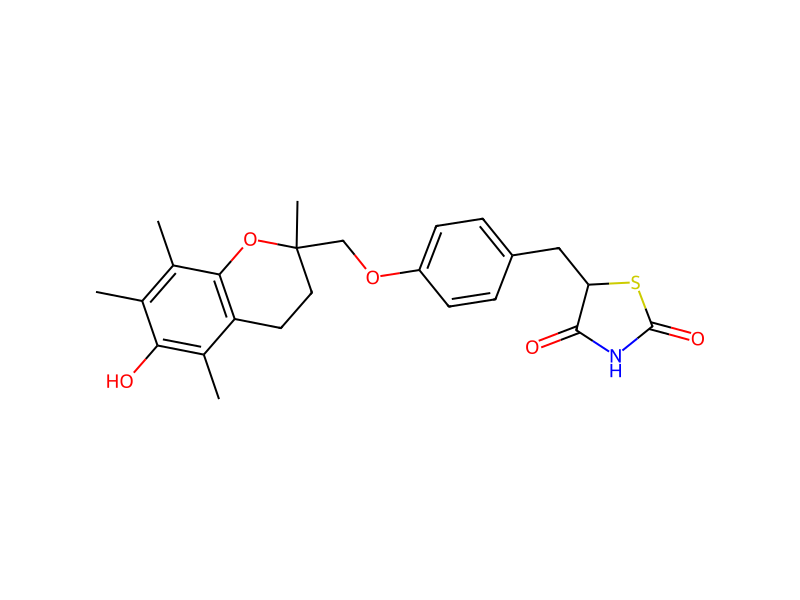
97322-87-7Cc1c(C)c2c(c(C)c1O)CCC(C)(COc1ccc(CC3SC(=O)NC3=O)cc1)O2GXPHKUHSUJUWKP-UHFFFAOYSA-NTroglitazone is a member of chromanes and a thiazolidinone. It has a role as a ferroptosis inhibitor, an antioxidant, a hypoglycemic agent, an antineoplastic agent, a vasodilator agent, an anticonvulsant, an anticoagulant, a platelet aggregation inhibitor and an EC 6.2.1.3 (long-chain-fatty-acid--CoA ligase) inhibitor.
FDA approved drugs -> Active ingredient
FDA approved drugs -> Active ingredient
安全情報は参考情報です。供給元の安全データシート(SDS)、適用法令、専門家による評価に代わるものではありません。
Large prospective studies showed that significant elevations in serum aminotransferase levels (equal to or greater than 3 times the upper limit of the normal range [ULN]) occurred in 1.9% of patients with diabetes treated with troglitazone for 24 to 48 weeks, compared to only 0.6% in placebo recipients. These enzyme elevations were usually asymptomatic and often resolved despite continuation of therapy. Nevertheless, elevations >10 times ULN occurred in 0.5% of patients (but in no placebo recipient) and a proportion of these developed symptoms of liver injury and jaundice. Soon after the approval of troglitazone as therapy for type 2 diabetes in the United States, cases of severe acute liver injury began to be reported, and dramatic case reports as well as small case series documented that clinically significant injury was occurring in 1:1000 to 1:10,000 recipients. The latency to onset of injury was typically 1 to 6 months and the onset was marked by fatigue, weakness, dark urine and jaundice, and an acute hepatitis-like elevation in serum enzymes (hepatocellular pattern). Allergic phenomena (rash, fever, eosinophilia) were uncommon and serum autoantibodies were not usually present. Liver biopsies showed acute inflammatory changes and variable degrees of necrosis, ranging from rare spotty necrosis to bridging hepatic necrosis and submassive or massive necrosis. At least two dozen cases of acute liver failure and death or need for liver transplantation were reported to the FDA before troglitazone was withdrawn from use in 2000.
Troglitazone is a thiazolidinedione antidiabetic agent that lowers blood glucose by improving target cell response to insulin. It has a unique mechanism of action that is dependent on the presence of insulin for activity. Troglitazone decreases hepatic glucose output and increases insulin dependent glucose disposal in skeletal muscle. Its mechanism of action is thought to involve binding to nuclear receptors (PPAR) that regulate the transcription of a number of insulin responsive genes critical for the control of glucose and lipid metabolism. Troglitazone is a ligand to both PPAR‘± and PPAR‘_, with a highter affinity for PPAR‘_. The drug also contains an ‘±-tocopheroyl moiety, potentially giving it vitamin E-like activity. Troglitazone has been shown to reduce inflammation, and is associated with a decrase in nuclear factor kappa-B (NF-‘_B) and a concomitant increase in its inhibitor (I‘_B). NF-‘_B is an important cellular transcription regulator for the immune response. Unlike sulfonylureas, troglitazone is not an insulin secretagogue.
A - Alimentary tract and metabolism
QA - Alimentary tract and metabolism
Troglitazone is an oral antihyperglycemic agent which acts primarily by decreasing insulin resistance. Troglitazone is used in the management of type II diabetes (noninsulin-dependent diabetes mellitus (NIDDM) also known as adult-onset diabetes). It improves sensitivity to insulin in muscle and adipose tissue and inhibits hepatic gluconeogenesis. Troglitazone is not chemically or functionally related to either the sulfonylureas, the biguanides, or the g-glucosidase inhibitors. Troglitazone may be used concomitantly with a sulfonylurea or insulin to improve glycemic control.
Troglitazone is a thiazolidinedione antidiabetic agent that lowers blood glucose by improving target cell response to insulin. It has a unique mechanism of action that is dependent on the presence of insulin for activity. Troglitazone decreases hepatic glucose output and increases insulin dependent glucose disposal in skeletal muscle. Its mechanism of action is thought to involve binding to nuclear receptors (PPAR) that regulate the transcription of a number of insulin responsive genes critical for the control of glucose and lipid metabolism. Troglitazone is a ligand to both PPARα and PPARγ, with a highter affinity for PPARγ. The drug also contains an α-tocopheroyl moiety, potentially giving it vitamin E-like activity. Troglitazone has been shown to reduce inflammation, and is associated with a decrase in nuclear factor kappa-B (NF-κB) and a concomitant increase in its inhibitor (IκB). Unlike sulfonylureas, troglitazone is not an insulin secretagogue.
A sulfate conjugate metabolite (Metabolite 1) and a quinone metabolite (Metabolite 3) have been detected in the plasma of healthy males. A glucuronide conjugate (Metabolite 2) has been detected in the urine and also in negligible amounts in the plasma. In healthy volunteers and in patients with type 2 diabetes, the steady-state concentration of Metabolite 1 is six to seven times that of troglitazone and Metabolite 3. In in vivo drug interaction studies, troglitazone has been shown to induce cytochrome P450 CYP3A4 at clinically relevant doses.


97322-87-7DTXSID8023719CHEMBL408CHEBI:9753化学的特性Crystalline Solid
Drug Induced Liver Injury Rank (DILIrank 2.0)
Troglitazone
vMost-DILI-concern
8
Withdrawn
DOI:10.1016/j.drudis.2016.02.015
Troglitazone has known human metabolites that include (2S,3S,4S,5R)-6-[[2-[[4-[(2,4-dioxo-1,3-thiazolidin-5-yl)methyl]phenoxy]methyl]-2,5,7,8-tetramethyl-3,4-dihydrochromen-6-yl]oxy]-3,4,5-trihydroxyoxane-2-carboxylic acid.
A sulfate conjugate metabolite (Metabolite 1) and a quinone metabolite (Metabolite 3) have been detected in the plasma of healthy males. A glucuronide conjugate (Metabolite 2) has been detected in the urine and also in negligible amounts in the plasma. In healthy volunteers and in patients with type 2 diabetes, the steady-state concentration of Metabolite 1 is six to seven times that of troglitazone and Metabolite 3. In in vivo drug interaction studies, troglitazone has been shown to induce cytochrome P450 CYP3A4 at clinically relevant doses. Half Life: 16-34 hours
説明Rezulin was launched in Japan, the UK (subseqently withdrawn) and the US for treatment of type Ⅱ diabetes. Two approaches, four steps and six steps, converge on 6-acetoxy-2-(4-aminophenoxymethyl)-2,5,7,8-tetramethylchroman which can be elaborated in two steps to Rezulin. It is the first of a new class of thiazolidenediones for NIDDM that reduces glucose concentrations without effecting insulin secretion. It binds to peroxisome proliferator-activated receptor gamma (PPARγ) thus activating this nuclear receptor which then influences carbohydrate metabolism. This is accomplished by increasing insulin sensitivity by upregulating glucose transporter (Glut1 and/or Glut4) expression without affecting the number or affinity of insulin receptors. There is also an increase in hepatic glycogen synthase activity which enhances glucose utilization and a reduction in hepatic gluconeogenesis by inhibiting fructose-1 ,&bisphosphatase. Pancreatic islet cell destruction is prevented. It reduces serum triglycerides because PPARγ causes fibroblasts to differentiate into adipocytes and does not activate RARα. It has a half-life of 9 h and is metabolized into three compounds having no activity.
来歴Troglitazone (Sankyo) was firstly approved 1995 in Japan and 1997 in USA and UK. It was launched in these countries in 1997. The recommended starting dose was 400 mg/d and the highest dose 600 mg. After being marketed, the daily practice revealed adverse events in the liver with cases of fatal liver failure. This lead to withdrawal of troglitazone from the market in the UK already after two months, in USA and Japan in the year 2000.
使用Troglitazone is an an oral hypoglycemic agent which improves insulin sensitivity and decreases hepatic glucose production. Antidiabetic.
一般的な説明A α-tocopherol (vitamin E) moiety containing thiazolidinedione class of insulin-sensitizer that acts as an activator of peroxisome proliferator-activated receptors γ (PPARγ). Also exhibits anti-proliferative and anti-inflammatory properties. Shown to induce cell cycle arrest and apoptosis in human hepatoma cells. Inhibits vascular smooth muscle cell (VSMC) migration by rapidly activating MEK/ERK pathway leading to the induction of c-fos and Ets-1 expression. Blocks PDGF-induced cell proliferation of pancreatic stellate and accelerates p21Cip1 turnover by inhibiting PKCδ signaling in VSMCs. Exerts positive inotropic effect via Ca2+ sensitization in the sarcoplasmic reticulum and inhibits Na+/H+ exchange activity and proliferation of macrovascular endothelial cells.