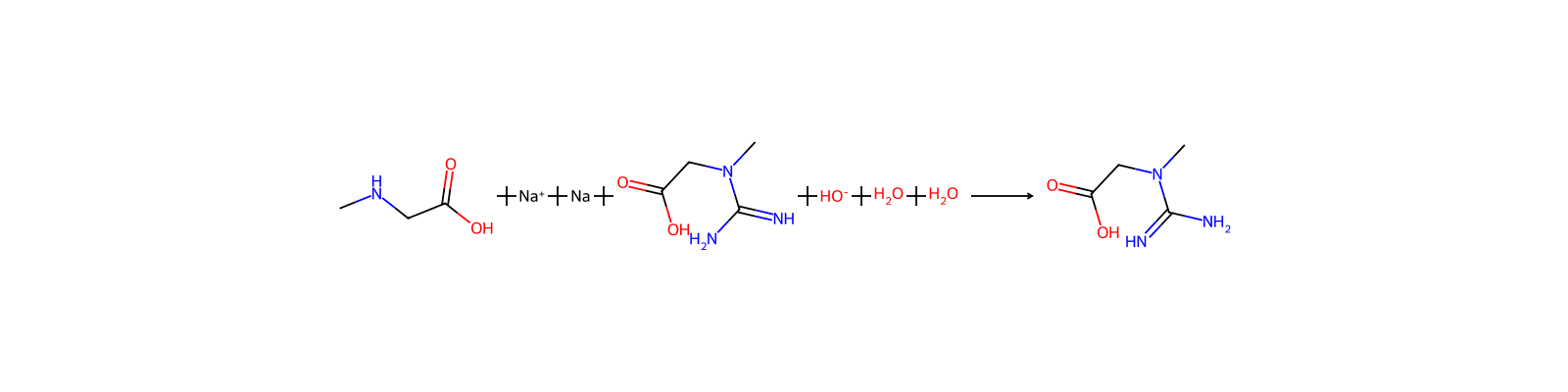

基本情報
- 標準SMILES
CN(CC(=O)O)C(=N)N- InChIKey
CVSVTCORWBXHQV-UHFFFAOYSA-N- 分子式
- C4H9N3O2
- 平均分子量
- 131.13 g/mol
- 単同位体質量
- 131.06947653
概要
Creatine is a glycine derivative having methyl and amidino groups attached to the nitrogen. It has a role as a geroprotector, a nutraceutical, a neuroprotective agent, a mouse metabolite and a human metabolite. It is a glycine derivative and a member of guanidines. It is a conjugate acid of a creatinate. It is a tautomer of a creatine zwitterion.
名称と識別子
- 優先名称
- Creatine
- IUPAC
- 2-[carbamimidoyl(methyl)amino]acetic acid
- 現地名
- N-メチル-N-アミジノグリシン
- 英語名
- Creatine
- 分子式
- C4H9N3O2
- 分子量
- 131.13
名称と別名
creatine57-00-1CreatinN-amidinosarcosineKreatinKrebiozonmethylglycocyamineN-methyl-N-guanylglycineGlycine, N-(aminoiminomethyl)-N-methyl-Pyrolysate(alpha-Methylguanido)acetic acidN-carbamimidoyl-N-methylglycine
名称をさらに表示
クレアチン1-メチルグアニジノ酢酸N-メチル-N-アミジノグリシンN-グアニル-N-メチルグリシン(1-メチルグアニジノ)酢酸メチルグリコシアミンクレアチン無水物N-GUANYL-N-METHYLGLYCINEMONOHYDRATE CREATINEN-Methyl-N-amidinoglycinecretineCreatine HMBCreatineAnhydrousNutrition Creatinecreatine zwitterion
Cosmocair C 100KreatinumNeotine2-(1-methylcarbamimidamido)acetic acidN-(aminoiminomethyl)-N-methylglycinealpha-Methylguanidino acetic acid2-[carbamimidoyl(methyl)amino]acetic acidNSC-8752
データベース識別子
- CAS
57-00-1、6020-87-7- PubChem CID
- 586
- DTXSID
DTXSID1040451- ChEMBL
CHEMBL283800- ChEBI
CHEBI:16919- UNII
- MU72812GK0
- EC Number
- 200-306-6
- Nikkaji
- J9.321A
物性
構造計算による物性
- XLogP
- -1.2
- 極性表面積
- 90.4 Ų
- 水素結合供与体数
- 3
- 水素結合受容体数
- 3
- 回転可能結合数
- 3
- 重原子数
- 9
- 形式電荷
- 0
- 複雑度
- 134
実験および物理化学的性質
Chemical ClassesBiological Agents -> Amino Acids and Derivatives
DrugsPharmaceuticals -> Listed in ZINC15
pHNeutral reaction to litmus
Density1.33 at 25 °C
Solubility
Slightly soluble in water, insoluble in ether
Slightly soluble in ether and ethanol
In water, 1.33X10+4 mg/L at 18 °C
13.3 mg/mL at 18 °C
Dietary IngredientsCreatine
Human DrugsBreast Feeding; Lactation; Milk, Human; Amino Acids; Complementary Therapies
Melting Point
Decomposes at 303 °C
303 °C
Vapor Pressure0.00079 [mmHg]
Physical Description
Solid; [Merck Index] White powder; [Alfa Aesar MSDS]
Solid
Dissociation Constants
pKa1 = 3.8 (carboxylic acid); pKa2 = 12.7 (amine)
pKb = 11.02 at 20 °C
Collision Cross Section
126.0 Ų [M+H]+ [CCS Type: DT; Buffer gas: N2; Ionization: ESI+; Dataset: TOXCAST; Source Identifier: DTXSID1040451]
126 Ų [M+H]+ [CCS Type: DT; Method: single field calibrated with ESI Low Concentration Tuning Mix (Agilent)]
125.9 Ų [M+H]+ [CCS Type: DT; Method: single field calibrated with Agilent tune mix (Agilent)]
126 Ų [M+H]+
物理化学的性質
- 融点
- 295 °C · ~295 °C (dec.)
- 沸点
- 242.43 °C · 242.43°C (rough estimate)
- 比重(密度)
- 1 · 1,33 g/cm3
- 屈折率
- 1.57 · 1.5700 (estimate)
- 貯蔵温度
- Keep in dark place,Inert atmosphere,Room temperature
- 溶解性
- 水(少し、加熱)
- 外見
- 個体
- 酸解離定数(Pka)
- 2.63 · 2.63(at 25℃)
- 色
- ホワイトからオフホワイト
- 水溶解度
- 水に溶ける。
- Merck
- 14 · 14,2568
- BRN
- 907175 · 907175
- 主な用途
- 食品および飲料パーソナルケア医薬品
- 化粧品成分の機能
- スキンコンディショニング
- InChI
- 1S/C4H9N3O2/c1-7(4(5)6)2-3(8)9/h2H2,1H3,(H3,5,6)(H,8,9)
- InChIKey
- CVSVTCORWBXHQV-UHFFFAOYSA-N
- SMILES
- CN(CC(O)=O)C(N)=N
- LogP
- -1.258 · -1.258 (est)
- CAS データベース
- 57 · 57-00-1(CAS DataBase Reference)
- NISTの化学物質情報
- Glycine, N-(aminoiminomethyl)-N-methyl-(57-00-1)
- EPAの化学物質情報
- Glycine, N-(aminoiminomethyl)-N-methyl- (57-00-1)
- CAS Number Unlabeled
- 57 · 57-00-1
化学的性質
化学的特性White powder
安全と法規制
GHS分類
GHS Classification
This chemical does not meet GHS hazard criteria for 72.3% (149 of 206) of all reports.
Warning
H315 (27.7%): Causes skin irritation [Warning Skin corrosion/irritation]
P261, P264, P264+P265, P271, P280, P302+P352, P304+P340, P305+P351+P338, P319, P321, P332+P317, P337+P317, P362+P364, P403+P233, P405, and P501 (click each P-code to see the statement)
Aggregated GHS information provided per 206 reports by companies from 13 notifications to the ECHA C&L Inventory. Each notification may be associated with multiple companies.
危険有害性情報
Regulatory Information
Chemical: Glycine, N-(aminoiminomethyl)-N-methyl-
Status: Active Update: 11-10-2022 https://echa.europa.eu/registration-dossier/-/registered-dossier/12796
Glycine, N-(aminoiminomethyl)-N-methyl-: Does not have an individual approval but may be used under an appropriate group standard
Creatine: Does not have an individual approval but may be used under an appropriate group standard
Other Safety InformationEvaluation - Chemicals that are unlikely to require further regulation to manage risks to environment
Hazards SummaryA skin and strong eye irritant; [Alfa Aesar MSDS]
Hazard Classes and CategoriesSkin Irrit. 2 (27.7%)
安全と保護具
Disposal Methods
SRP: The most favorable course of action is to use an alternative chemical product with less inherent propensity for occupational exposure or environmental contamination. Recycle any unused portion of the material for its approved use or return it to the manufacturer or supplier. Ultimate disposal of the chemical must consider: the material's impact on air quality; potential migration in soil or water; effects on animal, aquatic, and plant life; and conformance with environmental and public health regulations.
毒性情報
Body Burden
The mean creatine level in the urine of 50 patients with muscular dystrophy was 3.56 mmol/L which is much higher than that of the controls 0.24 mmol/L(1). The mean level of creatine in the blood of patients with uremia was 0.1 mmol/L which is over twice that of the controls blood level of 0.04 mmol/L(1).
Environmental Fate
TERRESTRIAL FATE: Based on a classification scheme(1), an estimated Koc value of 24(SRC), determined from a water solubility of 1.33X10+4 mg/L(2) and a regression-derived equation(3), indicates that creatine is expected to have very high mobility in soil(SRC). The pKa values for the amino and carboxylic acid moieties of creatine are estimated to be 12.7 and 3.8(4), respectively, indicating that this compound will primarily exist as a zwitter ion and zwitter ions do not volatilize from moist soil surfaces. Creatine is not expected to volatilize from dry soil surfaces(SRC) based upon an estimated vapor pressure of 7.9X10⁻⁴ mm Hg(SRC), determined from a fragment constant method(5). Creatine has been reported to be degraded by activated sludge(6).
AQUATIC FATE: Based on a classification scheme(1), an estimated Koc value of 24(SRC), determined from a water solubility of 1.33X10+4 mg/L(2) and a regression-derived equation(3), indicates that creatine is not expected to adsorb to suspended solids and sediment(SRC). The pKa values for the amino and carboxylic acid moieties of creatine are estimated to be 12.7 and 3.8, respectively(4), indicating that this compound will primarily exist as a zwitter ion and zwitter ions do not volatilize from water surfaces. According to a classification scheme(5), an estimated BCF of 3(SRC), determined from its water solubility(2) and a regression-derived equation(3), suggests the potential for bioconcentration in aquatic organisms is low(SRC). Creatine has been shown to be degraded by activated sludge(7).
ATMOSPHERIC FATE: According to a model of gas/particle partitioning of semivolatile organic compounds in the atmosphere(1), creatine, which has an estimated vapor pressure of 7.9X10⁻⁴ mm Hg at 25 °C(SRC), determined from a fragment constant method(2), will exist solely in the vapor phase in the atmosphere. Vapor-phase creatine is degraded in the atmosphere by reaction with photochemically-produced hydroxyl radicals(SRC); the half-life for this reaction in air is estimated to be 4 hours(SRC), calculated from its rate constant of 9.5x10⁻¹¹ cu cm/molecule-sec at 25 °C(SRC) that was derived using a structure estimation method(3). Creatine does not absorb light at wavelengths >290 nm(4) and therefore is not expected to be susceptible to direct photolysis by sunlight(SRC).
Toxicity Summary
In the muscles, a fraction of the total creatine binds to phosphate - forming creatine phosphate. The reaction is catalysed by creatine kinase, and the result is phosphocreatine (PCr). Phosphocreatine binds with adenosine diphosphate to convert it back to ATP (adenosine triphosphate), an important cellular energy source for short term ATP needs prior to oxidative phosphorylation.
Soil Adsorption/Mobility
The Koc of creatine is estimated as 24(SRC), using a water solubility of 1.33X10+4 mg/L(1) and a regression-derived equation(2). According to a classification scheme(3), this estimated Koc value suggests that creatine is expected to have very high mobility in soil.
Natural Pollution SourcesCreatine is produced by the liver, pancreas, and kidney for the use of transferring phosphate from adenosine triphosphate (ATP). Creatine is predominantly found in skeletal and cardiac muscle(1).
Artificial Pollution SourcesCreatine's production and use as a diagnostic for myocardial disfunction(1) and as a performance enhancing supplement(2) may result in its release to the environment through various waste streams(SRC).
Environmental Biodegradation
AEROBIC: Creatine has been reported to be aerobically degraded by activated sludge(1).
ANAEROBIC: Creatine, at a concn of 500 umol/10 ml, was fermented into methane by methanogenic enrichment cultures from Leine River mud (lake Kolksee, Germany) and black pond mud, containing Methanosarcina barkeri(1). Creatine was fermented into methane with an efficiency of 1.59 moles of methane/mole of creatine(1). Creatine did not support growth of a pure culture of M. barkeri(1).
Carcinogen ClassificationNo indication of carcinogenicity to humans (not listed by IARC).
Environmental Bioconcentration
An estimated BCF of 3 was calculated for creatine(SRC), using water solubility of 1.33X10+4 mg/L(1) and a regression-derived equation(2). According to a classification scheme(3), this BCF suggests the potential for bioconcentration in aquatic organisms is low.
Volatilization from Water/Soil
The pKa values of the amino and carboxy moieties of creatine are 12.7 and 3.8(1), respectively, indicating that this compound will primarily exist as a zwitter ion and ions do not volatilize from water or moist soil surfaces. Creatine is not expected to volatilize from dry soil surfaces(SRC) based upon an estimated vapor pressure of 7.9X10⁻⁴ mm Hg(SRC), determined from a fragment constant method(2).
Non-Human Toxicity Excerpts/LABORATORY ANIMALS: Chronic Exposure or Carcinogenicity/ Chronic creatine supplementation in rats down-regulates creatine transporter protein expression. ... Leading to lower amounts entering cell at any given time.
Environmental Abiotic Degradation
The rate constant for the vapor-phase reaction of creatine with photochemically-produced hydroxyl radicals has been estimated as 9.5X10⁻¹¹ cu cm/molecule-sec at 25 °C(SRC) using a structure estimation method(1). This corresponds to an atmospheric half-life of about 4 hours at an atmospheric concentration of 5X10+5 hydroxyl radicals per cu cm(1). Creatine is not expected to undergo hydrolysis in the environment due to the lack of hydrolyzable functional groups(2). Creatine does not absorb at wavelengths >290 nm(3) and therefore is not expected to be susceptible to direct photolysis by sunlight(SRC).
安全データ
- wgk
- 3
- tsca
- TSCA listed
- 毒性
- A compound that is phosphorylated to phosphocreatine, which represents a store of high-energy phosphoryl groups in muscle that can be transferred to ADP, yielding ATP for muscle contraction. The enzyme involved in phosphate transfer between them is creatine phosphokinase that catalyzes the reaction Phosphocreatine+ADP→ATP+creatine An increase in serum creatine phosphokinase may be indicative of damage to non-hepatic tissue but not to the liver.
- hs_code
- 29252900
- risk_code
- 36/37/38
- 化審法
- 新規公示化学物質(2011年3月31日以前届出)
- hazard_code
- Xi
- safety_code
- 26-36
- ストレージクラス
- 11 - Combustible Solids
- 有毒物質データの
- 57-00-1(Hazardous Substances Data)
化学と産業
薬理情報
Bionecessity
Creatine is a non-protein amino acid found in animals, in much lesser amounts, plants. Creatine is synthesized in the kidney, liver and pancreas from the amino acids L-arginine, glycine and L methionine. Following its biosynthesis, creatine is transported to the skeletal muscle, heart, brain and other tissues. Most of the creatine in these tissues is metabolized to phosphocreatine (creatine phosphate). Phosphocreatine is a major energy storage form in the body.
Pharmacodynamics
Creatine is a essential, non-proteinaceous amino acid derivative found in all animals. It is synthesized in the kidney, liver, and pancreas from L-arginine, glycine and L-methionine. Following its biosynthesis, creatine is transported to the skeletal muscle, heart, brain and other tissues. Most of the creatine is metabolized in these tissues to phosphocreatine (creatine phosphate). Phosphocreatine is a major energy storage form in the body. Supplemental creatine may have an energy-generating action during anaerobic exercise and may also have neuroprotective and cardioprotective actions.
Mechanism of Action
In the muscles, a fraction of the total creatine binds to phosphate - forming creatine phosphate. The reaction is catalysed by creatine kinase, and the result is phosphocreatine (PCr). Phosphocreatine binds with adenosine diphosphate to convert it back to ATP (adenosine triphosphate), an important cellular energy source for short term ATP needs prior to oxidative phosphorylation.
Supplemental creatine may have an energy-generating action during anaerobic exercise and may also have neuroprotective and cardioprotective actions.
Creatine, creatine kinase and phosphocreatine make up an intricate cellular enegy buffering and transport system connecting sites of energy production in the mitochondria with sites of energy consumption. CK is a key enzyme in involved in cellular energy homeostasis. It reversibly catalyzes the transfer of the high-energy phosphate bond in PCr to adenosine diphosphate (ADP) to form adenosine triphosphate (ATP), and it catalyzes the transfer of the high-energy phosphate bond in ATP to creatine to form PCr. During periods of intense exercise and skeletal muscle contraction, bioenergetic metabolism switches from one in which oxidative phosphorylation is the major pathway of ATP production to one in which so-called anaerobic glycolysis becomes dominant.
Biological Half-Life3 hours
Metabolism/Metabolites
Within muscle and nerve cells, about 60 to 67% of the creatine entering the cells gets converted to phosphocreatine via the enzyme creatine kinase. About 2% of creatine is converted to creatinine, and both creatine and creatinine are excreted by the kidneys.
Half Life: 3 hours
Absorption, Distribution and Excretion
In muscle and nerve, most of the creatine is phosphorylated to phosphocreatine (pCr) in a reaction that is catalyzed by the enezyme creatine kinase (CK), there are three isoforms of (isoenzymes) of CK. CK-MM is the skeletal muscle isoform; CK-BB, the brain isoform, and CK-MB, the isoform found in cardiac muscle. Most of the PCr in the body is in skeletal muscle.
Creatine is absorbed from the small intestines and enters the portal circulation and is transported to the liver. The ingested creatine, and the creatine made in the liver, is then transported into the systemic circulation and distributed into various tissues of the body, including muscle and nerves, by crossing the cell membrane via a specific creatine-transported system against a 200:1 gradient.
Tissue LocationsAdipose Tissue
Cellular LocationsCytoplasm
Metabolite Pathways3-Phosphoglycerate dehydrogenase deficiency
用途と製造
Uses
An amino acid found mainly in skeletal and cardiac muscle; Involved in the transfer of high energy phosphate in muscle cells; [Merck Index] Used in the diagnosis of myocardial dysfunction and as a dietary supplement to enhance athletic performance; [HSDB]
Used in diagnosis of myocardial disfunction; dietary supplement for exercise performance
For nutritional supplementation, also for treating dietary shortage or imbalance
Methods of ManufacturingMonosubstituted and N,N-disubstituted compounds, including guanidinocarboxylic acids (eg, creatine), are produced industrially by the reaction of cyanamide with the corresponding amines or aminocarboxylic acids.
Household ProductsInformation on 3 consumer products that contain Creatine in the following categories is provided:
General Manufacturing Information
Glycine, N-(aminoiminomethyl)-N-methyl-: ACTIVE
The literature suggests that some pharmaceutically active compounds originating from human and veterinary therapy are not eliminated completely in municipal sewage treatment plants and are therefore discharged into receiving waters(1). Wastewater treatment processes often were not designed to remove them from the effluent(2). Selected organic waste compounds may be degrading to new and more persistent compounds that may be released instead of or in addition to the parent compound(2).
Commercially isolated from meat extracts
応用分野
解説クレアチン,脊椎動物の筋肉中に存在し,筋肉活動の際,クレアチンリン酸とともに重要な役割を果たす.人体には90~120 g,その90% は筋肉中に存在する.グリシン,アルギニンおよびL-メチオニンから生合成される.結晶性固体.分解点303 ℃.水,エタノールに可溶,エーテルに不溶.アミノ酸に類似した化合物で、アミノ基のかわりにグアニジン基をもっている。化学式は図のようになる。脊椎動物(せきついどうぶつ)の筋肉には多量に含まれる。 ATP(アデノシン三リン酸)によりリン酸化されクレアチンリン酸(エネルギー貯蔵の役目をするフォスファーゲンの一種)となる。生合成は、アルギニンからグアニジン基がグリシンに移転する経路で行われる。分解は、分子内脱水により環状化合物のクレアチニンとなり、直接尿中に排泄(はいせつ)される。血中または尿中のクレアチニンの量は比較的一定で、筋肉の総量に比例している。
天然物の起源Creatine is an amino acid that occurs naturally in dairy products, seafood, and beef. It is manufactured by the body in the liver, kidney, and pancreas.
使用Creatine is used for gyrate atrophy, McArdle's disease, muscular dystrophy, amyotrophic lateral sclerosis, and rheumatoid arthritis. It is used in congestive heart disease to improve exercise tolerance and to enhance athletic performance.
使用用途クレアチンは、筋肉が収縮する際のエネルギーであるATP (細胞の中に存在し、生命活動で利用されるエネルギーを保存・利用する上で必要な物質) の再合成に利用され、クレアチンリン酸として筋肉に存在しています。 運動時にはATPが分解される際に発生するエネルギーが使用されますが、ATPの量には限界があるため、運動し続けるにはクレアリン酸によるATPの再合成が必要です。クレアチンには運動時などの持久力や筋力を高める効果があるので、主に短時間で激しい運動を繰り返す際に、クレアチンの運動能力を高める効果が有効です。 また、アスリートだけではなく、クレアチンの高齢者の運動能力に及ぼす効果についても研究が進められており、高齢者の筋力維持やリハビリテーションを目的としたクレアチンの活用方法が研究されています。
調製方法
純化方法Likely impurities are creatinine and other guanidino compounds. It crystallises from the minimum volume of boiling H2O as the monohydrate. The hydrate is also obtained by dissolving in H2O and adding Me2CO. Drying under vacuum over P2O5 or drying at 100o gives the anhydrous base. The anhydrous base can be obtained also by dissolving the hydrate in H2O, seeding with the anhydrous base and cooling in ice. A m of 258 -268o(dec) was reported. The picrate crystallises from 17 parts of H2O with m of 218-220o(dec). [King J Chem Soc 2377 1930, Hoffmann et al. J Am Chem Soc 58 1730 1936, Mendel & Hodgkin Acta Cryst 7 443 1954, Greenstein & Winitz The Chemistry of the Amino Acids J. Wiley, Vol 3 p 2750 1961, Beilstein 4 III 1170, 4 IV 2425.]
上流・下流製品情報
下流製品
サプライヤー50 社
上海阿拉丁生化科技股份有限公司400-6206333 13167063860 · [email protected]
石家庄苏瑞化工有限公司15833970389 15833970389 · [email protected]
科瑞迪化学400-821-5857 021-64326257 · [email protected]
上海将来实业股份有限公司400-0066400 13621662912 · [email protected]
Syntechem Co.,Ltd[email protected]
上海迈瑞尔生化科技有限公司4006356688 18621169109 · [email protected]
阿法埃莎(中国)化学有限公司400-6106006 · [email protected]
安耐吉化学&3A(安徽泽升科技股份有限公司)400-0056266 · [email protected]
上海相辉医药科技有限公司13761987713 · [email protected]
上海景颜化工科技有限公司13817811078 · [email protected]
上海泰坦科技股份有限公司400-6009262 15618770481 · [email protected]
泰安鑫润生物科技有限公司15318133072 15318133072 · [email protected]
BOC Sciences1-631-485-4226; 16314854226 · [email protected]
Beckmann-Kenko GmbH+49 4241 9308 88 · [email protected]
玛雅试剂+86 (573) 82222445 (0)18006601000 452520369 · [email protected]
四川库利南科技有限公司400-1166-196 18981987031 · [email protected]
天津希恩思生化科技有限公司400 638 7771 · [email protected]
湖南汇百侍生物科技有限公司0731-85526065 13308475853 · [email protected]
斯百全化学(上海)有限公司021-021-021-67601398-809-809-809 15221380277 · [email protected]
上海源叶生物科技有限公司13636370518 · [email protected]
艾科试剂4008-755-333 18080918076 · [email protected]
TCI AMERICA800-4238616 · [email protected]
TOKYO CHEMICAL INDUSTRY CO., LTD.03-36680489 · [email protected]
TCI Europe320-37350700 · [email protected]
烟台傲嘉生物技术有限公司+86 13853510897 · [email protected]
南京杜莱生物技术有限公司025-84699383-8003;025-846993838003-8003 18013301590 · [email protected]
山东思扬生物科技有限公司15666921172
陕西帕尼尔生物科技有限公司13720616393;029-84385017-8003 13720616393 · [email protected]
上海倍卓生物科技有限公司021-61119791,13386096464 · [email protected]
北京环宇世纪化学科技有限公司hysj_bj.com
上海将来实业股份有限公司400-0066400 13621662912 · [email protected]
上海将来实业股份有限公司021-61552785 · [email protected]
日照力德士化工有限公司010-51268198 · [email protected]
美岚实业(上海)有限公司021-58958189 · [email protected]
上海爱蝶实业有限公司021-58957966 18930537195 · [email protected]
四川省维克奇生物科技有限公司028-81700200 18116577057 · [email protected]
广拓化学(上海)有限公司021-60899189-8001 18918189673 · [email protected]
上海创赛科技有限公司400-6087598 15021221957 · [email protected]
上海馨远医药科技有限公司021-24206007 13764915196 · [email protected]
上海麦克林生化科技股份有限公司15221275939 15221275939 · [email protected]
杭州杰恒化工有限公司0571-87396432 · [email protected]
江苏艾康生物医药研发有限公司025-66028182 17714375163 · [email protected]
成都润泽本土化工有限公司13096311329 028-88469284 616445927 · [email protected]
湖北巨胜科技有限公司027-59599241 18871490274 · [email protected]
池州凯隆进出口贸易有限公司[email protected]
Sigma-Aldrich西格玛奥德里奇(上海)贸易有限公司021-61415566 800-8193336 · [email protected]
桦特昇生物科技(武汉)有限公司027-59207879 1972026995 18140587686 · [email protected]
潍坊市前进精细化工有限公司18753684562 · [email protected]
天津阿尔塔科技有限公司022-6537-8550 15522853686 · [email protected]
西安康诺化工有限公司029-86107037 15829389671 · [email protected]
補足説明
定義本品は、次の化学式で表されるアミノ酸である。
関連反応
58 件


関連ノート
読み込み中…